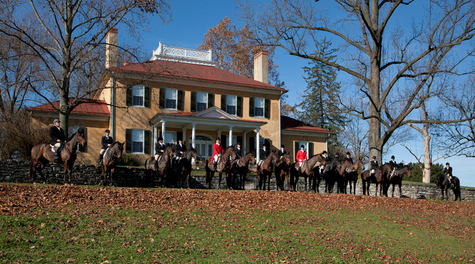
 Fifteen Cleveland Bays convened for a celebration of the breed at a special meeting of the Blue Ridge foxhounds at Farnley. / Matthew Klein photo
How fitting that a large contingent of Cleveland Bay horses should convene at Farnley Farm for a special foxhunt with the Blue Ridge Hunt on Saturday, November 19, 2011.
The late Alexander Mackay-Smith, a past Master of the Blue Ridge, and his wife Joan purchased Farnley, near White Post, Virginia, in the 1930s. During Mackay-Smith’s travels in England over that decade he decided that the Cleveland Bay horse made the ideal field hunter. He imported and bred Cleveland Bays and introduced the breed to foxhunters and to other horsemen in this country.
Today the breed is dangerously rare, with only about five hundred purebreds in the world and less than two hundred in North America.
And how fitting that Mackay-Smith’s step-great-granddaughter Denya Dee Leake should be present at the meet aboard her Cleveland Bay-Thoroughbred cross Fearnought, a most handsome and competent example of the breed, both in the hunting field and in the show ring.
“They all came here in plain brown wrappers!” quipped onlooker Ian Harrison, DVM, as Cleveland Bay riders and horses lined up for the photographers in front of Farnley. (The solid bay color is prepotent in the breed and its crosses.)
The Enthusiasts
Cleveland Bay owner Peter Cook—with the blessing of the Blue Ridge Masters Doris Stimpson, Linda Armbrust, and Anne McIntosh—organized the meet. Farnley owner Hetty Mackay-Smith Abeles, daughter of the late Alexander, graciously opened her farm and home. Hetty’s brother Dr. Matthew Mackay-Smith, mounted for hunting, spoke briefly to the assembled Cleveland Bay riders. The sky was pure blue, and this correspondent was powerfully aware that his old friend Alexander was beaming at us all from above.
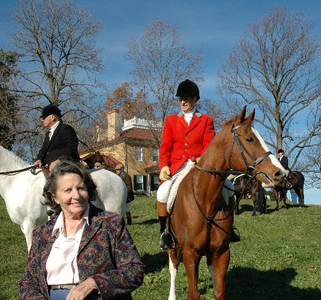 Farnley owner Hetty Mackay-Smith Abeles and her brother Matthew Mackay-Smith, DVM have a long family history with the Cleveland Bays.“During World War II, when the English could scarcely feed their own people, the breeding of horses, hounds, and other non-essential animals was drastically curtailed,” explained British-born Peter Cook. “During that time, Alex was the largest breeder of Cleveland Bays in the world. He had more than fifty here at Farnley. After the war, he sent a stallion that he bred back to England. My mare, whose bloodlines on both sides go back to England, has Farnley blood from that stallion that Alex sent back.”
That stallion was Farnley Exchange, the only purebred Cleveland Bay stallion to have been bred in the United States and then exported back to England for breeding purposes.
“Farnley Exchange was the son of a stallion that my father had imported from England and named Cleveland Farnley,” Hetty explained, then added, “I have just received word from Henry Edmunds [a council member of the Cleveland Bay Horse Society in England, of which The Queen is a Patron] that they are aware of this gathering today and send their best wishes. He made special mention that they still value highly the blood of Farnley Exchange in their pedigrees.”
Entering this venerable home for the hunt tea after the meet, one could easily feel transported back to England. Ancient family portraits cover the walls, including eighteenth century portraits of Cleveland Bay horses. Peter Cook’s wife Beth sat at the head of the table pouring tea.
I asked Matthew if he had hunted a Cleveland Bay while growing up at Farnley. He pointed to a Jean Bowman painting of a striking horse upon which his wife Winkie sat bareback, legs dangling loose, holding just the lead shank attached to the halter.
“That’s Farnley Ensign,” he said, “an Anglo-Cleveland [out of a Thoroughbred mare by a Cleveland Bay stallion]. I hunted him for seventeen seasons, starting when I was twelve years old until I was twenty-nine.
“Jean came to paint his portrait. She sketched him all afternoon from various angles but wasn’t really satisfied. ‘Put him away,’ she said, ‘and we’ll try again another day.’
“Winkie, who was holding the lead shank, slipped up on him bareback and started back to the barn. ‘Stop!’ Jean said. ‘Come back and just ride him around me!’ and she sketched out this painting. I think it’s one of her best of any horse.”
The Horses
The Cleveland Bay is said to be England’s oldest breed of horse. As the name suggests, the breed originated in the Cleveland region of the northeastern part of that country. Descendant mares of the so-called Chapman horses—pack horses bred by the monks at the monasteries in the Middle Ages—were crossed in the mid-seventeenth century with imported barb stallions for both pack and harness use. The Chapmans were the foundation mares of the Cleveland Bays.
In the eighteenth century, these useful Chapman-barb crosses were crossed with Thoroughbreds to increase their speed under harness. The resulting crosses became known as the Yorkshire Coach Horse—tall, elegant, and a favorite of royalty and the well-to-do. We know these horses today as the Cleveland Bay.
Always bay in color, the Cleveland Bay is intelligent, versatile, sensible, bold, and honest. Because it has a strong character coupled with a sensitive temperament, it can be ruined by insensitive handling early in its schooling.
The Cleveland Bay breeds true to type (reproduces with consistency), and with its good substance and free movement, makes an excellent cross with the Thoroughbred.
The Meet
Hounds must have known it was a special day, for they put in a superb performance. The last fox was most obliging, remaining above ground for over forty-five minutes, running large circles through Farnley and the adjoining Mackay-Smith family farms. He assured a fine day of sport for all horses and riders before finally going to ground.
Marilyn Webster, one of the principal breeders of Cleveland Bays in this country at her Idle Hour Stud in St. Thomas, Pennsylvania, brought three Cleveland Bays to the meet, including her stallion Yorktown, which she rode.
Yorktown is a proven and impressive ambassador for the breed. After the hunt the stallion stood at the end of his lead shank, kindly and quietly nibbling grass as Webster went about her business organizing the untacking, grooming, and loading of her horses.
Examples speak more powerfully than words. As I looked at this well-used stallion, he interrupted his grazing, fixed a large and kindly benevolent eye upon me, then returned to his grass. I realized that all the enthusiasts’ pretty words said this day about the Cleveland Bay’s temperament were ratified in reality.
Posted November 22, 2011