Foxhunting Life readers may not recognize their old friend, Pete, in this story. We generally find him drunk, misguided, and irresponsible. On this timely subject, however, the author allows him a sober and a somber moment.
Pete settled himself in the chair, took a pull from his pint, wiped the froth from his mouth and belched. Outside the pub it was pitch black and a wind drove hail against the windows, but inside a fire burned in the hearth and its warmth filled the room.
“Job’s buggered,” he said. “Hunting isn’t coming back.”
I looked at him. “Bonner, Barney, and the Countryside Alliance to name but a few would disagree,” I said.
Pete took another pull on his pint and sat considering. Finally he spoke.
“What would happen if it did?” he asked. “T’ hunt monitors will go back to being sabs. Never be like it was in our day.”
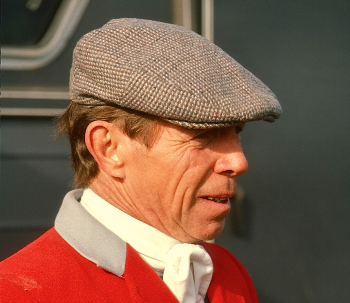
Bobby Joe Pillion, 1989, after judging the first Piedmont-Midland Foxhound Match / Douglas Lees photoRobert Joseph “Bobby Joe” Pillion died at home in Millwood, Virginia on January 12, 2014. He was seventy-nine.
“I just love to hunt,” he often said.
That’s how he concluded just about every foxhunting conversation we had. I can see him saying it, with a shake of his head and a thoughtful smile.
Bobby Joe was one of the most beautiful horsemen I have ever seen crossing the country. He whipped-in to the Blue Ridge Hunt for more than thirty years, riding nimble and athletic Thoroughbreds of such a uniform type that people trying to describe any new horse of that sort would simply say, “That’s a Bobby Joe horse.” In fact, you never knew which horse he was riding because they all went the same for him.
Bobby Joe was chosen to be a judge for both the 1989 and the 1991 highly publicized foxhound matches between the Piedmont and the Midland packs, both held in the Piedmont country. The matches were fashioned as a modern replay of the Great English-American Foxhound Match of 1905 and held in the same country. Sporting journalists came from England as well as the U.S. to cover the matches.
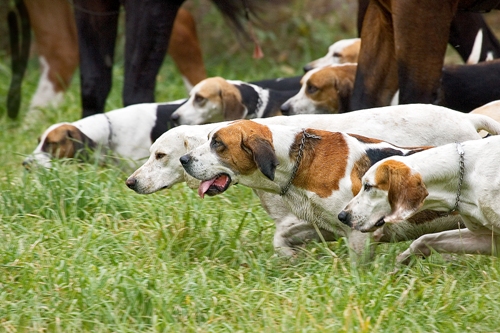
Wayne-DuPage drag hounds head to covert. / Chris Carney photo
Drag hunting, according to conventional wisdom, is what a hunt does when its country is constricted by suburban development. Sometimes that’s true, but, more often, hunts follow a dragged line of man-laid scent because the Masters want to. And a few hunts have been doing it for more than a century.
Each type of hunting—live or drag—has its pluses and minuses, depending on the needs and priorities of the participants. Drag hunting offers a controlled hunting experience to the benefit of hounds, riders and landowners. With a judicious laying of the drag, hounds are safer because roads and other hazards can be avoided; farmer’s crops are protected from horse’s hooves; homeowners’ lawns and yards are not trampled; and small pets are safe from the attention of hounds (all assuming that hounds don’t riot).
For riders who seek a gallop over fences, drag hunting offers a more efficient use of time, with no standing on a windy hillside while hounds search a covert for a fox (which may or may not be found). Thus the drag-hunting day typically lasts about two to three hours, with guaranteed galloping and jumping, better suiting those with a busy schedule, rather than the three- to five-hour day usually consumed by the ebb and flow of live hunting.
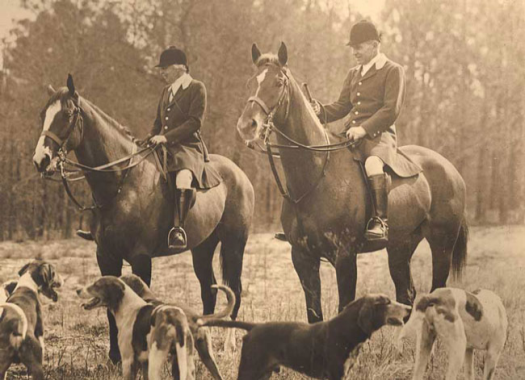
Mrs. Louise Eustis Hitchcock, MFH and huntsman of the Aiken Drag Hunt and Mr. Thomas Hitchcock / Courtesy Hitchcock Woods Foundation
Drag hunting was once a gloriously competitive sport, the roots of which go back to seventeenth-century England. During the reign of King James I (1603–1625), it began as a sport known as running a train scent. A “drag was laid, hounds were put on the line, and ran it at a racing pace. The horse in the lead at the end of the drag was declared the winner,” wrote the late Alexander Mackay-Smith in his Foxhunting in North America.
Later in the same century, during the reign of King Charles II (1649–1685) , a gentleman could enter his hound or hounds to compete for the Woodstock Plate, a race for hounds following a four-mile drag as a test of both the hound’s speed and its ability to follow a scent. When houndsmen and spectators discovered that the best and, not incidentally, the most enjoyable way to follow the hound race was on horseback, the sport of drag hunting was born according to John Philip Hore in his History of Newmarket.
Even Hugo Meynell, the father of modern foxhunting, played his part in drag-hunting history when, in 1763, he participated in a celebrated hound match in the form of a drag hunt between his Quorn Foxhounds and those of Mr. Barry’s Cheshire Foxhounds. By the nineteenth century, the notion of a guaranteed, sustained gallop over jumps appealed to many sportsmen, especially those who mainly hunted to ride.
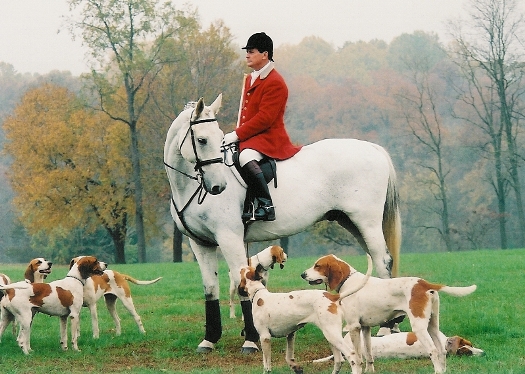
Robert Taylor, MFH and huntsman of the Goshen Hounds, had a memorable hunt with hounds on New Year's Day.
Some days you simply wonder what the gods are thinking. Today, New Year’s Day, was a day that I simply could not hunt because of social obligations unrelated to the hunting world. No amount of explaining and squirming would have been adequate to allow me to meet with the Goshen Hounds (MD) today. Consequently, it was with some delight when I was finally able to quietly announce at about 2:00 pm that I thought I would "visit the kennels" for a short while.
When I arrived it was apparent the hounds were still in the field, so I drove to the usual draw down Middleton Lane and was greeted with the distant view of a whipper-in and the cheering of huntsman and Joint-Master Robert Taylor. I knew exactly where they were, but getting to them in my trusty Tahoe was a different matter. Undaunted, I proceeded on (in four wheel drive), but still could not quite make contact.
Several riders were coming in with tales of, "Wow! What a run! My horse is cooked!" In desperation, I gave up and headed to the kennels. Soon I was greeted with the sight of Robert and hounds coming in, and, oh, what tales they had to tell.
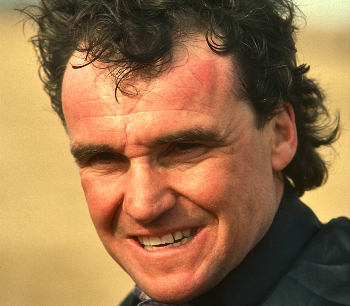
Douglas Lees photoBay Cockburn, ex-MFH, hard-riding huntsman, and former winning steeplechase jockey and trainer, died of complications from melanoma on December 25, 2013.
Confined to a wheelchair for the last fifteen years of his life as the result of a riding accident, Bay was an aggressive race rider and had been referred to as the Evel Knievel of all huntsmen. He represented the epitome of invincibility in the saddle until one fateful day, while exercising a hunter over a straightforward coop that he had jumped countless times, he fell and was left paralyzed from the chest down.
He stayed in the game as best he could, training steeplechase horses, and despite the wheelchair, he continued to live the only way he knew how: full speed forward. I saw him at the races one day propelling his motorized chair, rocking perilously over the lumpy ground across a hillside until it finally toppled over. Friends rushed to right him and rearrange him in his chair, and he continued his hurried progress to get a glimpse of his horse at the next fence. Just another of many falls to ignore. Bay maintained his training license and remained active through 2013.
Bay rode in sanctioned races and point-to-points from 1991 to 1997 with twelve sanctioned wins to his credit. I saw him steal a race down the stretch at the Blue Ridge Hunt Point-to-Point one year. He was lying second trying to overtake the leader. He anticipated just when the jock in first place would turn around to check on him. His body went quiet as if he had resigned himself to second place. The jock in front checked on Bay, was satisfied he had the race won, turned back to the wire and went to sleep. Bay got into his horse like a whirling dervish and passed his victim just before the wire.
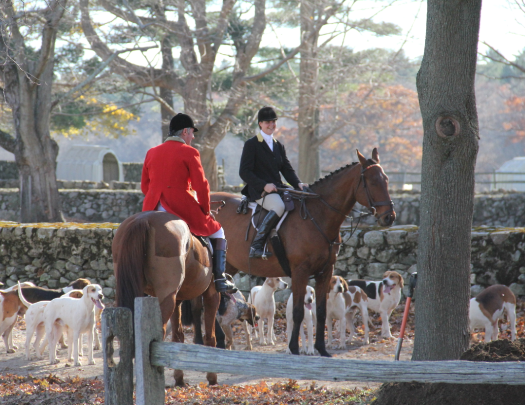
Heather Player carried the horn and Norfolk huntsman John Elliott whipped-in to her at the All New England Hunt hosted by Myopia in 2010. / Mary Marks photo
Myopia Hunt whipper-in Heather Player will move inland from Boston’s North Shore to become huntsman for the nearby Norfolk Hunt next season. Founded in the late 1800s, both hunts are among North America’s most venerable hunting institutions, and both have been hunting the drag since that time.
Heather grew up hunting with Myopia under the tutelage of well-known North Shore trainers Patrick and Barbara Keough.
“When I was around seven years old I started riding with Patrick and Barbara at the Myopia Hunt Club Stables,” said Heather. “Patrick started me hunting at eleven, and from
then on that’s all I wanted to do. I would do the local horse shows but never enjoyed it as much as hunting. I earned my Junior Colors at fourteen. My first paying job was at the Myopia Hunt Club at sixteen, riding and hunting horses.
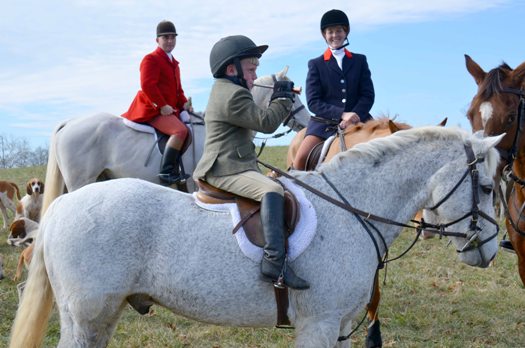
Colby Poe huffs and puffs on huntsman Ross Salter's hunting horn. Honorary whipper-in Denya Dee Leake tells the story. / Michele Arnold photo
Ross Salter, first-season huntsman at Old Dominion Hounds (VA), and I came to the hunt three seasons ago. There were a few juniors in the field on a regular basis and always a good number on Junior Day. This year, however, the number of juniors on ordinary hunting days has increased dramatically, and Junior Day was a complete surprise to everyone.
We met at Copperfield Farm, between the village of Hume and the village of Orlean. The staff walked to the top of the hill with hounds and waited for the juniors to join us. They started coming up the hill, and they just kept coming and coming. We had juniors that were nearly adults, juniors that were just old enough to ride away from their parents, and some that were being led by their parents! In total we had fifty-two juniors surrounding the hounds.
Including the juniors we had a field of one hundred and nineteen riders. In all of Old Dominion’s history I do not believe that they have seen so many juniors in one place on perfectly behaved horses and ponies. The Masters, Gus Forbush, Dr. Scott Dove, and Douglas Wise-Stuart, each assigned certain kids to each staff member and to become Field Master. Each of us staff members had two kids with us at the beginning, and we slowly brought more kids up as the day went on.
So Why All the Juniors?
Colby Poe huffs and puffs on huntsman Ross Salter's hunting horn. Honorary whipper-in Denya Dee Leake tells the story. / Michele Arnold photo
Ross Salter, first-season huntsman at Old Dominion Hounds (VA), and I came to the hunt three seasons ago. There were a few juniors in the field on a regular basis and always a good number on Junior Day. This year, however, the number of juniors on ordinary hunting days has increased dramatically, and Junior Day was a complete surprise to everyone.
We met at Copperfield Farm, between the village of Hume and the village of Orlean. The staff walked to the top of the hill with hounds and waited for the juniors to join us. They started coming up the hill, and they just kept coming and coming. We had juniors that were nearly adults, juniors that were just old enough to ride away from their parents, and some that were being led by their parents! In total we had fifty-two juniors surrounding the hounds.
Including the juniors we had a field of one hundred and nineteen riders. In all of Old Dominion’s history I do not believe that they have seen so many juniors in one place on perfectly behaved horses and ponies. The Masters, Gus Forbush, Dr. Scott Dove, and Douglas Wise-Stuart, each assigned certain kids to each staff member and to become Field Master. Each of us staff members had two kids with us at the beginning, and we slowly brought more kids up as the day went on.
So Why All the Juniors?
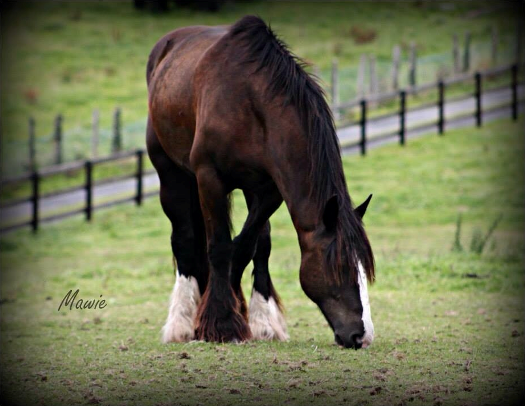
Midnight, a 16-hh black Irish cob at Coopers Hill is everyone's favorite, young and old.
How do I match riders I have never met with horses that will take care of them out hunting? The answer to that question starts with how the animal was gentled into riding and jumping to begin with. That’s the key.
It takes a number of years to get a horse hunting right. Anyone who hunts knows that you can get pullers, stoppers, and downright cranky horses. And then there are the ones that kick, bite, and buck. An odd buck of joy is fine, but the buck that is directed toward the rider’s dismount is coming from a horse that wasn’t respected and won’t give respect.
Down through the years the locals have brought very difficult animals to our yard for breaking. But we like to turn that word—breaking—on its head. We prefer to say we gentle and respect the animal and allow them the time to come to the conclusion that it is okay to accept the bit, okay to be brushed, okay to have their feet lifted up, to be saddled and eventually mounted. Some animals accept sooner than others simply because some trust sooner than others. The manner in which this is done determines the product—the horse—you are going to mount for your day’s hunting.