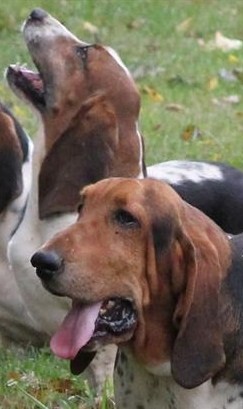
The Ashland Bassets / Susan Monticelli photoWhen not following foxhounds on horseback, many foxhunters and their like-minded friends can be found following their local basset or beagle pack on foot—a perfect way to continue enjoying sport and a country lifestyle. Any foxhunter who thrills to the cry of foxhounds and hasn’t yet heard a pack of bassets in full cry must try a day’s hunting behind these wonderful hounds!
Even after dismounting from the saddle on a Saturday, many still yearn to hunt on before returning to an office on Monday. There are others who have hung up their tack for various reasons, and some who have never hunted astride yet love being outdoors on fall and winter afternoons. For all these sportsmen and women, the Ashland Bassets—hunting the territories of the Casanova, Old Dominion, Orange County, and Warrenton foxhound packs in Virginia—have provided a welcome window through which to extend one's weekend enjoyment of the countryside and venery.

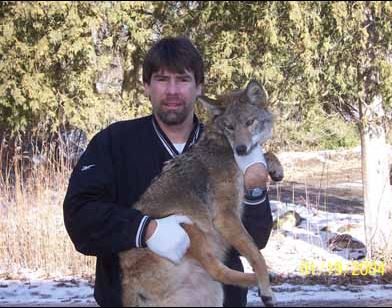
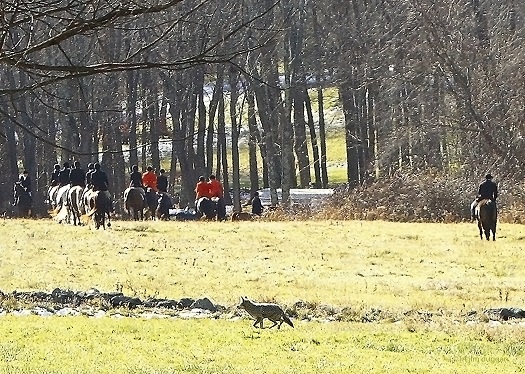
Dr. Stanley Gehrt and an anesthesized coyote in metropolitan ChicagoThe Belle Meade Hounds in Thomson, Georgia will once again stage their annual Hunt Week—Gone Away with the Wind—this season from January 18 to 24. As before, the week will be fun-filled with hunting, parties, a hunt ball, and the camaraderie of the field.
As a bonus, this year’s affair will feature a fascinating presentation by special guest Dr. Stanley Ghert, Associate Professor of Wildlife Ecology and a Wildlife Extension Specialist at Ohio State University.
Dr. Ghert, who has enthralled foxhunters at MFHA meetings over the years, will talk to Belle Meade Hunt Week attendees on Thursday morning, January 22, about his special subject of research—the coyote. This much-aligned animal has survived and even flourished over the past hundred years despite the best efforts of the federal government to eradicate it.
Early in the twentieth century, at the behest of western ranching and agricultural interests that were losing stock to predators, the U.S. Government instituted program after program designed to erase the wolf, grizzly bear, mountain lion, and coyote from the landscape. The programs were mostly successful in their purpose. The wolf, grizzly, and mountain lion were driven nearly to extinction. The coyote, however, was the one predator that not only survived the pressure, but increased its population and its range, slowly expanding eastward and covering now the entire country. How it did that is one of the mysteries of the animal world.
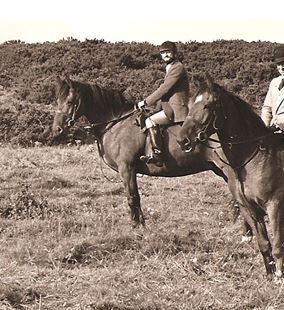
Steve Price on his first foxhuntSome time ago in Norm Fine's Blog we asked the question, How to did you come to go foxhunting? Fine told his story and received some good Comments in response. Here’s Steve Price’s story. Use the Comments field to send us yours!
It happened nearly forty years ago. I was half of a two-person equestrian journalist junket to Ireland. Over lunch in his home at Scarteen, Master Thady Ryan invited us to join him the following day. My companion happily agreed, but I demurred. My jumping skills were limited to beginner courses---egg-rolls and twice-arounds---and I had seen the formidable banks and ditches separating the County Limerick fields.
“Aw, I’ll give you my best hunting horse,” Thady assured me, “you’ll be safe as houses.”
In for a penny… I shrugged, and went along.
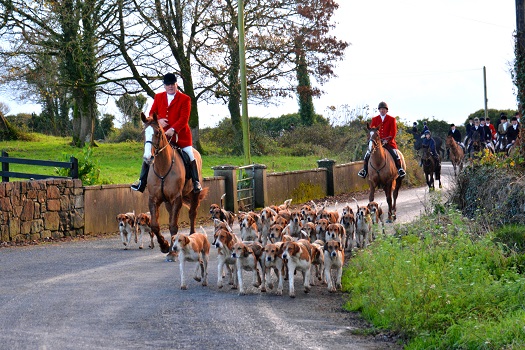
Galway Blazers huntsman Tom Dempsey and whipper-in Anthony Costello hack home after a cracking day's hunting in Craughwell. / Noel Mullins photo
The County Galway Foxhounds (the Blazers), hunted by Tom Dempsey, had a brilliant day's hunting at Craughwell, finding five foxes and running each one to ground.
The hunt was formed in the early nineteenth century and hunts about thirty square miles of unique limestone wall country. The first Master and huntsman was John Denis, an ancestor of the late Lady Molly Cusack-Smith, MFH, who, neé Molly O’Rourke, hunted the Blazers during World War II. There were many other well known Masters, including Isaac (Ikey) Bell, father of the modern English foxhound; American film director John Huston; and Captain Brian Fanshawe, one of England’s illustrious Masters (Warwickshire, North Cotswold, and Cottesmore) and renowned breeder of foxhounds. Two Field Masters that held office for long periods were Lady Anne Hemphill and Willie Leahy.
The Galway Blazers have some of the very best hunting country in the world. To say it is unique is an understatement, with miles of small enclosures, resulting in often fifty stone walls to the mile and uninterrupted views of hounds hunting. To hunt even once with the Galway Blazers is on most hunt followers’ bucket list.
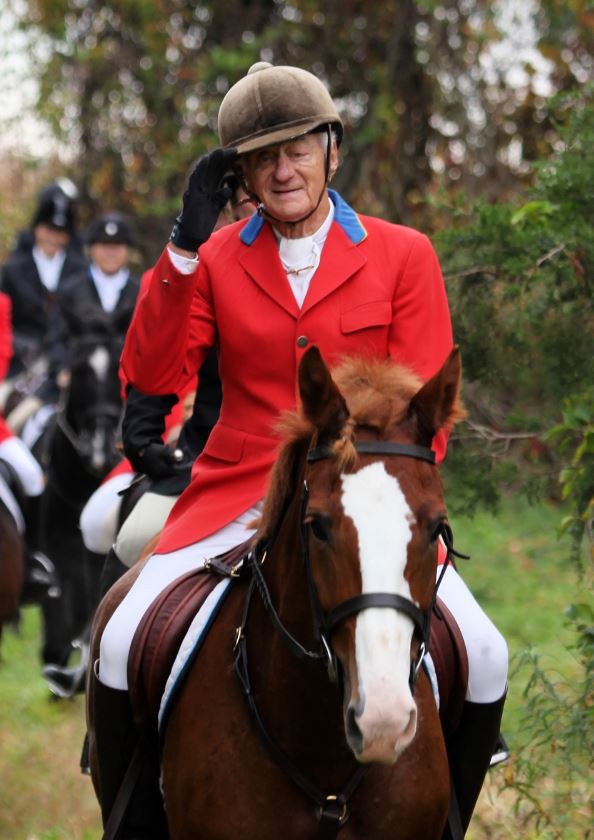
Julie Stuart Seger photoStuart Grod—popular field member of the Fairfield County Hounds (CT)—has retired after forty-three consecutive seasons hunting in the first flight. A retirement party was held in Stu’s honor at the hunt’s clubhouse on November 22, 2014, where well-known food and travel author Michael Stern read a poem he composed for the occasion.
"Build a bridge with your hands on the mane;"
"Trot smooth as you head for the jump;"
"Go light when your hands hold the reins;"
"And don't crowd on the lead horse's rump:"
Just some of Stu's tips I've acquired
Since I started to ride with you folks.
I'll miss you up there, you strange country squire
With your bright eyes, your wisdom, and jokes.
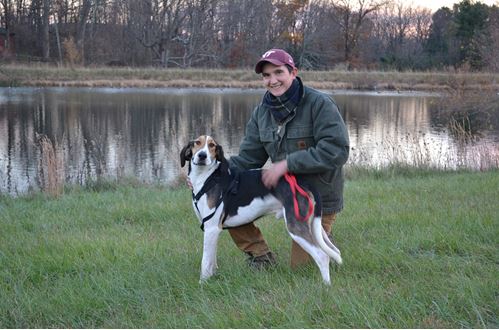
Charter and Tyler / Cynthia Daily photo
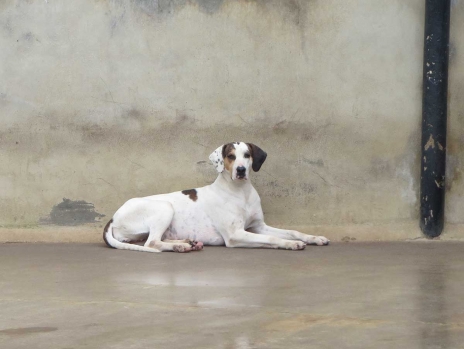
The odyssey of Live Oak Charter—the frightened foxhound that escaped from the Virginia Foxhound Show last May, traveled from Leesburg to Middleburg (more than twenty miles as the crow flies), crossed two major four-lane highways, subsisted on whatever food he could find, lost part of his tongue and shattered his jaw—finally ended after six long months in Hollywood’s finest style.
Charter has been adopted by the vet tech that cared for him at Blue Ridge Veterinary Associates. He lives on a hundred-acre farm, sleeps on his new owner’s bed, and runs long distances with him every day. Charter’s survival literally “took a village,” and Live Oak MFHs Daphne and Marty Wood, who supported and monitored the efforts of so many dedicated people from afar, couldn’t be happier.

Columnist Russ Hannah, writing for NorthJersey.com, recalls the day the Essex Fox Hounds (NJ) paid tribute to Bert Hannah, his late father. Bert wasn’t a foxhunter, a landowner, or a captain of industry. He was, writes Russ, an “ordinary man who had once been a Minnesota lumberjack with a third-grade education, if that.”
Bert was a caretaker on a large estate near the Brady estate and Hamilton Farms. The latter represented five thousand acres, constituting the primary Essex hunting country. The former, Martha Brookes Hutcheson’s estate of 104 acres, where Bert Hannah served as caretaker, was closed to the hunt by the owner as the result of a fallen rider being seriously injured there years earlier.
Nevertheless, Bert Hannah was an animal person. He bred field trial beagles—one a 1963 National Champion, Longview Susie at left in news photo with two of her offspring. And he loved horses.
Bert was always friendly to the Essex riders, stopping to talk as they went by. Any injured or lost foxhound that passed Bert’s way was taken in by him, fed, and cared for before being returned to kennels.