What follows is a report on a fine day’s hunting, a description of a brilliantly executed new kennel complex that any hunt contemplating new kennel construction will appreciate, and an opportunity to become Joint-Master of an Irish pack for any foxhunter yearning for more adventure!
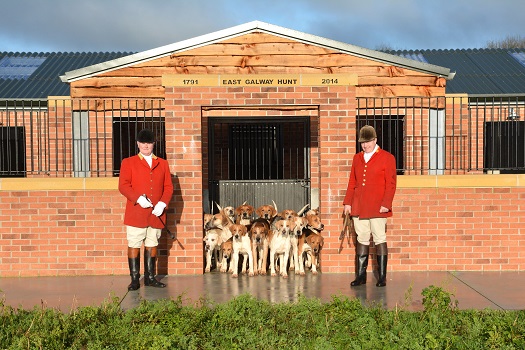
(l-r) East Galway Foxhounds Joint-Master Joe Cavanagh and huntsman Liam McAlinden with hounds at the New Kennels / Noel Mullins photo
The history of the East Galway Foxhounds goes back to Giles Eyre of Eyrecourt who kept a pack of hounds from about 1790. The East Galway Foxhounds was founded in 1880.
In addition to those milestones, the year 2014 will go down as a proud year for the East Galway followers. A brand new state of the art kennel complex was developed and financed by Joint-Master Joe Cavanagh and handed over to the hunt recently. Cavanagh, a successful businessman and a former owner of Cavanagh Foundry in Birr, is passionate about hunting. A former Master of the Ormond Hunt for twenty seasons, he joined the mastership of the East Galways eight seasons ago. Joe bred the international eventer Comanchee who with his rider James Robinson was third at Burghley and fourth at Badminton, the latter which he competed in ten times, and the last time at nineteen years of age!
The project of building the new kennels has taken Cavanagh three years from purchasing the site, visiting kennels in the UK and Ireland for ideas of what mistakes to avoid, securing planning permission, and then building. Meticulous about detail, his top priorities were the welfare of hounds and horses and comfortable surroundings for the huntsman to do his work.
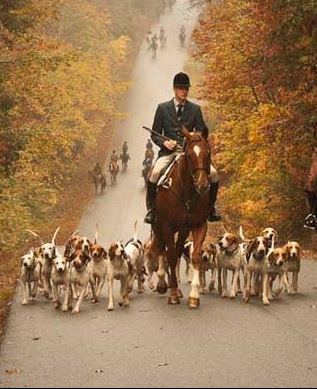
Huntsman Jordan Hicks moves from the Tryon Hounds to the Piedmont Fox Hounds / Erik Olsen photoAs we approach the close of the 2014/2015 foxhunting season, here’s our report on thirteen hunts that have either hired or will require a new huntsman for next season. We have already featured personal close-ups of three of the migrating huntsmen—Guy Allman, Brian Kiely, and Graham Buston—and we plan to bring you more.
We invite readers to fill us in on any moves that we’ve missed. We also invite you to send us a personal profile on any of these huntsmen that we can publish as a feature article. Or, just send us the information, and we’ll write the story. Use the “Contact Us” link that appears at the bottom of every screen to communicate directly with me, and be sure to include your phone number.
What follows is foxhunting’s version of musical chairs.
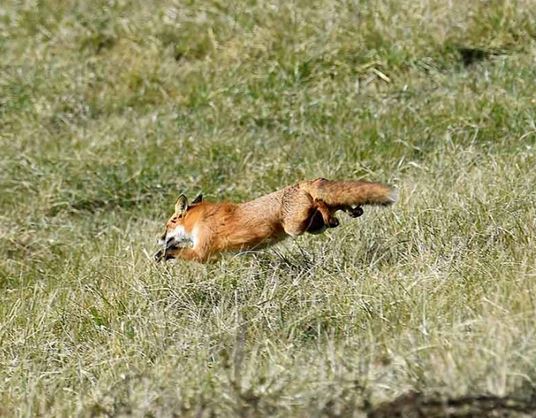
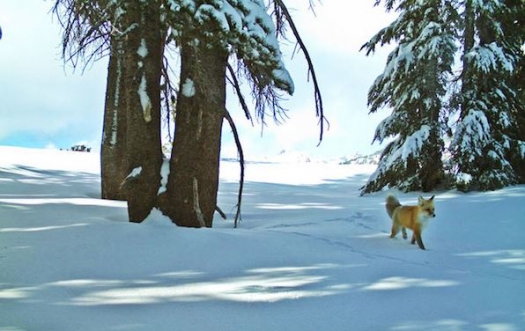
Sierra Nevada red fox / National Park Service photo
It’s been one hundred years since a sighting of the Sierra Nevada red fox has been confirmed in Yosemite National Park. Also known as the High Sierra fox, it is a subspecies (vulpes vulpes necator) of the red fox (vulpes vulpes) and was captured on camera in Yosemite in mid-December, 2014. The California Fish and Game Commission declared this exceedingly rare subspecies threatened in 1980, and it could receive federal protection under the Endangered Species Act this year.
The Sierra Nevada red fox is slightly smaller and darker than the more common red fox, which is non-native to California. It’s range is limited to alpine and subalpine meadows above 4,500 feet.
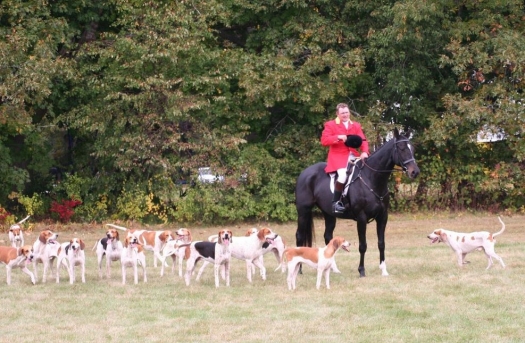
Brian Kiely and the Myopia foxhounds / Ashley Hill photo
Brian Kiely knows he will have big boots to fill when Larry Pitts, huntsman for the Potomac Hunt (MD), retires after thirty-five seasons there. Brian spent a weekend recently with the Potomac Masters, had a chance to hunt with Larry, and accepted the position of huntsman starting next season.
“The way Larry conducted himself, the way the hounds related to him, was poetry,” said Brian. “It was a fabulous experience just to watch him.”
“I remember seeing Larry some years ago at the Virginia Foxhound Show,” Brian continued. “Hounds from hunts all over were arriving at the kennels...nervous...running off...and there was Larry, calmly walking his pack through all the confusion, without a care.”
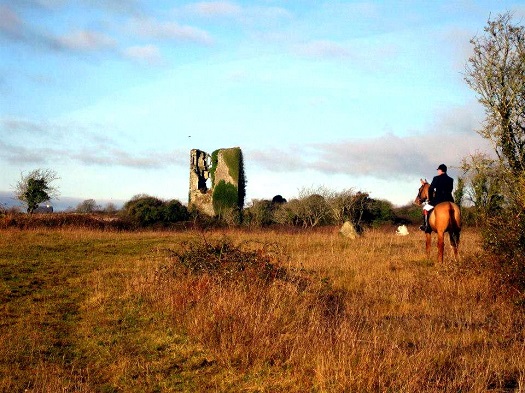
The morning’s heavy showers abated, affording my visitors a promising start at the Moyvilla meet, County Galway. I am still forming opinions on which hunt on our card is best, but Moyvilla would be among my favourites. It regularly brings out the best in Master and huntsman David Burke!
Skies were clearing nicely as we drove to the meet, air temperature considerably cooler than previous days. Martin McNamara, who just started riding in September and is a recent convert to the stone walls, was on Darcy, a fifteen-two-hand Irish Cob gelding. Andrea Ypma, visiting from Canada, was excited to be part of the foot followers. She had arrived in Ireland two days earlier for a three-week immersion into the Irish Hunting culture with us at Coopers Hill Livery. The wall builder was tasked with the important job of escorting Andrea to all the finest places to watch the fox bolt and view some of the horses jumping the walls.
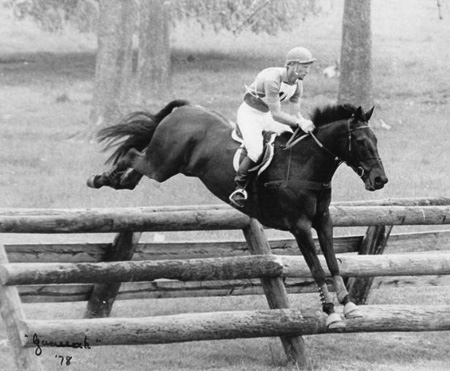
In the last issue of FHL WEEK, Kate Samuels wrote about what eventing horses can learn by going foxhunting. Your editor was reminded of an article we published back in 2010 that turned that question on its head somewhat. We had asked Olympic three-day medalist James Wofford what foxhunters can learn from eventers. As we are now in that part of the hunting season when a traveling fox may take us for the longest and most arduous run of the season, we thought it would be worthwhile republishing Wofford’s advice.
James Wofford on Carawich, 1978 / Gamecock photo
For most of us field members, perhaps one of the greatest single factors influencing the joy we experience in a day’s hunting is our riding ability. The more competently we are able to cross the country on our horse, the closer we come to a totally fulfilling experience.
Since eventers know just a bit about crossing the country, we asked instructor, team coach, author, and Olympic medalist James Wofford to discuss some of the principles of his particular discipline and how they might be applied to the hunting field.
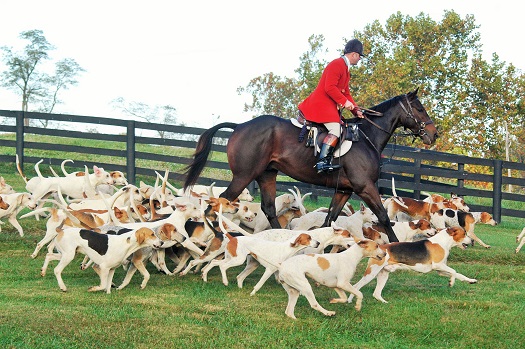
Once again the time of year has arrived when hunts and huntsmen contemplating change make their decisions known—one to the other. Foxhunting Life will feature at least some of these huntsmen’s personal transitions through the coming months.
Nancy Kleck photo
Guy Allman, popular huntsman for the Blue Ridge Hunt (VA) for the past three seasons, received an offer he couldn’t refuse. He’ll return to England—home for him and his wife, Fran—to carry the horn for the Bicester with Waddon Chase Foxhounds. Guy will succeed huntsman Patrick Martin, who is retiring after twenty-two seasons hunting the pack.
The condition, fitness, and biddability of the Blue Ridge hounds testify to Allman’s work ethic. He spends a great deal of time training puppies early on, so by the time the season starts they are ready to enter, off the couples, all at once. On the first day of the season, every hound to be entered is out with the pack. And it’s a big pack, typically twenty-five to thirty couple, virtually every hound in kennels capable of walking on four legs.
Also on the first day of hunting, every hound is fit not only for the chase but for the late-summer weather as well. Allman wants hounds as oblivious to the heat as he appears to be. There are to be no excuses.
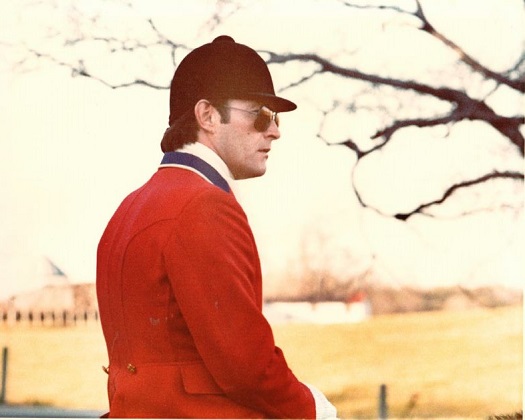
Vicky Moon photo, circa 1980s
Peter Hitchen, MFH, died January 12, 2015 from complications stemming from injuries sustained in a fall in the hunting field a month earlier. He was seventy-six. At the time of his passing, Peter was serving in his twenty-seventh season as Joint-Master of the Potomac Hunt (MD).
Peter was born in England but didn’t start foxhunting until he emigrated to the U.S. in 1962. After settling in the Washington, D.C. area, Peter was introduced to the sport by a friend. He also met his bride-to-be, Nancy Tilton Orme of Leesburg, Virginia, who also encouraged his involvement with hunting to hounds at The Loudoun Hunt.
From that time on, Peter never let anything interfere with his maturing love of and passion for foxhunting. After many seasons of whipping-in at the New Market/Middletown Valley Hounds (MD) and later at The Potomac Hunt, Peter joined Irvin L. (Skip) Crawford as Joint-Master of Potomac in 1987. With huntsman, Larry Pitts, they oversaw the development of what is unquestionably one of the premier packs of American foxhounds in the United States, giving good sport to their members and garnering championships and grand championships at the hound shows year after year.
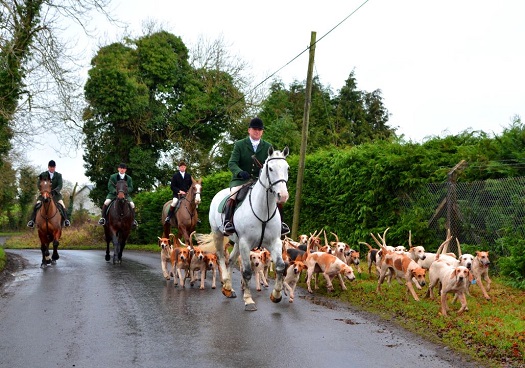
Ballymacad huntsman Kevin Donohoe with hounds at Archerstown. Following (l-r) are whippers-in Bobby Kellett, Maurice Quinn, and Irish MFHA trainee Keith Broderick. / Noel Mullins photo
There is a rich history of hunting in County Meath, Ireland. The Sherbourne family kept a pack at Loughcrew, and the Ballymacad Foxhounds were founded there in 1797.
The Ice Age of 30,000 years ago made a massive contribution to foxhunting in the Ballymacad hunt country. The countryside is made up of drumlins, small tear drop-shaped hills such as found in the Carolinas in the U.S. Many are covered in gorse, and despite the weather if one looks underneath the cover there is always a snug dry base, which makes them natural homes for foxes. Add to that the small bogs and hazel woods and you have variety. Foxes don’t have far to travel, and prying eyes are easily avoided.
To hunt foxes successfully in this country, hounds need to be true to the line to reduce their opportunities of going to ground too quickly. The country is challenging; one needs a horse that can jump walls, wire, drains, double and single banks, and a rider that can stay on!