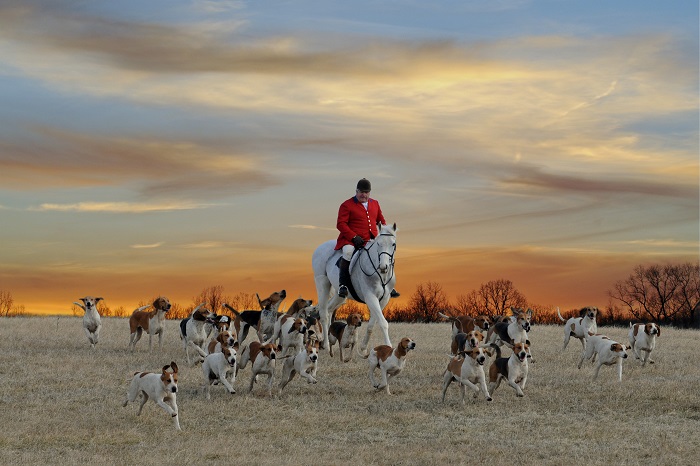
Huntsman Tommy Lee Jones and the foxhounds of the Casanova Hunt, now disbanded. / Richard Clay Photography
For the Casanova Hunt (VA), established in 1909 during the waning days of Theodore Roosevelt’s term as president, June 30, 2020 marks the end of the era. It’s a real heartbreaker. And a personal one.
It was an easy hack from the kennels at Weston to the Boarding House covert, so named half a century ago by Capt. Ian Benson, MFH and huntsman, because that covert harbored everything. It was often a quick cast and hounds were away.
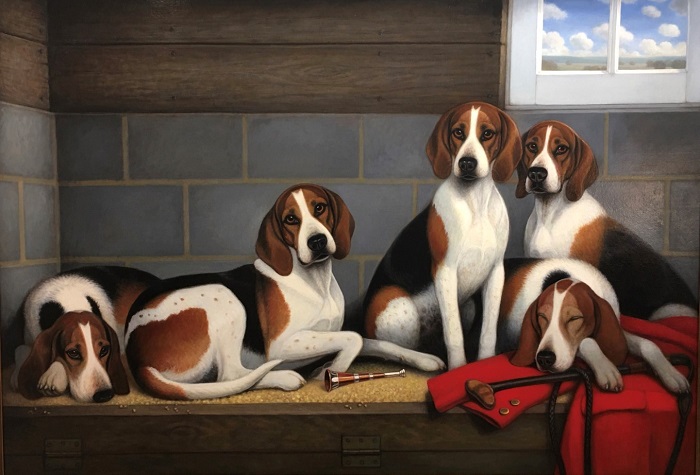
Foxhounds in a Kennel, Christine Merrill (American, Contemporary), oil on canvas, 42 x 60 inches, framed: 49 ½ x 67 ½ inches, contact gallery for more information.
This painting of foxhounds in kennel, almost monumental in scale, caught our eye. Offered by William Secord Gallery in New York City, the composition by a contemporary artist is reminiscent of many we’ve seen by traditionalists such as John Emms (1843−1912) in particular, but the execution veers dramatically from the style of the traditional Masters. We are also reminded of Emms’s work in the very scale of the framed painting: 49-1/2 x 67-1/2 inches; Emms often worked in this large format.
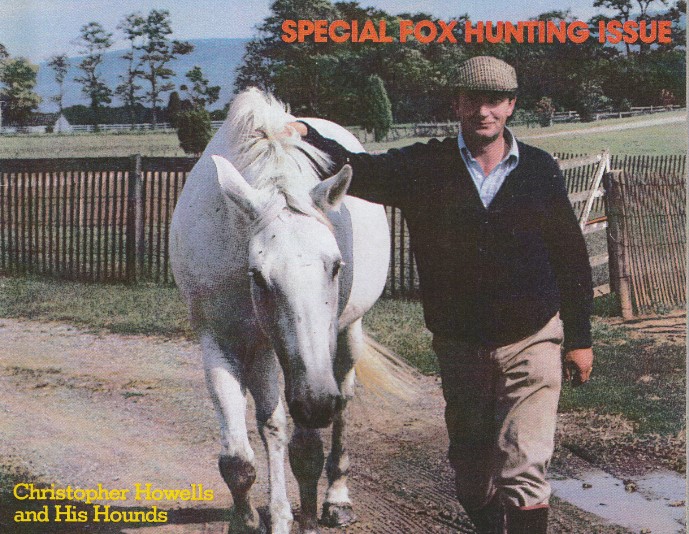
One day some years ago while recuperating from whatever had me grounded at the moment, I decided to follow my home pack, the Blue Ridge foxhounds, by vehicle. Fortunately, Chris Howells had an open seat, so I climbed into his blue pickup truck.
I knew that whatever would be seen of the action that day from any vehicle would be seen from Chris’s truck first. Every road follower wants to ride with Chris. If there’s no room, they do their best to follow him. Chris knows the country and how the foxes run.
Chris hunted the Blue Ridge foxhounds from 1973 to 2001 during the Mastership of Judy Greenhalgh. Since his retirement from the saddle, Chris has been following hounds on the roads for another almost twenty years. He serves as the principal road whip and remains a valued and knowledgeable member of the staff.
The following article was first published in the November 1983 edition of "Horseplay" magazine. –Ed.
The early morning light shows a solitary figure on his way to the kennels, a terrier at his heels and a can of Pepsi in his hand. Christopher P. Howells, huntsman for the Blue Ridge Hunt in Boyce, Virginia, is about to start another busy day. Hounds greet him with an enthusiastic din, but turn quiet as he speaks to them in his soft English accent and sees to the feeding.
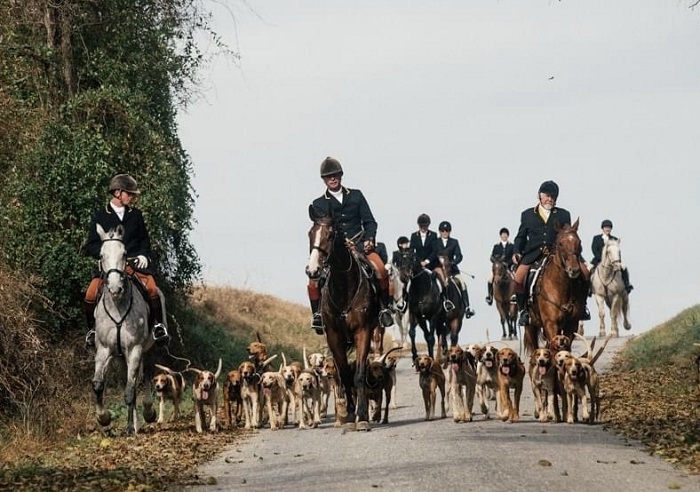
Sean Cully, MFH and huntsman (center), with hounds of the Rose Tree-Blue Mountain Hunt (PA). To the left is Brady Cully, whipper-in; to the right is Dr. Edward Franco, Joint-MFH and whipper-in.
When hunts merge, the resulting whole can often become greater than the sum of its parts. Take the case of a once-small hunt in Pennsylvania—the Blue Mountain Hunt. It was established by Sean Cully, MFH, in 1999 as a farmer’s foot pack. It became a mounted pack in 2009, was Registered with the MFHA in 2011, and became a Recognized pack in 2014.
Through unanticipated but judicious mergers, Cully’s little foot pack has stabilized a historic foxhunting country in Pennsylvania, rejuvenated the oldest subscription pack of foxhounds in the United States, and become a national influence and model for the sport.
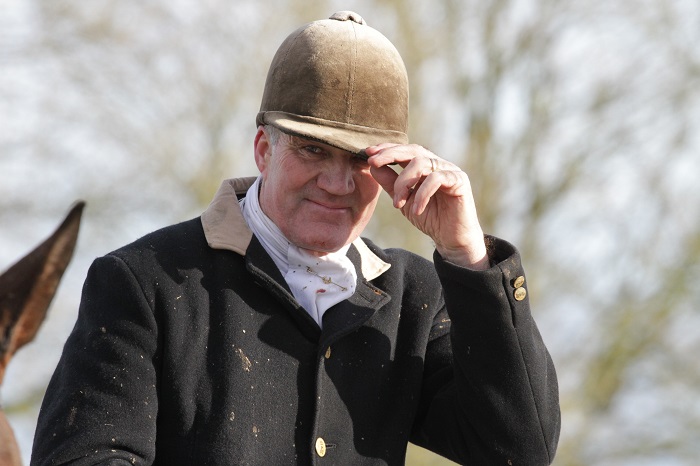
Meet Val O'Connell, Field Master, Scarteen Black and Tans. / Catherine Power photo
Val O’Connell's is possibly one of the best known faces in organised Irish racing through his role in the Turf Club (now the Irish Horseracing Regulatory Board). Val serves as chief inspector of courses and clerk of the course for half a dozen southern meetings. Perhaps what is less well known is that Val is one the keenest hunting men in these islands.
He has been Field Master of the famed Scarteen Hounds in Co Limerick for almost twenty seasons. I am among those who have attempted to follow him across the country on his grey, and know what a formidable horseman he is. As Field Master, Val is following in the footsteps of the legendary PP Hogan who held the role for many years when Thady Ryan carried the horn. Longtime Scarteen whipper-in Tommy O’Dwyer became young Val’s mentor. “Give the hounds a chance, and never jump into a field until hounds have left it,” was Tommy’s advice, and Val follows it to the letter in his role as Field Master.

Charlie Lewis whipped-in at Belle Meade for fifty years. / Bella Vita Photogaphie
Charlie Lewis announced his retirement as Master at the Annual Meeting of the Belle Meade Hunt (GA) after twenty-one years of service. Charlie has whipped-in to Belle Meade huntsmen for fifty years―to Master and huntsman Epp Wilson and before that to Epp’s late father, James, the hunt’s founder, Master, and first huntsman.
Over the years, Charlie has mentored several Belle Meade youngsters in the art of whipping-in, crossing the country, and growing into responsible adults. He served on the Belle Meade Hunt Committee as well.
“Charlie has been the go-to guy for fifty years,” said Epp Wilson. “He will tackle any problem for the Hunt. Whatever the problem or challenge, anyone in the Hunt could go to him and get wise counsel and advice. From landowner challenges, to friction between certain members, to building new hunt barns after fires.
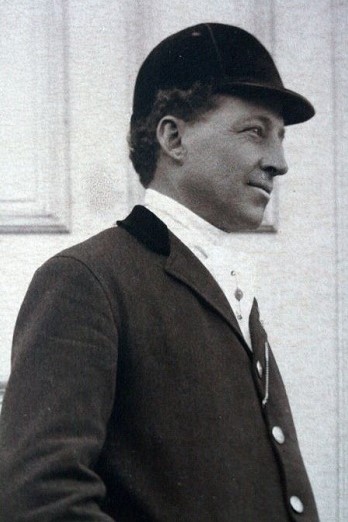
Harry Worcester Smith in hunting attire, circa 1910, from the Harry Worcester Smith Archive (MC0041), National Sporting Library & MuseumThis week's Bonus article, free to all (no subscription necessary), is an excerpt from Chapter 10 of "The Great Hound Match" by Martha Wolfe―a historical account (with liberties taken) of that famous quarrel between Masters A. Henry Higginson and Harry Worcester Smith over the merits and hunting ability of the English foxhound compared to the American foxhound. The author views the match as “a metaphorical battle in America’s coming of age―her psychic independence from Britain’s lingering shroud at the turn of the twentieth century.”
Saturday, November 4, 1905, Grafton Hunt’s Second Day
“Hounds never ran so fast since the world began.”
−Allen Potts quoting Dr. Charles McEachran, judge for The Match, Richmond Times-Dispatch. Saturday, November 5, 1905
You and Ham trot on ahead with the hounds,” Smith told Mal Richardson. “We’ll not be far behind.”
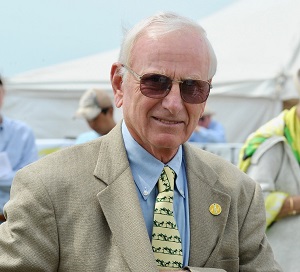
Douglas Lees photoRobert Allen Kinsley, MFH of the Elkridge-Harford Hunt (MD), passed away peacefully at his Pennsylvania home on Wednesday morning, June 10, 2020. He was surrounded by his wife Anne (Whalen) Kinsley and his family.
Bob loved his time in the hunting field and on the wooded trails of his farms—riding, fishing, and hunting. He will be remembered for his unfailing love for animals. He created an amazingly successful business, was a hunting member of the Elkridge-Harford Hunt for thirty years, served as Joint-Master for sixteen years, and he ran steeplechase horses.
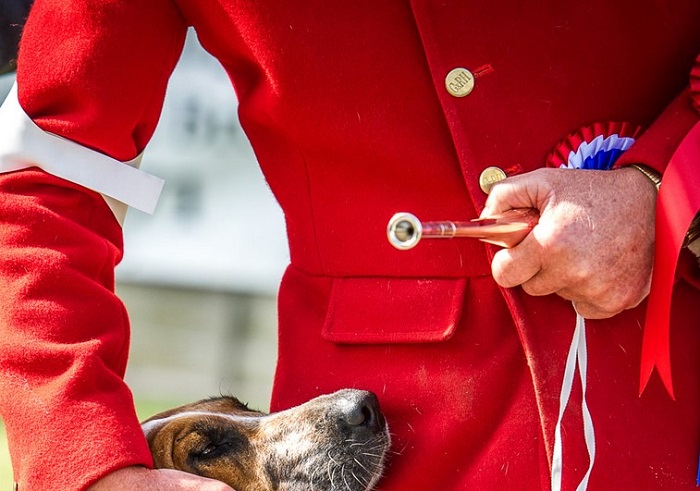
Here’s a first in the centuries-old history of hound shows—an International Virtual Hound Show!
Hound associations around the world have signed on so their member hunts may enter hounds in classes for staghounds, foxhounds, deer hounds, beagles, basset hounds, and mink hounds, and let the champions be crowned. Fourteen hunting associations are supporting the event, including the Masters associations in North America, England, Ireland, Australia, New Zealand, and France. Entry Forms are ready upon which to record entries in thirty-six divisions in nine separate catalogs.





Keyboard Bullying Harms Your Hunt and Your Sport
As a twenty-two-year-old, I have grown up in the age of extreme technological and social media growth. Everyone has it; everyone uses it. I’ve also grown up in the hunting field and follow hounds three days a week. I travel to hunt and do my best to experience all types of hunting, all over.
My happy place is on a good horse, behind a great pack of hounds. The hunt field is the place where you can leave all other thoughts behind for a few hours and turn your focus to staying topside and keeping up with hounds. The hunt field is a place to be at peace, away from our own and the world’s struggles, whether big or small. But recently...