Night Hunting with Dad
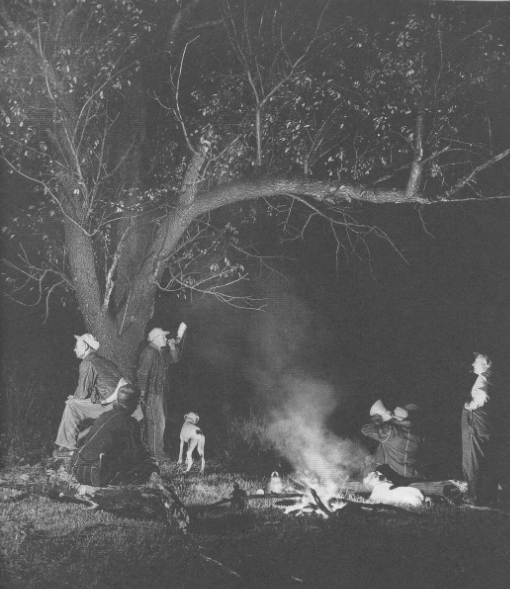
This is a true story as best as I can recollect. I was about six or seven years old that night, but as you can imagine this was a story told and retold around many a local foxhunter’s fire for many years thereafter.
Dad often took me foxhunting with him when I was little. I don’t have many memories of those hunts other than falling asleep in the back of whatever old car dad had at the time. The foxhunting that dad and his friends participated in did not involve horses or fancy scarlet coats. Their steeds were Ford and Chevy, GM and Oldsmobile; the uniforms worn were usually whatever work clothes they had been wearing that morning.
The Dawgs of Dixie
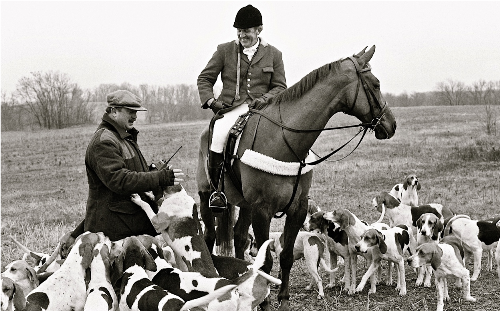
Douglas Lees photo In 1989, ghosts of the Great Hound Match of 1905 were awakened from their long slumber in the Piedmont Fox Hounds country of Virginia when Ben Hardaway, MFH of the Midland Fox Hounds (GA), brought his pack of Crossbreds (English crosses on American July bloodlines) to duel on alternating hunting days with […]
Foxhunter/Patriot to Be Honored in Bronze
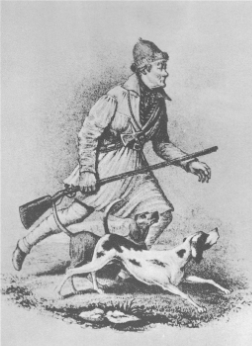
Jonas Cattell from “Memoirs of the Gloucester Foxhunting Club” by William Milnor, Jr., Philadelphia, 1830Jonas Cattell, foxhunter and revolutionary hero, will be honored with a seven-foot bronze statue to be erected in Haddonfield, New Jersey. We foxhunters know about Cattell’s exploits in the hunting field thanks to Alexander Mackay-Smith’s classic book, The American Foxhound: 1747–1967, but I never knew about Cattell’s heroism during the American Revolution. He turned the misfortune of his arrest by Hessian mercenaries into advantage for the Colonial cause.
Cattell whipped-in for the Gloucester Foxhunting Club, the first organized foxhunting club in North America. It was founded in 1766 by a group of Philadelphia gentlemen and named for Gloucester County, New Jersey, directly across the Delaware River. According to Mackay-Smith, quoting Clifton Lisle describing their sport, “When Cupid, the huntsman who succeeded Old Natty, was in the saddle with Jonas Cattell whipping-in to him, amazing runs were made.”
“In 1798, for example, one is recorded that went to Salem, a distance of forty miles by the map from find to kill. Another ended on the ice of the Delaware, a Jersey fox crossing it with fifteen couple of hounds not a hundred yards from his brush—to be rolled over just short of the Jersey shore. Robert Wharton, president of the club at that time, was the first man up, next to Jonas Cattell, the whipper-in, who had crossed the river on foot.”
Eddie Arcaro Goes Foxhunting
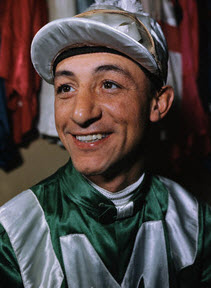
Hall of Fame jockey Eddie ArcaroEddie Arcaro (1916–1997) is regarded by many as the greatest jockey in the history of American Thoroughbred racing. He tallied more wins in classic stakes races than any other jockey and is the only jock to have won the Triple Crown twice—Whirlaway (1941) and Citation (1948). He has the most wins of any jockey in the Belmont (six) and the Preakness (six) and is tied with Bill Hartack for Kentucky Derby wins (five). He won 4,779 of his 24,092 races and earned a record setting $30 million in purses.
On November 23, 1954 Arcaro experienced his first foxhunt when he appeared at a meet of the Piedmont Fox Hounds in Philomont, Virginia, as reported by Liz Smith in Sports Illustrated’s December 27 issue of that year:
The Fell Foxes of Dove Crag
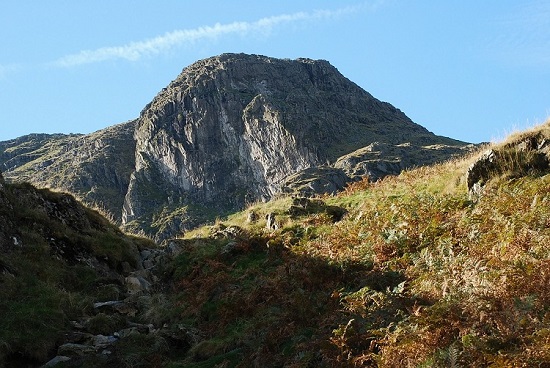
Dove Crag in the rugged Lake District of Cumbria, England
A sheep trod wove its way up the steep fell side, gaining height with an ease unmatched by any route a human could devise. Following it and climbing all the time I skirted small outcrops of rock, crossed a stream full of melt-snow water at the best point to do so, and finally arrived on the ridge. Stopping to catch my breath, for although the route to a sheep would have been easy this human was very unfit, I gazed at the view in front of me. My horizon was filled with snow covered peaks under a bright blue sky. Warm sunlight bathed the ridge and gave a small crag to my left a sharpness normally unseen.
The Coniston foxhounds had disappeared to god knows where, and had been gone for some time. I’d watched them climb the fell side I now stood on. It had been a beautiful sight as they climbed, in a line, like as someone put it “a hound trail.” Their music had carried down the valley, growing fainter as they crested the ridge and then as they dropped into the next valley it disappeared altogether, leaving an eerie silence.
The Hunt Button Mystery
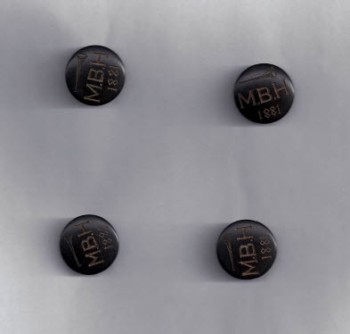
It began with a subscriber’s question. Vicki Reeves wrote, “A friend inherited some hunt buttons which have a hunting horn on them and “M.B.H. 1881.” How can I find out what hunt they represent or any additional information about the buttons?”
Foxhunting Life was able to identify the buttons as those of the Meadow Brook Hunt (NY). Once that was established, the owner of the buttons, Connie Rhodes West from Tampa, Florida was able to surmise the likely provenance of the buttons back through family history. Her story was so interesting, and the chronicle of the fabled Meadow Brook Hunt is so extravagant, we thought our readers would enjoy a trip back to those bygone days.
Ruler’s Message
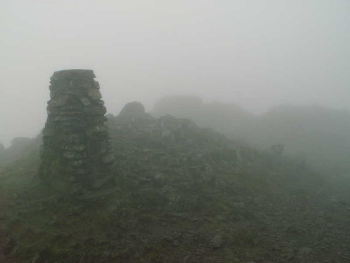
A thick mist descended upon Red ScreesAs reported by The Westmorland Gazette, April 14, 1900
On Monday the meeting of the Coniston Foxhounds was at Grove farm. Hounds got upon a drag close to the farm and carried it up Martindale Pasture, by Hind Cove, to Troutbeck Hundreds. Here a fox was unkennelled, which went across Woundale Bottoms, crossed the Kirkstone Road, and climbed up Brow End Allotment. Climbing along the top to Woundale Head, he made a sharp turn to the left, and came down behind Kirkstone House. He now crossed the road at the Ullswater side of the Pass, near the Kirk Stones, and scrambled up the sides of Red Screes.
Old Huntland, Joe Thomas Photos Discovered
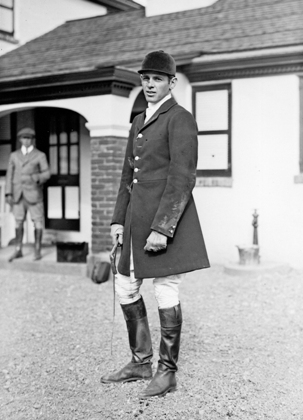
A youthful Joseph B. Thomas at Huntland / Courtesy of Karen L. MyersJoseph B. Thomas, MFH came to Middleburg, Virginia via Boston and New York in the early part of the twentieth century and built Huntland—house, stables, and kennels. Thomas was a founding member of the American Foxhound Club, Master of the Piedmont Fox Hounds, and author of Hounds and Hunting Through the Ages, the first comprehensive book on hunting with hounds ever written by an American.
Thomas became the largest breeder of foxhounds for mounted packs in North America and helped to define the American foxhound breed. He has been a subject of great interest to all serious scholars of North American foxhunting, and much has been written about him. However, available images of Thomas (and his famous huntsman Charlie Carver) to grace all that published text have been sparse.
Now, just in time for the present owner and restorer of Huntland, Dr. Betsee Parker, to celebrate the hundredth anniversary of her famous home, we have a treasure trove of recently discovered old photographs of Thomas, Carver, hounds, and kennels.
The Foxes of Cumbria
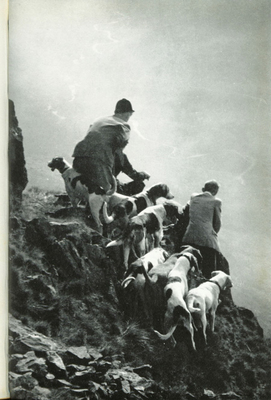
BorrowdaleIn the Lakeland District on the English/Scottish border, about four or five miles from Ambleside on the Hawkshead road is a T-junction. Turn right and the road ascends the shoulder of a small water-cut valley, finally reaching it’s destination at the Drunken Duck public house from whence a choice of routes beyond this story can be found.
The Lunesdale and Oxenholme Staghounds
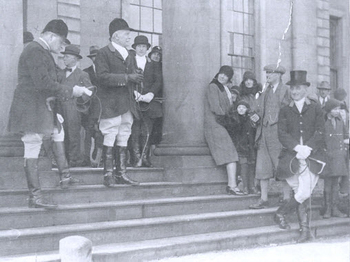
Not your ordinary fell foot pack!Don’t bother looking this one up in Baily’s! (Not to be confused with the Lunesdale Foxhounds.) The Lunesdale and Oxenholme Staghounds concluded its sporting operations upon the outbreak of World War II. The hunt was an anachronism in the Lakeland fells of northern England, and its history, as related by Ron Black in a just published fifty-eight page booklet, taught me something of carted stag hunting that I found sufficiently fascinating to relate here.