Belle Mead Foxhounds Establish New Hunt Record at Tally Ho Lake
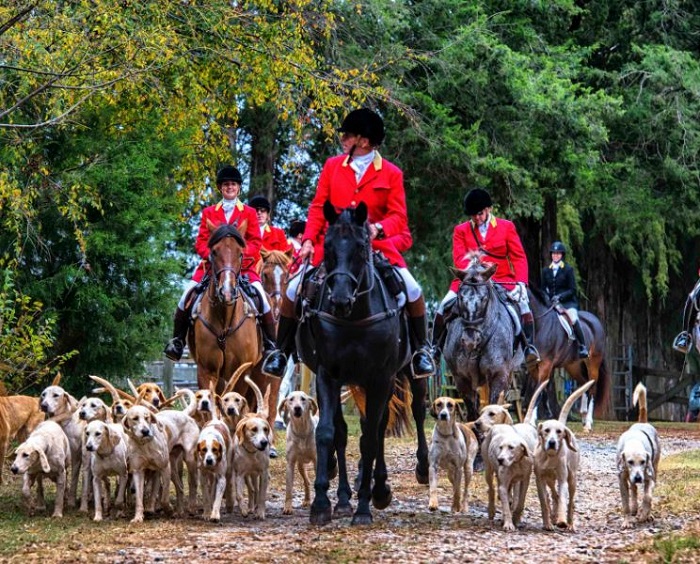
Epp Wilson leads foxhounds, staff, and field. / Reflected Glory photo
The radio crackled.“Tally-Ho coyote at the Catfish Pond headed west.”
It was the first day of our annual Joint Meet weekend with the Shakerag Hounds (GA), and we had just unkenneled 22-1/2 couple of hounds. Whipper-in John Bell had already left—standard operating procedure—to get into position for the draw and viewed the coyote away even before we put hounds in. Tally Ho Lake is in the southeast corner of our hunting territory, where only two herds of cattle remain in our entire country.
The Meath Foxhounds at Scut Fagans Pub
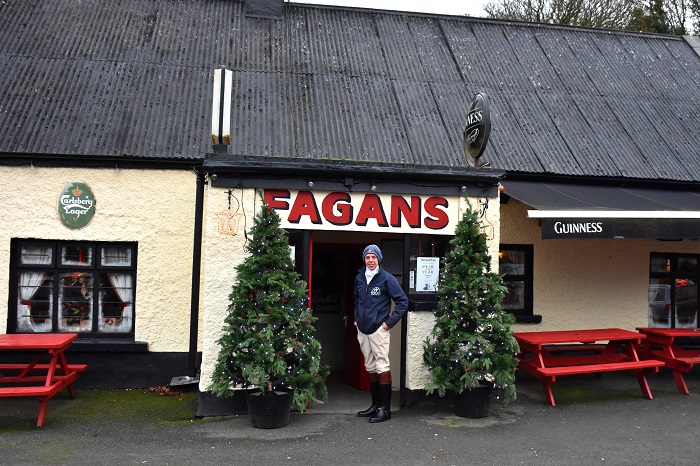
Meath Foxhounds honorary whipper-in Johnny Clarke outside Scut Fagans pub / Noel Mullins photo
Scut Fagans Pub
Those who missed the Meath Foxhounds’ meet at Scut Fagans pub in Moynalvey missed one of the best hunts of the season. But more of that later.
The pub is a step back in time and so tiny that if you are having a drink and standing against the back wall, you probably could still reach the bar! With its galvanized roof, Scut Fagans has probably been there since pre-history! It has been short-listed as one of the top eighteen Irish pubs one should visit before retiring to that great hunting field in the sky.
The North Tipperary at Loughton House
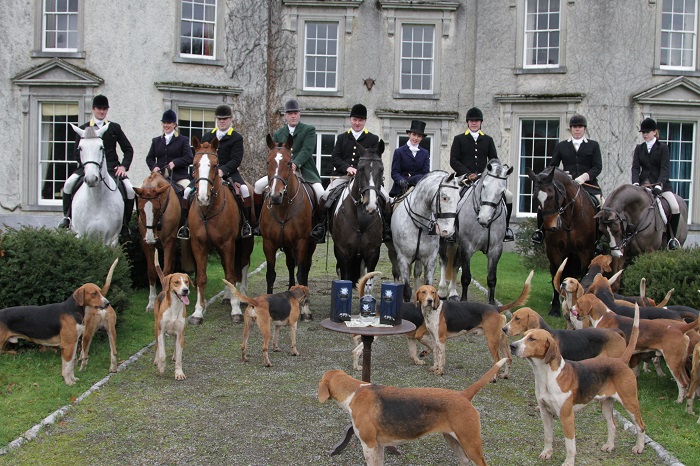
Visitor Tony Holdsworth, retired huntsman for the Duke of Beafort’s (UK) wears the green livery of his former hunt. Center is Denis Gilmartin, Master and huntsman of the North Tipperary. To the right on the gray is Rose Scanlon, mounted side-saddle. To the right again, on the gray and bay horses, are Loughton House hosts, Dr. Michael Lyons and Dr. Andrew Vance, MFH. / Catherine Power photo
It’s been a couple of seasons since we were with the North Tipperary Foxhounds (IRE). A visit was overdue, so when we heard through Arabella Scanlon whom we met last year in East Clare that a very special lawn meet was upcoming at Loughton House, we jumped at the opportunity. Set in more than a hundred acres of fabulous park and farmland in the small village of Moneygall, the eighteen-bedroom estate straddles the Tipperary-Offaly border and, likewise, the border between the North Tipperary and Ormond hunting countries.
Loughton is just a stone’s throw from Barak Obama Plaza. The U.S. President, traveling in the footsteps of his mother’s family, visited Moneygall in 2011.
In Strange New Territory
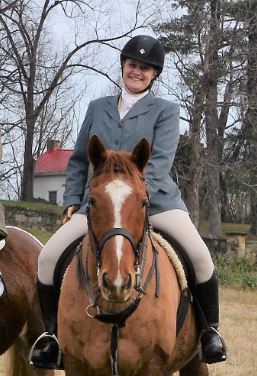
Liz Callar photoIt is hard to believe now, but at the start of the 2017 hunting season I was actually lamenting the difficulties of leaving a hunt I had been with for fifteen years and joining another. Even at the time, I realized it was a small issue in the scheme of things that can happen in life. Making new friends and riding across some breathtaking new country quickly proved to me that I had made the right decision.
That season started out well. I was hunting regularly, and in October, Karen and I traveled with the Last Chance Hounds to the Moore County Hounds Hark Forward Foxhound Performance Trials in North Carolina. By January, however, hunting was the last thing on my mind. And I never did get out after that.
Waterford Opening Meet at Historic Curraghmore
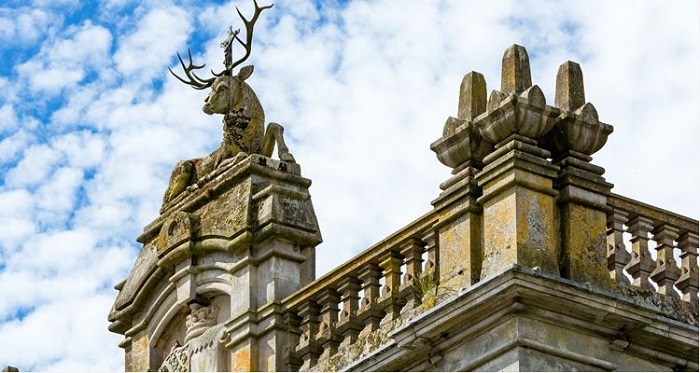
St. Hubert’s stag and the crucifix atop the medieval tower at CurraghmoreOpening meets are always special, but when it is at Curraghmore for the Waterford Foxhounds, and a lawn meet to boot, it goes beyond special. Indeed, the hunt was originally known as the Curraghmore Hounds. The estate is steeped in all things of the horse. Even as we drove in the long avenue (it must be more than a mile), race horses were being unboxed and tacked up on the gallops and schooling grounds which are widely used by trainers in that part of the country.
Curraghmore is the historic home of the Ninth Marquis of Waterford. His ancestors through his maternal line, the de la Poers (Power), came to Ireland from Wales with Strongbow and the Normans around 1170—about a century after the Norman invasion of England and about 320 years before Columbus ‘discovered’ the New World.
Hunting In the Footsteps of Irish History
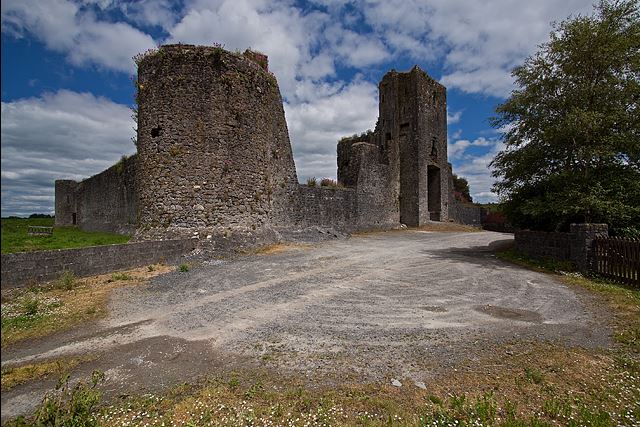
Thirteenth century Liscarroll Castle in the Duhallow hunting country, near the site of the Battle of Liscarroll in 1642.
There are certain days that stand out in the sporting calendar, Gold Cup day in Cheltenham, Aga Khan day at the Royal Dublin Show, the Maryland Hunt Cup in the USA, Munster final in Thurles (especially if Cork and Tipperary are playing), but ranking at least equal to any of these must be a meet of the Duhallow in Liscarroll. The Duhallow kennels are nearby, and huntsman Ger Withers is a native of the parish so it could be described as their spiritual home. As if all this weren’t enough, longstanding hunt chairman Pat Fleming farms nearby, and the Flemings have been farming in Liscarroll since the Battle of Liscarroll around 1642.
In Praise of the Penn-Marydel
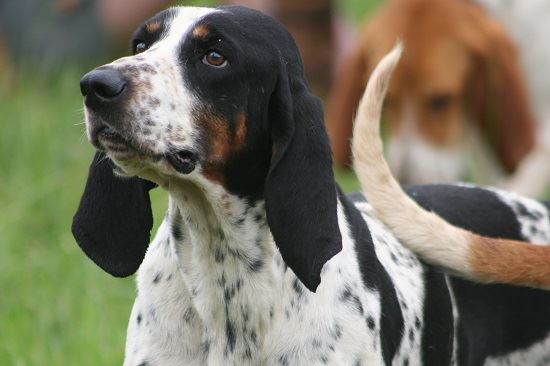
Gretchen Pelham photo
While packing hounds to the first covert on an autumn hunting morning a couple of seasons ago, I quickly noticed the absence of spider webs laying in the morning dew that so often are the bane of scenting here in the excessively drained sandy soils of my hunting country. Sure enough that harbinger proved accurate when precocious ten-month-old Dooley opened on riot, indicating that scenting conditions were indeed optimal. Whippers-in were out on point, so I had to break out my shooting iron to get the attention of the easily swayed new entry that joined the persistent Dooley.
After counting all twenty-five-and-a-half couple and telling them how disappointed in them I was, I moved from Manly Crossing and recast them into Cow Head. That particular cast was mostly to settle them down and perhaps jump another deer, as that location offers the opportunity for quick correction.
The Westmeath Foxhounds at Streamstown
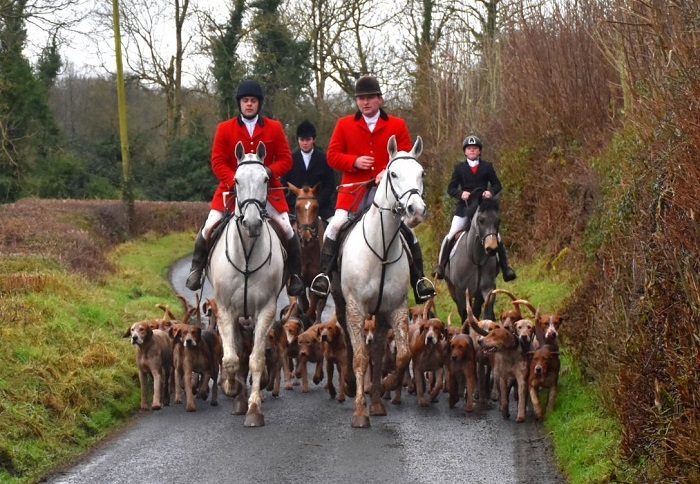
Westmeath Foxhounds (IR) and staff: huntsman Mark Ollard (rt) and whipper-in Adam Douabbse. John Smith and Frano Derwin follow / Noel Mullins photo
The Westmeath Foxhounds, located in the Midlands of Ireland, was founded in 1854. It has had many illustrious Masters over the years such as Sam Reynell (1835-91), the Earls of Longford (1890s), Hon. Kieran Guinness (1973-76), Sir Dermot and Lady Molly Cusack Smith (1949-50), and Harry Worcester Smith (1912-13) from the USA (no relation to Sir Dermot).
Smith wanted to prove that American hounds and Thoroughbred horses could handle the Irish hunting country as well as the native horses and hounds. He was disappointed on both counts. First, the Westmeath hunt committee insisted he hunt the local pack, and second, though he was a brave and competent rider, he notched over fifty falls off his Thoroughbred horses in the course of the season!
Performance Trial a Home Run at Mission Valley
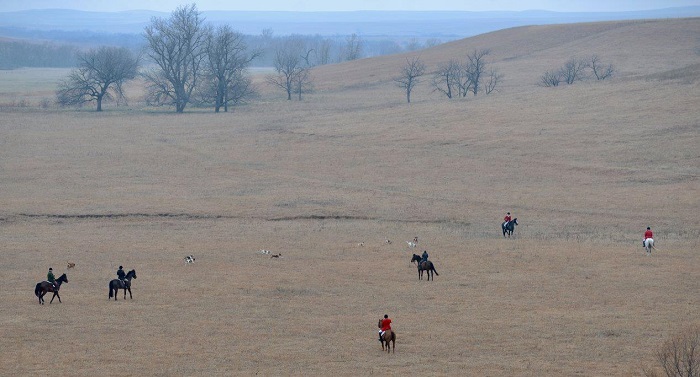
“Don’t like hobbles and I can’t stand fences; Don’t fence me in!” A song that could have been written in the tallgrass prairie of Kansas. / Julie Honsinger photo
The MFHA Hark Forward Performance Trial Series took participants to the prairies of middle America, a unique experience. I love the traditional hunt countries on the East Coast with large forests and big open fields, and I also love the totally different experiences of hunting in land where it is so wide open you can literally see for miles in every direction. Here, in the wide open expanse of the Kansas prairie, field members get to see most all of the hound work.
Mission Valley Hunt (KS) hosted this Foxhound Performance Trial over the weekend of March 2–4, 2018. Five hunts from the Midwest competed. In addition to Mission Valley, hounds were entered from Bridlespur Hunt (MO), Fort Leavenworth Hunt (KS), Mill Creek Hunt (IL), and North Hills Hunt (NE). Guest huntsman was Angela Murray, MFH, Red Rock Hounds (NV).
March Madness Joint Meet with Bull Run and Farmington
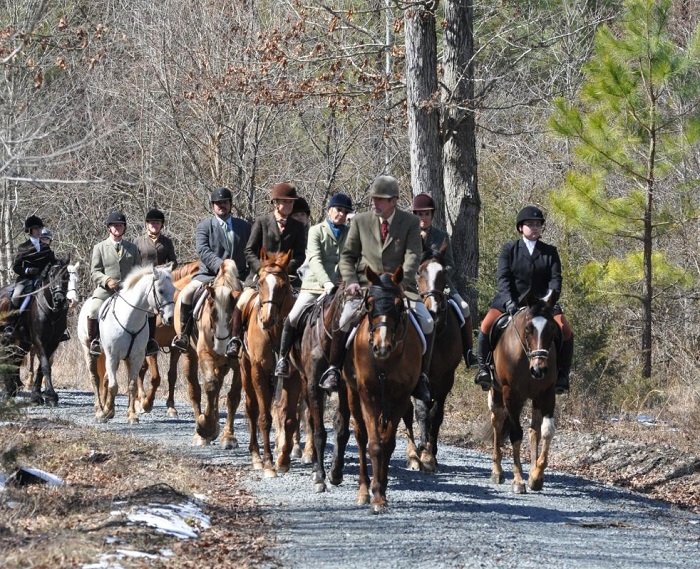
Retired Bull Run huntsman Greg Schwartz leads the second flight. / Elizabeth H. Sutton photoFarmington Hunt’s participation in March Madness Week at Bull Run Hunt started with a lot of questions. Hounds had not hunted in a week. Would they be up to the task of more open country and multiple game—fox and coyote? Did they have what it takes to give the sporting Bull Run field and their March Madness visitors a good day’s hunting? Would renegades riot?
These questions nagged at some of the Farmington Hunt members and staff as we assembled at Horseshoe Farm in Rapidan, Virginia with twelve-and-a-half couple and a good gang of members. Three huntsmen and former huntsmen from further north said to me, “Well, you all will have to up your game today,” as we kidded about the lack of action that had been experienced on the three previous days due primarily to the weather.