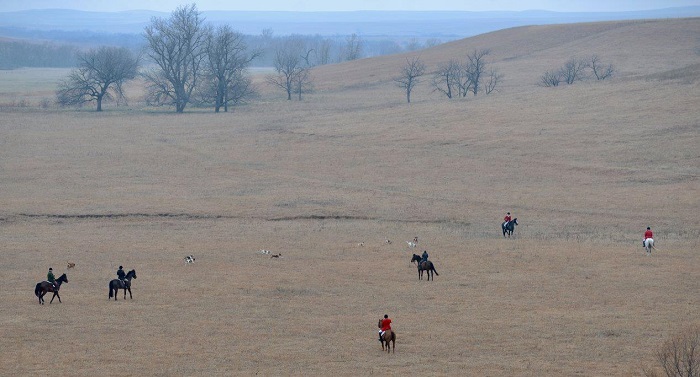
 “Don’t like hobbles and I can’t stand fences; Don’t fence me in!” A song that could have been written in the tallgrass prairie of Kansas. / Julie Honsinger photo
The MFHA Hark Forward Performance Trial Series took participants to the prairies of middle America, a unique experience. I love the traditional hunt countries on the East Coast with large forests and big open fields, and I also love the totally different experiences of hunting in land where it is so wide open you can literally see for miles in every direction. Here, in the wide open expanse of the Kansas prairie, field members get to see most all of the hound work.
Mission Valley Hunt (KS) hosted this Foxhound Performance Trial over the weekend of March 2–4, 2018. Five hunts from the Midwest competed. In addition to Mission Valley, hounds were entered from Bridlespur Hunt (MO), Fort Leavenworth Hunt (KS), Mill Creek Hunt (IL), and North Hills Hunt (NE). Guest huntsman was Angela Murray, MFH, Red Rock Hounds (NV).
On Friday night, participants were treated to a wonderful reception hosted by Mission Valley at their clubhouse, the Fin and Feather Club, and led by organizer Dr. Jane Jeffries, MFH. As Head Judge, I reviewed scoring procedures in preparation for the first day’s meet at this, Mission Valley’s primary fixture. Master Jeffries explained how in 1984, a group of hunt members purchased a former gun hunting club contiguous to land owned by a Mission Valley member here in Miami County, Kansas. That eight-hundred-acre fixture is now home to the Mission Valley clubhouse and kennel. In 2002 the property was converted to a Kansas Land Trust property, limiting future development.
The clubhouse was renovated since my previous visit, and it served as the perfect place for the welcome dinner, judges’ meeting, and lunch after the first day’s hunt. In addition to his many talents in the hunting field, kennelman and whipper-in Ryan Beer is also an outstanding cook! His smoked Boston butt, the main feature of the welcome dinner, was delicious.
Day One
A much-needed rain had fallen the day before the first meet, so conditions seemed good. Hounds met at the clubhouse which sits on top of a hill. The wind and cold quickly chilled this Georgia foxhunter to the bone. Many wore scarves and ear muffs. Even with gloves, my fingers wouldn’t work right. It felt like there was nothing between that hill and the North Pole but a four-strand barb wire fence with three broken strands. However, we went from cold and shivering to hot and steaming in record time.
Master Jeffries did just as huntsman Angela Murray requested: she took us to the best covert first. The coyote popped up as we approached the covert before hounds even began drawing. The first ten hounds were sight chasing before they ever put their noses to the ground. We were all off and running like scalded cats, due north. The Fin and Feather hunt country is beautiful and large with the kennels and clubhouse right in the middle. Finding a coyote right in the middle also meant that, if the coyote ran straight for very long, it would run right out of the country. My group judging on the left flank was even with the lead hounds until they took a hard right, where we got thrown out and had to play catch-up for the rest of the run. We found out the hard way that the radios we brought didn’t communicate with Mission Valley’s radios. Thank goodness David “Dude” Kruger, huntsman from North Hills, had his tracking unit. That was the only way we and the field knew where the pack had gone. They ran due east all the way to New Lancaster Road where they had to be stopped at a property line. We regrouped there and drew on for another coyote.
Huntsman Angela Murray picks up the story: “Hound 33 [Mission Valley Belle] worked through a large covert, then she came out of the covert, picked her way across the pasture and through the second covert. Ryan and I watched as the coyote broke out of the covert first. Then came the hounds who were still trailing with Hound 33 in the lead. Then she opened strongly and led the way across the field. It was really cool how respected she was in the pack. Every single hound came and honored her after only forty-five minutes of hunting together. Scent was pretty spotty and Hound 33 kept sorting out checks and leading the way. With scent failing and temperatures rising we lost him completely. She was considered strongly for Huntsman’s Choice.”
After a “Whoopie Wagon” stop in a bean field, we drew on west and got more hunting and trailing scores. One coyote line went for about a mile through beautiful rolling country, and hounds checked on a windswept hilltop. Then they cast themselves back into the woods they had just come out of. They then trailed down to the riverbank and appeared to be marking something to ground. We jumped off our horses and ran in on foot hoping to find that they had put a fox or coyote to ground and we could get some marking scores. The river bank was about twenty-five feet high—straight down except for a small ledge under the root ball of a big tree. We found a den but it was way too small for a coyote or fox. In hindsight, we think the coyote crossed the windswept hilltop where scent was blown away. We know that hounds checked there. Then they apparently trailed some other critter to the small den on the riverbank.
We drew toward home and, with rising temperatures and failing scent, couldn’t find anything fresh enough to run, so we decided to head in. We had had fine sport with lots of good scores. Angela blew “Going Home,” and the entire field cheered her and the hounds for a great day. Field Master Nick Badgerow did a fine job keeping the field close to the action. Hunt country topography can make a big difference in how huntable a fixture is and how enjoyable it is crossing the country. The Mission Valley topography was a perfect mix of wooded coverts, open fields, and both gently rolling and steep hills.
The first day’s scores were announced at an evening reception hosted by Mission Valley members John and Janet Bennett at their beautiful home. All competing hounds received scores for the first day and each of the five participating hunts had at least one hound among the top ten. Fort Leavenworth Tracker 2010 won the first day totals and the high point pack for the first day went to Bridlespur.
Day Two
The alarm went off even earlier as we had a nearly two-hour drive to the meet (as compared to two minutes on Day One). But it was well worth it! About twenty trucks and trailers caravanned from Paola to the Flint Hills. We had enough personnel, equipment, and horses to invade and occupy a small country! It was thrilling to see so many people so pumped about going hunting in the prairie…about going hunting anywhere. The further we drove, the more wide open and beautiful the countryside became.
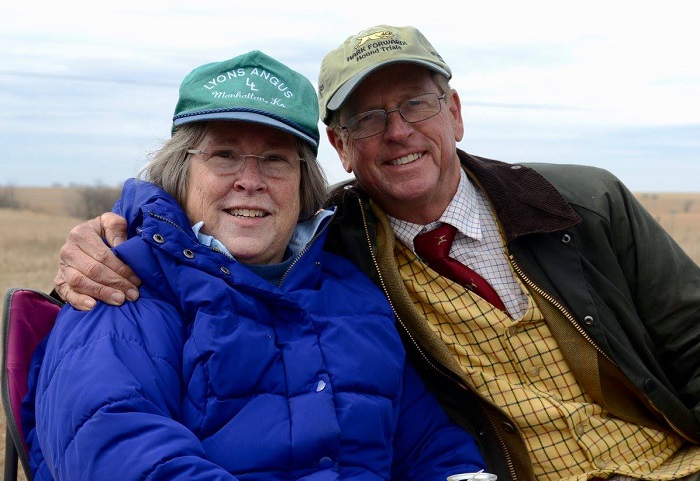 Hark Forward Trials Chairman Epp Wilson and Mrs.Virginia Miller, whose family has owned the Mashed O Ranch for over a hundred years. / Julie Honsinger photo
We met at the fabulous Mashed O Ranch. This fourteen-thousand-acre ranch has been in the same family for over a hundred years. The matriarch of the family, Mrs. Virginia Miller, was the most delightful lady. She and her longtime farm manager and his wife were as warm and gracious as they could be. It was obvious that they loved the land—and there was a lot of it—and they loved sharing it with us foxhunters. They normally run about eight hundred head of cows and calves year-round, and they bring in an additional couple thousand head in the spring and summer.
The first draw was southerly, then west from the meet, which was in the northwest corner of the ranch. Hounds surprised us when they hit a line going due north and did a beautiful job of working it in the wind. That line played out pretty quickly, and we drew on to the south. Hounds hit and missed for a bit before settling on a line. The run quickened as hounds drew closer to the quarry.
As beautiful as this prairie is, there are lots of ditches hidden in the tall grass this time of year. Everyone had to be on their toes—riding hard to stay with hounds, but alert and ready to quickly negotiate a blind ditch at the bottom or on the sides of the hills. This coyote ran east for a mile and then followed the drain south for another mile until hounds had a major check at a fork in the valley. There were a lot of trees in this particular valley so we judges couldn’t see exactly what was happening. Only Guest Huntsman Angela recognized the split, as we learned later.
The main pack charged east. Angela and her guide, Ryan Beer, galloped on south with just seven hounds. The main pack checked briefly at a county gravel road, then continued on east. We had to gallop a quarter mile north to get to a gate to cross the road. Dude again came to our rescue with his handheld tracking unit and got us going straight to the running pack in the next big valley. With Angela accompanying the other half of the pack, I was asked to take the horn for the group of hounds the field and I were following. Those hounds worked another quarter mile, checked and circled, and worked out the line beautifully. Hounds worked north up the drain until our hosts decided that we should gather hounds and carry them to Angela’s group.
Once reunited, we learned that Angela saw the coyote break out of the covert with only seven hounds on him. They ran him well over two more big fields to the southwest.
“Hound 61 [North Hills Lyse (pronounced Lease)] was leading the race as the seven hounds got up close to the coyote. The hounds caught up to their coyote, but did not bring him to bay,” Angela said. After crossing another hill, hounds lost near a pond. As they were about to run out of the country, it was a good spot to collect them and meet up with the rest of the hounds and us. “Hound 61 worked through some really hard checks and kept going,” Angela said. “She would be running with her head down, following the line, then rock back and look ahead. Smart hound!”
With hounds all together again, we drew on toward the trailers, hitting and missing along the way, but not finding a line fresh enough to run. Angela blew “Going Home,” after which the field applauded her again. Field Master Nick led the field in shouting three cheers for Angela. We had just ended two great days of outstanding hunting in some of the prettiest hunt country in America.
Bridlespur Gin had the top score for Day Two, and Bridlespur Hunt once again took top honors for the day. Overall, Leavenworth Tracker was the high-scoring foxhound over the two days of hunting and Bridlespur Hunt was the overall top-scoring hunt. Click for complete scores of all hounds hunts for each day and overall totals.
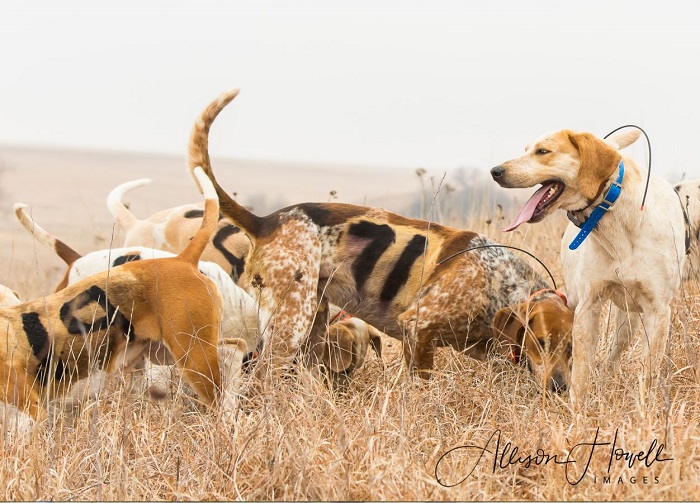 Fort Leavenworth Tracker 2010 (#71) was overall High Point foxhound after two days of hunting. / Allison Howell photo
“Tracker is a handsome guy and a solid citizen that never stopped going,” said huntsman Angela Murray. “This dog made an effort to always be in the right place at the right time. Nice hound. Good job, Fort Leavenworth!”
Tracker goes back three generations in tail male to Arapahoe breeding and in tail female to an Arapahoe dog hound. Otherwise, it’s all Fort Leavenworth bloodlines. Fort Leavenworth Master and huntsman Dr. Steve Thomas credits former huntsman H. Lee McGuire for establishing Tracker’s bloodlines and former huntsman Stephanie Wilcox for Tracker’s breeding and training.
“This is my second season as huntsman, and I inherited a wonderful pack of hounds,” writes Thomas. “Tracker is usually the first to find the line and always honest. He’s a joy to hunt but also a fabulous teacher for my younger hounds. At the end of his eighth season, he hunts as hard as any hound in the pack.”
Eight seasons of hunting is beyond the average expected working life of a foxhound. Yet Tracker ratified Thomas’s statement by finishing overall with the highest score in the Endurance category of all hounds that competed. The Performance Trial scoring program automatically increases point scores as the hunting day progresses, thus rewarding those hounds still working later in the hunting day for their endurance. For an eight-season hound to win the overall Endurance category as well as finishing with the top overall score is an achievement worth noting. Fort Leavenworth Tracker has to be one tough dog hound!
Huntsman’s Choice is a huge honor. This is the hound that the guest huntsman would most like to take home. Angela’s pick for Huntsman’s Choice was North Hills Lyse, Hound 61.
“She is my type of hound—light, fast, young…third season,” said Angela. “She never stopped working the entire time—both days. Any time hounds were working, she was in the middle of it. She carried the line all by herself after the big split on the second day. She sorted out several checks and got it going for the pack time and time again.”
“I was super impressed with the way that all the different styles of hounds worked so well together. Mission Valley put on a great party. They were very generous with their time and really made an effort to make it a monumental event. It was great recognition for the Midwest to have this major Hark Forward event at Mission Valley,” concluded Angela in her remarks.
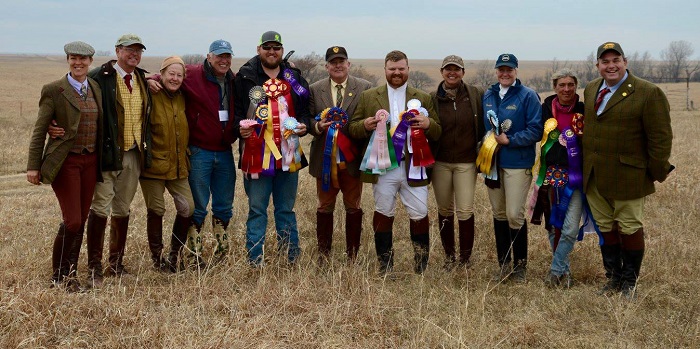 (l-r) Judith Craw, Hark Forward, Hound Trials (HFHT) Committee; Epp Wilson, MFH, Belle Meade, HFHT Chairman; Jean Derrick, Belle Meade, former MFH, Whiskey Road and Edisto, HFHT Hon. Sec.; Grosvenor Merle-Smith, ex-MFH, Tennessee Valley, Golden Vale, Bull Run, Judge; Dave “Dude” Kruger, Prof. Huntsman, North Hills; Col Mark French, USA Ret. and MFH, Fort Leavenworth; Angela Murray, MFH, Red Rock, Guest Huntsman; Brenda Yost, Prof. Huntsman, Mill Creek; Eleanor Hartwell, Prof. Huntsman, Bridlespur; David Twiggs, MFHA Exec. Dir. and Judge.
In Closing
The first day we had more deer in three hours than we’ve seen at the performance trials all season, and not one hound came out on a deer. Most of these events have had an incident where at least a couple of hounds come out on a fresh deer line, think about running it for a moment, but turn back when corrected. This time, we did not have a single hound even think about running a deer line. The second day we did not see a single deer!
The new scoring system worked very well again. It’s so valuable to have results right after lunch while everyone is still together and can enjoy the awards ceremony. MFHA Executive Director David Twiggs and I were discussing what it was like before we had the new computerized scoring system. Results often took four-plus hours to compute, people got restless, and many left because they had to get on the road. With the new system, results are available while the energy level is still high. And everyone gets to hear the guest huntsman offer a perspective on the hounds and tell us in detail about his/her pick for Huntsman’s Choice.
With the scores computed so quickly, the Day Two awards ceremony becomes the grand finale of the whole event. There have been trials where results took many hours to compute due to internet access issues, and it still amazes us to produce printed results in the middle of a cattle field on a ranch in the middle of a Kansas prairie in the middle of the country! For further information about how the computer scoring system processes the scores, please contact me.
I have been hearing about the Flint Hills for many years. Everyone who has hunted there goes on and on about how great it is, but I never quite understood what was so special about the Flint Hills…until now.
The tallgrass prairie is set among low rolling hills of limestone strata that cover layers of sandstone, flint and chert, stretching to the horizon in every direction. There are a few trees along the streams, but most of the pastures are one hundred percent grass with no trees, and the occasional arroyo or dry ditch. It is an interesting mix of gently rolling hills, with the occasional steep hill or drop off. Most of the bottom land is suitable for and has been used for row crops. The hillsides and hilltops are too rocky to row crop, so the grass has been there for eons.
All hunts that have hosted performance trials know how much work it is. And how much of a team effort it takes to make it successful. Mission Valley Masters and members truly hit a home run with this performance trial. The country, the sport, the hospitality, and the fellowship were all top drawer. Click for more information about the Mission Valley Hunt.
Posted April 17, 2018