Dakota Slew Retires Rokeby Bowl at Piedmont
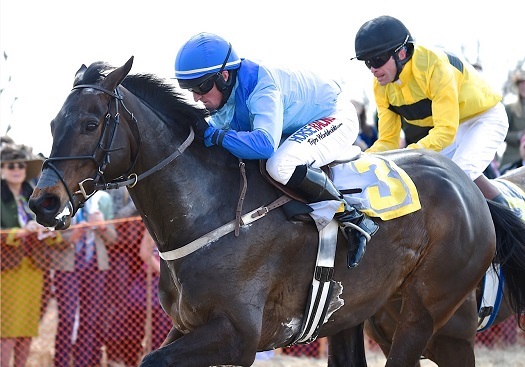
At the finish of the Open Timber Race it’s Dakota Slew (Robbie Walsh up) 1st, Dr. Alex (Teddy Zimmerman up) 2nd. / Douglas Lees photo
Dakota Slew and Dr. Alex battled for the lead throughout most of the Open Timber race, even jumping the last fence abreast, but at the wire it was Dakota Slew by a length. It was Dakota Slew’s third win in this race under rider Robbie Walsh, thus retiring the Rokeby Bowl for owner Maggie Bryant. Trained by Richard Valentine, Dakota Slew is one of six horses that tied for Leading Timber Horse in Virginia in 2014.
The Valentine-Walsh team scored their second win of the day in the Open Flat Race with Clark Ohrstrom’s Kisser N Run taking the lead from Preachers Pulpit with less than a half-mile to run and winning easily. Kisser N Run was the 2013 Life’s Illusion Filly and Mare champion, and last season’s winner of the Atlanta Steeplechase’s Georgia Cup.
Fout and Galligan Dominate Hurdles at Warrenton
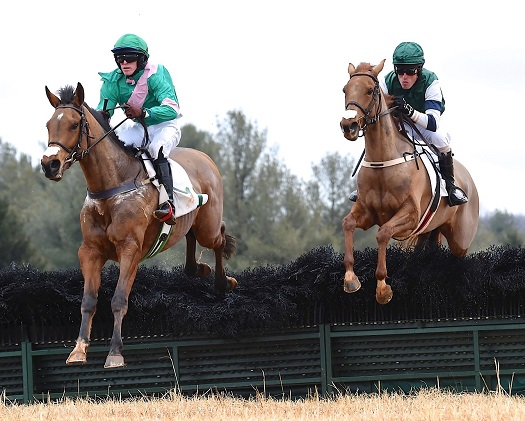
Open Hurdle: (l-r) Doug Fout-trained Papriformer (Gerard Galligan) finished first and Storyville (Kieran Norris) placed second / Douglas Lees photo
Trainer Doug Fout and jockey Gerard Galligan monopolized the hurdle races at the Warrenton Hunt Point-to-Point at Airlie Race Course on Saturday, March 14, 2015. Fout and Galligan swept all three hurdle races as well as the Open Flat Race.
With the Thornton Hill and Blue Ridge Races postponed, Warrenton’s was the first Virginia hunt race to go off as scheduled this wintry spring season. Because of the deep going, the race card was abbreviated, and the courses were modified.
What Foxhunters Can Learn from Eventers
In the last issue of FHL WEEK, Kate Samuels wrote about what eventing horses can learn by going foxhunting. Your editor was reminded of an article we published back in 2010 that turned that question on its head somewhat. We had asked Olympic three-day medalist James Wofford what foxhunters can learn from eventers. As we are now in that part of the hunting season when a traveling fox may take us for the longest and most arduous run of the season, we thought it would be worthwhile republishing Wofford’s advice.
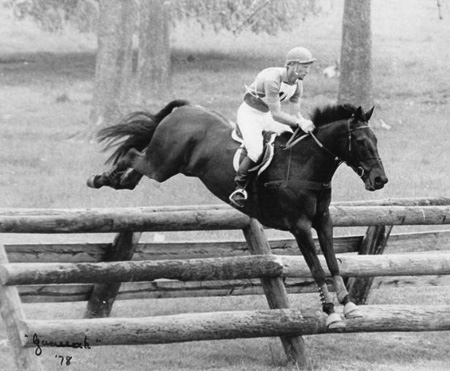
James Wofford on Carawich, 1978 / Gamecock photo
For most of us field members, perhaps one of the greatest single factors influencing the joy we experience in a day’s hunting is our riding ability. The more competently we are able to cross the country on our horse, the closer we come to a totally fulfilling experience.
Since eventers know just a bit about crossing the country, we asked instructor, team coach, author, and Olympic medalist James Wofford to discuss some of the principles of his particular discipline and how they might be applied to the hunting field.
A 3-Day Eventer Goes Foxhunting
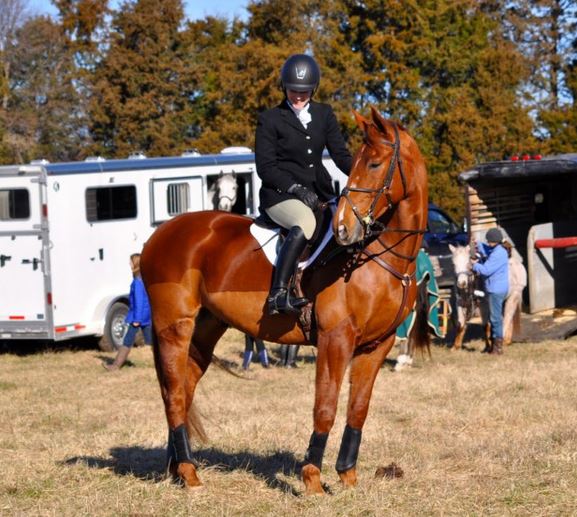
Handsome Leo and the author go hunting. / Joe Samuels photo
In England and Ireland, it’s de rigueur for eventing horses of all levels to spend their winter season in the foxhunting field, but in the U.S., not so much. In this country, the hunt field is not necessarily where young eventing enthusiasts start their passion for galloping at hedges and coops, or where young horses find their balance and footing across varied terrain.
We reap the benefits when we import sensible Irish horses that have already been out for two seasons at the age of five, but it is certainly less common than it used to be to find crossover between the two disciplines.
Leo, I decided, was going to take the old-fashioned route to finding his cross country talents; we were going to foxhunt. He had come an incredibly long way in the eighteen months that I owned him, in both cross country acumen and fitness for the activities required in eventing, but there was still something missing.
Piedmont Pair Are 2014 Field Hunter Champions in Virginia
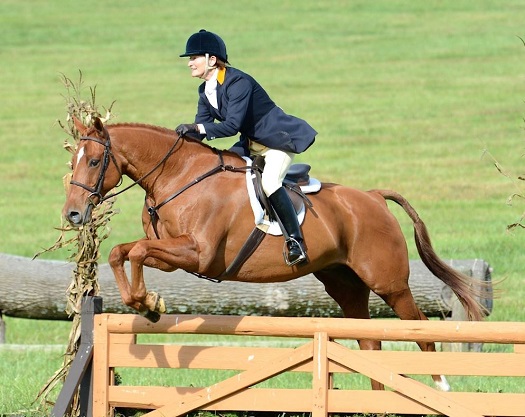
Laurie Ambrose and Stretch from the Piedmont Fox Hounds won the 2014 Mrs. Theodora A. Randolph Field Hunter Championship. / Douglas lees photo
In a hark back to bygone days, the Theodora A. Randolph Field Hunter Championships combine a whirlwind week of foxhunting and socializing against a backdrop of sporting estates, well-bred foxhounds, and passionate foxhunters. Always held the last week of September and ending the first weekend of October, this year’s event attracted seventy-four entries with a brilliant card of hosting hunts: Orange County Hounds, Blue Ridge Hunt, Loudoun Fairfax Hunt and the Piedmont Foxhounds. Judges ride alongside the field to observe the competitors in action before selecting several riders each day, based on how well their horses performed, for the finals on Saturday. Every hunt hosted a tailgate, and there were social functions every evening.
Foxhunters from twenty-two hunts and eight states rode in the event: Andrews Bridge, Belle Meade, Blue Ridge, Bull Run, Casanova, Deep Run, Elkridge-Harford , Farmington, Glenmore, Hillsboro, Keswick, Loudoun Fairfax, Lowcountry, Middleburg, Newmarket-Middletown Valley, Old Dominion, Orange County, Palm Beach, Piedmont, Snickersville, Warrenton, and Whiskey Road. Riders came from Florida, Georgia, Maryland, Pennsylvania, South Carolina, Tennessee, and Virginia. The six judges were Helen Brettell, Middleburg; Snowden Clark; Liz McKnight, ex-MFH, Elkridge-Harford; Ginny Perrin, MFH, Deep Run, and the husband-and-wife team of Lincoln Sadler and Cameron Sadler, MFH, Moore County.
Remembering the Irish War Horse
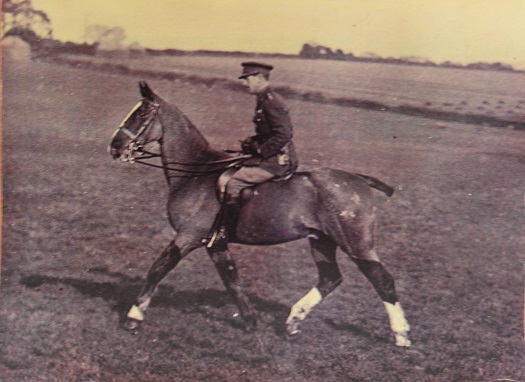
Fascinated by our summer series of articles about the WWI war horses on the occasion of the centennial of that horrific conflict, Noel Mullins, a regular contributor to Foxhunting Life, sent us this story that he wrote for this year’s Souvenir Programme of the Dublin Horse Show. Noel is a Member of the Royal Dublin Society Library & Archives Committee. His story is about Gladeye, a field hunter that went to war, survived, and returned to jump at the Dublin Horse Show in 1926.
War Horse Gladeye and Brigadier Walter Brooke
This year marks the centenary of World War I, and ceremonies around the world remember the nine million human casualties lost in the conflict. But it is often forgotten that eight million War Horses also lost their lives, going through the most terrifying experiences known to any living creature. War was declared on the July 28, 1914 and was expected to end by Christmas 1914, but sadly it lasted another four years until November 11, 1918.
Probably the two most well known Irish War Horses in history were Emperor Napoleon’s white horse Marengo and the Duke of Wellington’s Copenhagen who met at the Battle of Waterloo. Both are said to have been purchased at an Irish horse fair. War Horses in the mounted cavalry units were deployed in many battles in the first years of WWI, amongst them, the battles of Mons, First and Second Battles of Ypres, Festubert, Aubers Ridge, Marne, Vimy Ridge, the Somme Hill, and Cambrai.
The Lathom Remount Depot of World War I

The horror of the First World War is much on the minds of our English sporting friends this summer as the world marks the hundredth anniversary of that conflict. Foxhunters there are especially moved in remembering the terrible toll taken on the world’s equine population in numbers unequaled before or since. Ron Black in Cumbria, […]
A Horse Did That

Each summer, before Saratoga gets rolling in August, the advance teams arrive and get to work. Here’s what it was like for Joe Clancy. Lucky there was a horse around to help.
OK, breathe.
As usual, I spent the first two days of the meet hassling through any number of issues including—but by no means limited to—computer networks, the Internet, advertisements, articles, photography, housing, office space, bicycles, paper racks, paper boxes, a new printer.
Then came distributiongate and what now seem like days (but merely hours I guess) of telephone calls and discussions and wonder and angst. In the end, it all worked out. The computers communicated with everything. The ads showed up. We finished the first paper, we weathered a storm.
T’Breds Perform Gymnastic Feats at Elkridge-Harford Races
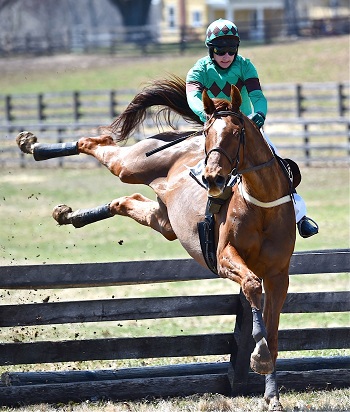
Hold Your Fire (Gus Dahl up) went on to win the Open Timber Race. / Douglas Lees photoThe ultimate equine athlete—the Thoroughbred—saved the bacon for at least two riders at the Elkridge-Harford Point-to-Point Races at Atlanta Hall Farm, in Monkton, Maryland on Saturday, April 5, 2014.
In the first race, Open Timber, Hold Your Fire led the field into the last fence, where he caught his right front on the top rail. Robbed of momentum, he twisted his rear end fully ninety degrees to get his hind end over. Rider Gustav Dahl stayed in the middle, and the pair went on to win the race. Click on Doug Lees’s brilliant photograph to see the three-shot sequence.
This was trainer Elizabeth Voss Murray’s first of two wins on the day. Ms. Murray, daughter of the late Tom Voss, is a new Master of the Elkridge-Harford Hunt.
Why We Cover the Hunt Races
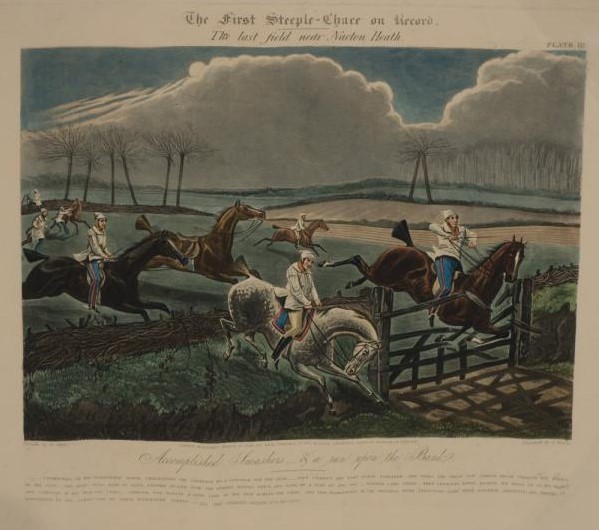
The first point-to-point race of the 2022 season is scheduled in Virginia for March 5 (rain date, March 12). The eighth and final hunt point-to-point of the season will be run on May 1. Foxhunting Life reports on most of these jump races as the season progresses. Some readers across North America might wonder why.
My answer is threefold: first, the very notion of a steeplechase race originated with foxhunters; second, many of our great field hunters have come from the ranks of the timber horses and conversely, many of the best steeplechase horses have their start in the hunting field; and third, most of the steeplechase jockeys are foxhunters as well.