Point-to-Points: Rappahannock Back in the Race
Lauren R. Giannini photo
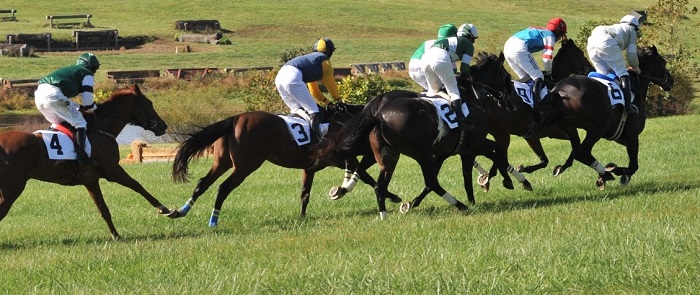
In a reversal of fortune for the sport of jump racing, the Rappahannock Point-to-Point Races are once again back on the race schedule after a twelve-year absence with a brand new racecourse. Good news for race enthusiasts!
The revived Rappahannock hunt races, last run in 2008, are scheduled for Saturday, March 7, 2020, over a brand new steeplechase course at Larry Levy’s Hill Farm, Route 522 North, just outside Culpeper, Virginia. What follows is a ”welcome-back” for Rappahannock’s return—Virginia’s season opener—as well as a kickoff to the upcoming hunt race season for all race goers. If you’re a hunt race official at your hunt, you might even find some new ideas from Rappahannock’s creative fee plans.
Cleveland Bay Reunion 2019
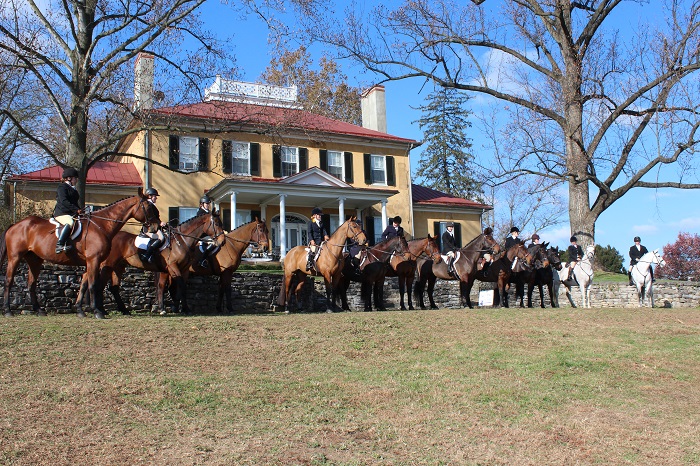
Twelve of the seventeen Cleveland Bay purebreds and crosses pose at the annual Cleveland Bay reunion before Farnley house in White Post, Virginia. / Karen Kandra photo
Cleveland Bay owners, breeders, and fanciers were privileged to travel back in time to recreate the heyday of this handsome, versatile, yet endangered breed of equine on November 16, 2019. The reunion combined with a meeting of the Blue Ridge Hunt is so appropriate at Farnley Farm in White Post, Virginia.
In the 1930s and 1940s the late Alexander Mackay-Smith bred both pure Cleveland Bay horses and partbreds at Farnley for use as field hunters. He remains the only North American breeder to have exported a stallion back to the UK from whence the breed originated. His stallion, Farnley Exchange, still appears in the pedigrees of most Cleveland Bays living in the world today.
Mackay-Smith’s daughter, Hetty Mackay-Smith Abeles, and her family welcomed the Blue Ridge Hunt subscribers, guests, and seventeen purebred and partbred Cleveland Bays to Farnley for the annual event. Mackay-Smith was a Master of Blue Ridge in the mid-twentieth century. Mrs Abeles and her family continue to breed their well-known Farnley Ponies there, based on bloodlines started and proven as early as the 1930s.
Reliable Staff Horses Don’t Grow On Trees
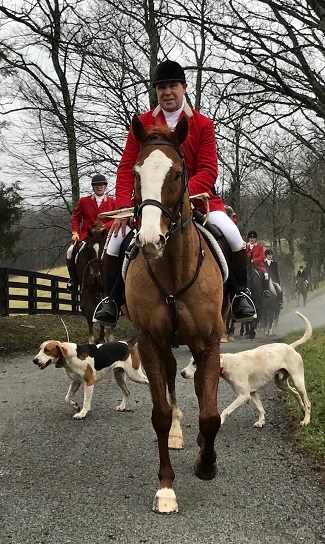
Camargo Huntsman, Andy Bozdan / Carla Babcock photoI guess I shouldn’t be surprised that some folks think of the staff horse that the huntsman or whipper-in is riding as just another horse. So before all the ‘egg spurts’ chime in, let me explain a little about the staff horse. Just imagine getting a jumping racehorse fit and ready for a race—weeks and months of preparation and hardening plus schooling over fences until the day arrives and the horse is off to the races.
Now think about getting a horse, if not racing fit, then pretty darn close to it, and not having one big race every couple of weeks but going out maybe twice a week and running for four to five hours. And in all weather, fair or foul. In the case of the huntsman, keeping up with hounds no matter the obstacles faced; in the case of the whipper-in, staying with or even getting on ahead of hounds in the ordinary course of the job. The staff horse puts in many more miles on a hunting day than does the field hunter. That is what’s required of it. No options.
How Horses Sleep

by Bill Fish
Do horses really sleep standing up or must they lie down? Can they dream like humans do? How many hours of sleep do they need on a daily basis? How are horses’ sleeping habits the same or different compared to those of other large animals?
Like cattle and some other animals, horses are capable of sleeping in a standing position. Sleeping while standing is beneficial because it tricks potential predators into thinking the animal is awake and less vulnerable. The ability to sleep while standing is due to a series of leg ligaments and bones called the “stay apparatus” that allows certain large animals, such as giraffes and zebras, to lock their legs.
Horses do not do all of their sleeping standing up. Horses engage in light sleep while standing, but cannot experience REM sleep unless they lie down. Horses regularly take short naps while standing throughout the day, which is likely the reason some people assume horses always sleep standing up.
Senior Senator Retires Maryland Hunt Cup
Photos by Douglas Lees
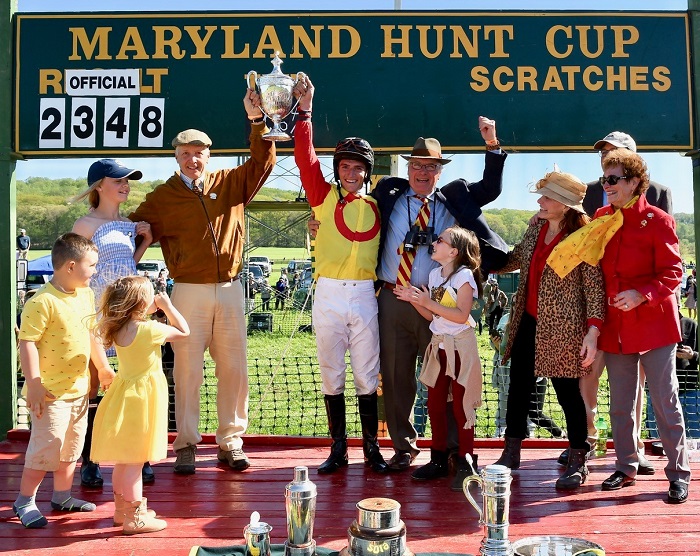
Trainer Joe Davies and jockey Eric Poretz hoist the Maryland Hunt Cup in jubilation as owner Skip Crawford, MFH, fist-pumps Senior Senator’s 3rd victory in the 125th running of the Maryland Hunt Cup to retire the trophy. Potomac Hunt Joint-Master Vicki Crawford is at far right.
In a heroic come-from-behind effort exacerbated by a momentary heart-stopping mishap, Senior Senator battled back and claimed the fruit of a four-year quest. Owner Skip Crawford, MFH, Potomac Hunt (MD) now takes permanent possession of the Maryland Hunt Cup—arguably the world’s crown jewel of timber racing—which he can place alongside the Grand National Challenge Cup which Senior Senator also retired just last week in Butler, Maryland.
Blue Ridge Hunt Point-to-Point: Family Day In the Country
Photos by Joanne Maisano
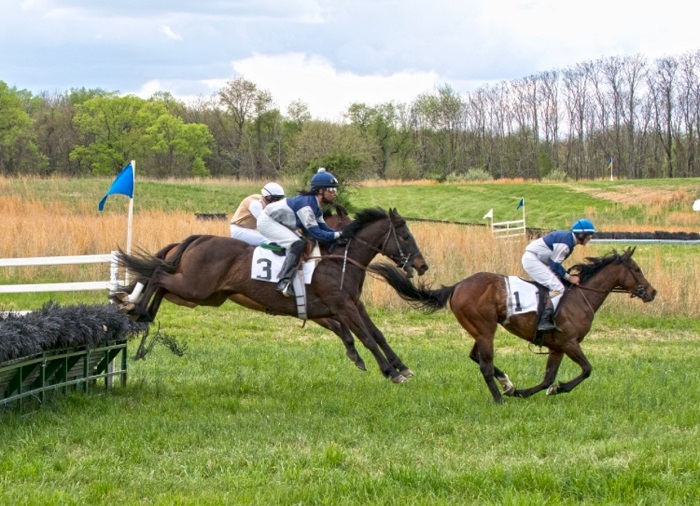
Maiden Hurdle (r-l): Number 1, Keoni (Woods Winants up) wins on a DQ; Number 3, Scrappy Warrior (Mike Woodson up) loses rider at the last fence.
Blue Ridge’s warm spring race day on Saturday, April 21, 2019 was a welcome change for those who hark back to those cold, blustery days on the Woodley hillside in early March when the races were formerly held.
In the first race of the day, Maiden Hurdle, trainer Michael Pearson saddled two strong horses, Keoni and Scrappy Warrior. With seasoned amateur jockey Woods Winants on Keoni and Mike Woodson on Scrappy Warrior, the Pearson team shared the pacesetting until the last fence when Scrappy Warrior stumbled and lost its rider. Racing to the stretch, Shannon Hill Farm’s All Out of Aces with 2018 leading jockey Barry Foley aboard grabbed the lead. Keoni battled back but All Out of Aces was first at the wire, then disqualified for cutting a pole and being off course. Keoni was declared the winner. Big E, ridden by Kieran Norris and trained by Julie Gomena placed second.
Senior Senator Retires Maryland’s Grand National Challenge Cup
Photos by Douglas Lees
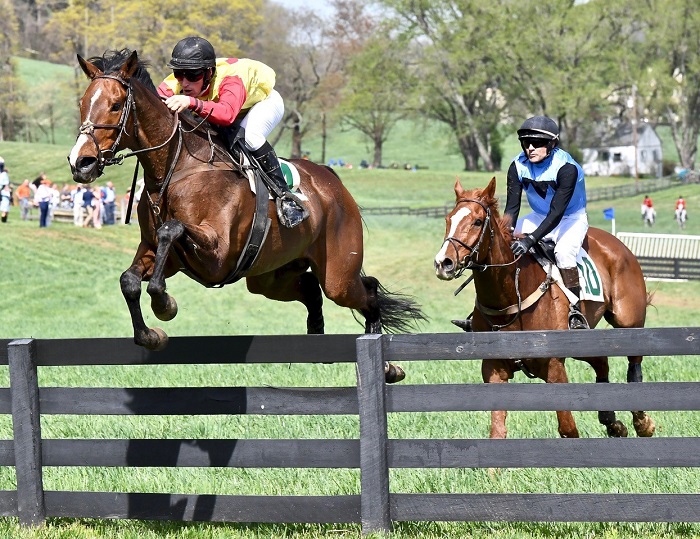
Senior Senator (Eric Poretz up) and challenger Monstaleur (Forrest Kelley up) at the last fence.Potomac MFH Skip Crawford’s Senior Senator won his third straight Grand National Point-to-Point—a three-and-a-quarter mile race over timber in Butler, Maryland—in a dominant finish to retire the challenge cup. The horse also has two legs up on the Maryland Hunt Cup and will be gunning to retire that trophy next Saturday in Glyndon.
How Randy Rouse’s National Fence Saved Steeplechasing
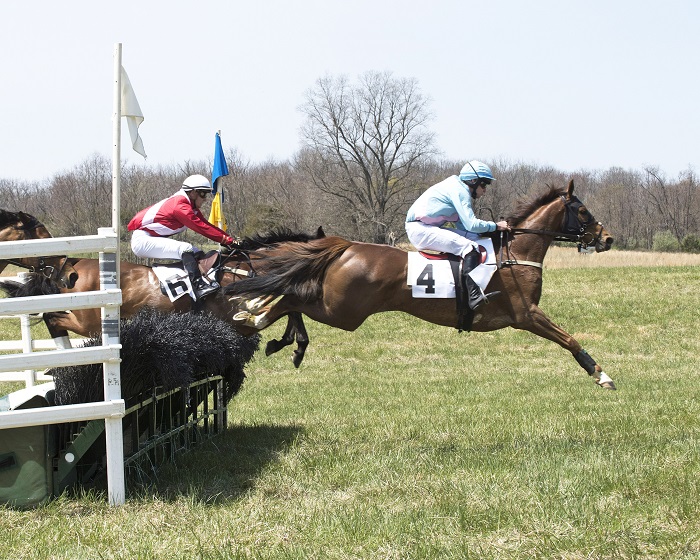
Steeplechase horses swish through the man-made national fences routinely at most hurdle races around the country today. Brush fences were once expensive and time-consuming to set up, and racetracks were dropping steeplechase races from their cards. / Joanne Maisano photoIt was autumn of 1973, and the world was in turmoil. U.S. forces were pulling out of Vietnam, the Watergate scandal was rocking the nation, and a looming energy crisis was getting global traction.
The steeplechase circuit, too, was in a state of flux. The year before, the bottom had fallen out of the industry. New York basically kicked out the jumpers and went from eighty-three jump races at Belmont, Aqueduct, and Saratoga in 1970 to fifteen in 1973. And those were at Saratoga only.
Jimmy Day Entries Finish Strong at Old Dominion
Photos by Douglas Lees
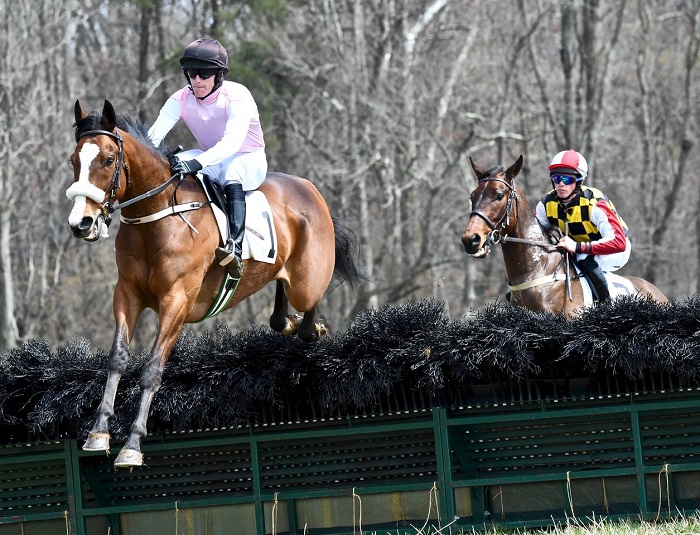
Maiden Hurdle race (l-r): #1, Apollo Landing (Bryan Cullinane up) finishes 1st; Leopard Cat (Paul Cawley up) places 2nd.
The trainer-rider team of Jimmy Day and Bryan Cullinane won four of the nine races carded at the Old Dominion Point-to-Point at Ben Venue Farm on Saturday, April 6, 2019. The Amateur/Novice Rider Hurdle (first race) was a walkover, and the rest of the fields were sparse, but Day and Cullinane won over hurdles, over timber, and on the flat.
In the Maiden Hurdle, Cullinane took Charlie Fenwick’s Apollo Landing right out to the front and pulled away from Leopard Cat for the easy win.
Gomena Saddles Three Winners at Orange County
Photos by Douglas Lees
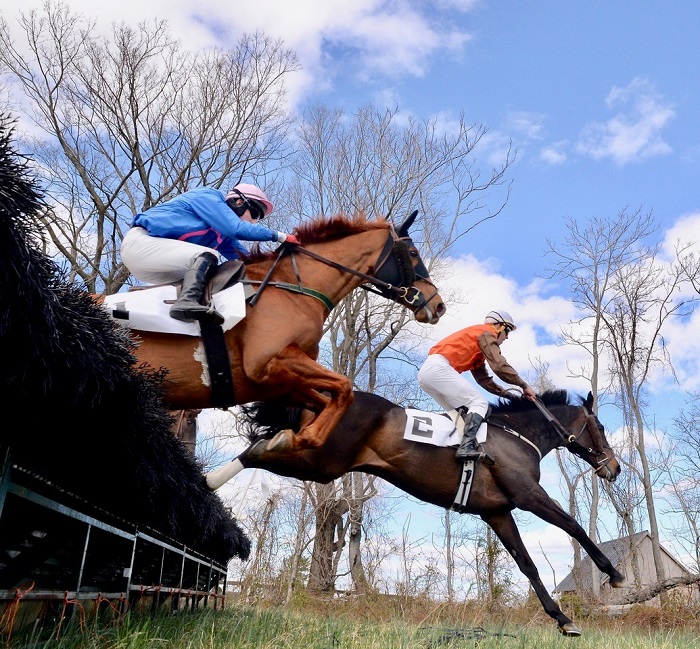
(l-r) Menacing Dennis (Aaron Sinnott up) finishes first; Ack Feisty (Jacob Roberts up) is third in the Open Hurdle.
Julie Gomena-trained horses swept three of the seven races for three different owners with three different riders at the Orange County Point-to-Point on Sunday, March 31, 2019: Maiden Flat (second race), Open Hurdle (fifth race), and the Open Timber (sixth race). Racing was run over the Locust Hill Farm racecourse in Middleburg, Virginia: