
Siegfried Sassoon’s Haunted Sequel
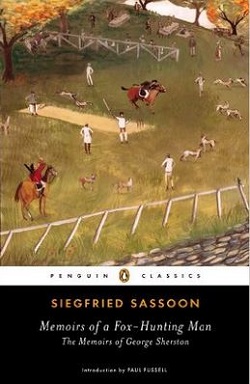
Memoirs of a Foxhunting Man, Siegfried Sassoon, 1928, Penguin Classics, paper, available at Amazon and bookstoresEarly July exactly one hundred years ago, British, French, and German troops engaged in battle near the River Somme that left a million men dead or wounded on the fields in just four months of butchery. Known to history as the Battle of the Somme, it was arguably the bloodiest in all of human history. All for a gain of just six miles into enemy-occupied territory.
Author and poet Siegfried Sassoon was at the Somme. His lovingly-written classic, Memoirs of a Foxhunting Man, ends with his wartime service, his loss of dear friends, and the beginnings of his ruminations on the madness of war.
For just the foxhunting content, the book is a classic to be recommended to any literate foxhunter. But Sassoon wrote a sequel, Memoirs of an Infantry Officer, which is the most moving anti-war book this reporter has ever read.
The Purebred and The Mutt

With permission, here is the first chapter of The Great Hound Match of 1905 by Martha Wolfe (Lyons Press). The Library of Virginia has selected Martha’s work as a potential Best Book of 2016 in the Non-Fiction category. Readers may cast their votes by clicking here.
A. Henry Higginson, MFH, Middlesex Hunt, in derby and spats with huntsman Robert Cotesworth and his imported English foxhounds of the period. / Courtesy, National Sporting Library and Museum
Storytellers claim that there is really only one story in the world: “A Stranger Comes to Town.” In this case, two strangers came to two towns in Virginia bringing with them their separate entourages—private train loads of friends and their horses, trunks of tack, boots, formal and informal clothing, food and wine, servants and of course their hound dogs. Neither Middleburg nor Upperville, Virginia, had seen the likes since J. E. B. Stuart established his headquarters at the Beverage House (now the Red Fox Inn) in Middleburg during the Gettysburg Campaign. Alexander Henry Higginson of South Lincoln and Harry Worcester Smith of Grafton, Massachusetts had determined that the Loudoun Valley in Virginia’s pastoral Piedmont was the best place to prove the relative worth of their chosen foxhounds.
Colour

We see every color of horse in the hunting field. And while foxhunters really shouldn’t care about color, I’m guessing that many riders have a preference. Right or wrong, I know I do. In this photo, several horses of varying colors are crossing the country well. We may be missing more colors than we care to, but we hope you’ll get the idea.
Keeping up with the Blue Ridge hounds in Virginia are (L–R) Cyrus (a paint) owned and ridden by Karel Wennink; Guitar (a “black-pointed bay”) owned and ridden by your editor; Hot Rize (a “black-pointed bay” and winner of the 2014 Virginia Gold Cup) owned and ridden by Russell Haynes; and Very Berry (a roan) owned and ridden by Jef Murdock, MFH, Old Chatham Hunt (NY). / Nancy Kleck photo
Colour by Edric G. Roberts
The old saying, so often repeated,
That ‘there never was yet a good horse
Of a really bad colour,’ is greeted
With a shrug, as a matter of course;
To the past it is now relegated
As the lore of some old-fashioned school,
Which believed in tradition that rated
An exception as proof to the rule.
The Meadow Brook Hunt Was More About People Than Hounds
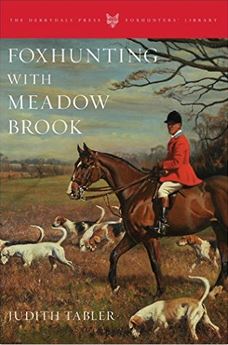
Book Review by Martha A. Woodham
Foxhunting with Meadow Brook, Judith Tabler, The Derrydale Press, 2016, 312 pages, available from Amazon.“Foxhunting with Meadow Brook on Long Island, New York, was always about more than the fox, the hounds, or the horses. Meadow Brook was about its people—some powerful, some idle, many wealthy—and their shared joy in galloping across beautiful country, only minutes outside New York City.”
This quote from the dust jacket blurb on Judith Tabler’s Foxhunting with Meadow Brook sums up her book well—except for one thing. Foxhunting with Meadow Brook Hunt Club in the early days was also about the jumping—the bigger the jumps, the better. Many members—high-powered businessmen from New York—were highly competitive, and every meet was a contest that, sadly, did not always end well. Over the decades Meadow Brook lost at least four members to dangerous riding.
Foxhunting In the Streets of Mayfair, And Other International Issues
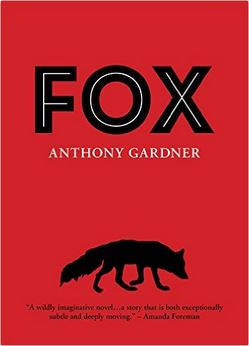
Book Review by Martha A. Woodham
Fox, Anthony Gardner, Ardleevan Press, 2016, 313 pages. Available through Amazon.Set in a dystopian future, Fox by Anthony Gardner is a bizarrely imaginative look at the topical but unrelated themes of high tech government intrusion, politicians running amok, pandemic disease, and I don’t know what else. Oh, yes, foxhunting, too, but I think it all means England had better lift the ban on foxhunting before things really get out of hand.
Gardner, an Irish author and journalist based in London, takes the reader on a cheeky romp through the English countryside as good guys and bad guys chase each other in search of…well, a lot of things.
A deadly disease, fox flu, is ravaging Europe and must be prevented from reaching Great Britain. Foxhunters like Frank Smith have been enlisted to kill all foxes, including those who have made English cities home. Frank, MFH and huntsman of the new Hyde Park Hunt, spends his early morning hours galloping after hounds down dark London streets in a new urban version of foxhunting.
Foxhunter/Lawyer/Archaeologist Channels Ogden Nash

A Norfolk Hunt meet at the Noel Morss estate, Needham, Massachusetts, circa mid-twentieth century
The roster of members who in 1898 organized the Norfolk Hunt (MA) near Boston, and rode as members through the early years of the twentieth century, boasts well-known family names synonymous with American commerce, finance, and government. One member, active through the middle of the twentieth century, perhaps lesser known but every bit as interesting, was Noel Morss. (His grandfather founded the Simplex Wire and Cable Company.)
Morss served as treasurer then president of the Norfolk Hunt from 1951 to 1964. He’d graduated from Harvard Law School, practiced law in Boston, and was also highly regarded as an amateur anthropologist and archaeologist. His discoveries made while leading Peabody Museum archaeological expeditions to Arizona and Utah and his scholarship that followed were of such caliber that he was appointed to a committee chairmanship at both Harvard and the Peabody.
Less recognized perhaps was his remarkable talent for writing humorous and whimsical verse. Here’s one that should resonate with anyone who’s ever taken riding lessons. Without attribution, one would readily assume it to be from the pen of Ogden Nash.
Fox Tales: Beth Carlson’s Art
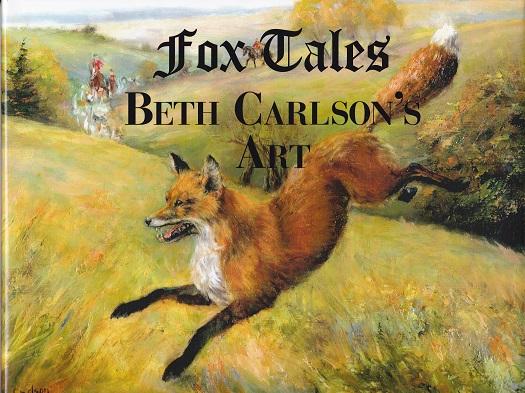
Fox Tales: Beth Carlson’s Art, Dog & Horse Fine Art, LLC, 2015, hard bound, color, 32 pages, $39.00, available from the publisher
Book Review by Martha Woodham
It’s not often that art lovers get to spend time with an artist to learn about the background of a painting, to discover insights into the thinking behind the work. But a lovely new book by artist Beth Carlson is like a walk through a gallery of her paintings with the Maine artist as your guide.
In Fox Tales: Beth Carlson’s Art, the artist has used her paintbrush to capture her encounters with foxes over the years. Each full-page painting—many in private collections and reproduced in full color on substantial, coated paper stock—is accompanied by a short essay by the artist explaining the history of each artwork.
A Little Something to Hang
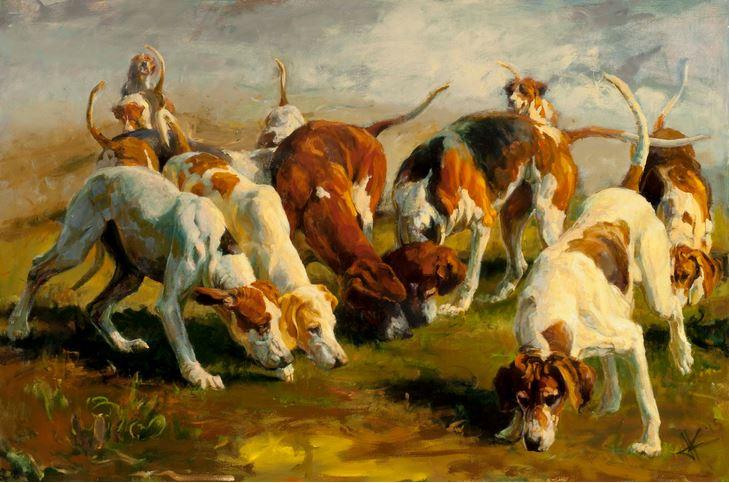
Juli Kirk (American, born 1957), Hounds on Scent, oil on canvas, 24″ x 36″, signed, dated 2015. Click on any of the images for a larger view.
Through the kind permission of Greg Ladd, owner of the Cross Gate Gallery in Lexington, KY, Foxhunting Life is proud to report, along with a selection of riveting images, on the highly successful third annual Sporting Art Auction at the Keeneland Sales Pavilion held there on November 18, 2015. Racing and shooting sports were also well represented.
Each year, Ladd travels across the United States and Europe to acquire important works worthy of the attention of a discriminating clientele. Eighty-nine percent of all the works offered were sold, and thirty-seven percent sold for more than the high-end estimates. Sir Alfred Munnings’ signed and dated painting of the champion French Thoroughbred, Mon Talisman, brought the top price of $250,500. At the other end of the spectrum, a lovely hunting gouache of a Worcestershire Foxhounds scene sold for just $3,450.
The Owl and the Earl
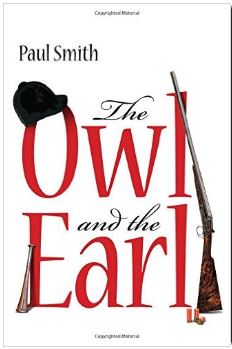
Book Review by Martha A. Woodham
The Owl and the Earl, Paul Smith, Silverwood Books, 2014, Paperback, 198 pages, $14.95As the newest Master of the Blankshire Hunt, our hero of The Owl and the Earl, Hector Griffiths, inadvertently steps into what is known as a “sticky wicket” when he is tapped to raise funds to build a new stable for the hunt.
Threatening to sabotage the fund raising is a rivalry between old money and new. The family of Lord Blankshire, the Hon. Alexander Bichester, came over with the Normans. By comparison, the fifth Earl of Melsham, aka “Sid,” is practically nouveau riche. Sid, known locally—but only behind his back—as “the belted earl,” likes to stick it to Alex every chance he gets, leaving poor Alex, a gentle soul, flummoxed, frustrated, and a bit peeved.
The Whip

Illustration by Lionel Edwards
As, still as a statue, he sits on his horse,
Watching and waiting,
Or rounding up stragglers behind in the gorse,
Cursing and rating,
He’s always the same, hard-bitten and game.
The voice of a hound, or the click of a hoof
Tell him what’s doing,
He knows, on the instant, alert and aloof,
All that’s brewing;
Lean-visaged and tanned, he’s always at hand.