Lady Anne Hemphill (1929–2015)
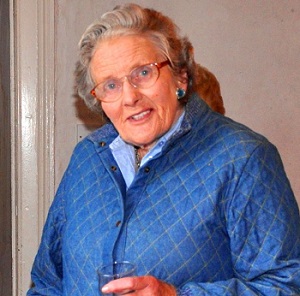
Lady Anne Hemphill (nee Ruttledge) passed away this week at Craughwell Nursing Home in County Galway. An elegant and friendly lady, with a pleasant greeting for everyone, she will be remembered as one of the most accomplished Field Masters for the Galway Blazers, a role she filled with style for fifteen seasons.
I remember hunting in Oranmore when Michael Dempsey was huntsman, and as he drew the last covert at the Rifle Range in near darkness, hounds found immediately and we were away. Lady Anne leading the field came down in a narrow lane when her horse slipped. Deciding to stop and help we got a glimpse of her hand barely visible over the wall waving us on as she was trying to extricate herself from under her horse, saying,” Go, on, go on, don’t mind me, enjoy yourselves!”
Our First Foxhunt Over the Irish Banks
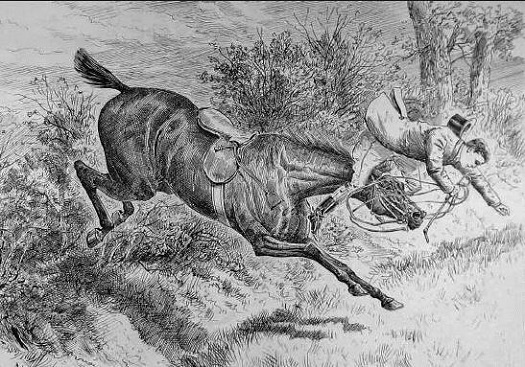
Here’s a second condensed installment from We Go Foxhunting Abroad: A First Venture with the Irish Banks and English Downs, Charles D. Lanier’s 1924 account of a father-daughter sporting trip to Ireland and England.
We put on our hunting things Saturday morning and climbed into the flivver for our first hunt with the United.
B had taken care to remove from her coat the orange collar of our home hunt colors, and I wore the regulation “visiting” dress of American custom—dark Oxford grey coat, cream colored Bedford cord britches, plain black jack boots and hunting bowler. I have never become an authority on the niceties of hunting etiquette and was simply aware one could not go amiss in these unpretentious togs.
Our flivver soon began to overtake people bound for the meet, gentlemen and ladies jogging along on short-tailed beasts with enormous quarters and hocks, grooms leading horses with their riderless saddles carefully protected by slip covers from the showers, which appear in South Ireland without a moment’s notice or a discernable cloud; showers that pass away, generally, as quickly as they come, with no one paying the slightest attention.
Outward Bound
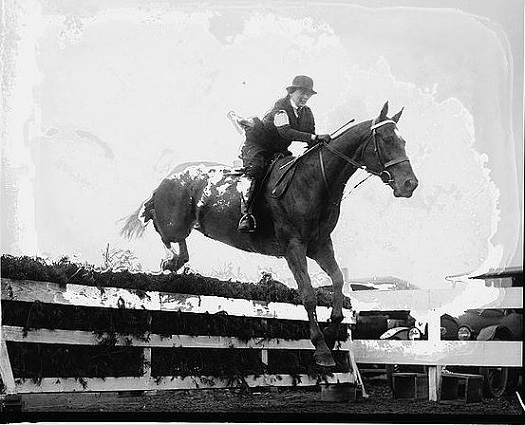
In juxtaposition to these times of fast and affordable air travel to and from England and Ireland for hunting holidays, here’s a look back to a 1924 account of a leisurely (and dramatic) father-daughter sea voyage—their first—to go foxhunting on the other side. It was also a different era for world events, as readers will note.
Author Charles D. Lanier was MFH of the Fairfield County Hounds (later the Fairfield and Westchester Hounds) from 1915 to 1921. His seventeen-year-old daughter, referred to as “B,” was Becky Lanier, later Becky Sharp, MB of the Nantucket Beagles, and still later Joint-MB of the Nantucket-Treweryn Beagles, who, along with her husband Joint-MB David “Bun” Sharp passed away in 1987.
Becky Lanier, 1920
What follows is a condensed version of Chapter 1, “Outward Bound,” from Charles Lanier’s We Go Foxhunting Abroad: A First Venture with the Irish Banks and English Downs published in 1924. Subsequent chapters in condensed form will appear through the remaining summer months.
A New Keswick MFH: Her Story
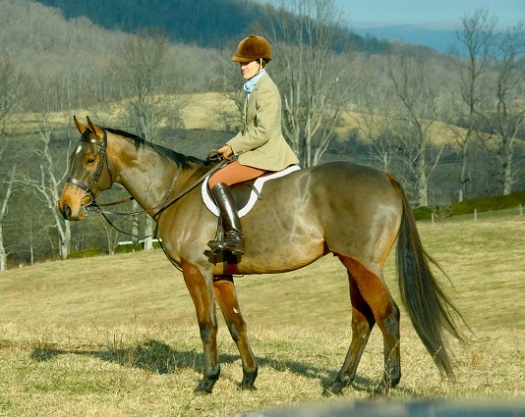
Sandra Forbush photo
If you are wondering where in the Keswick countryside the cover picture was taken, you are observant. It was not taken in Keswick but at Massie’s Corner in Rappahannock County where I grew up. My father, Wade Massie, loved to hunt foxes. My Uncle Jim tells how Pop used to get on the school bus in the morning and get off a few stops later where there would be a horse waiting for him. He would hunt all day with Ennis Jenkins, Larry Jenkins’ father, and get back on the bus in the afternoon. His parents were none the wiser.
Later Jack Bruce helped Pop put together a pack of hounds which Clint Eastham, son of famous hound breeder C.C. Eastham, would hunt for him. (It is kind of fun to think about how I would hunt with hounds and people with a lot of the same bloodlines sixty years later).
Pop also hunted with Rappahannock and was a whipper-in there. Current Rappahannock Master Oliver Brown likes to tell a story about how Pop could make any horse quiet. One day a visitor from New Jersey had come down to hunt. The visitor’s horse was rank, while Pop’s was going along well. Halfway through the day Pop offered to switch horses. By day’s end Pop’s new mount was going along on the buckle, and the visitor’s horse was jigging all around.
Is the Jockey Really an Athlete?
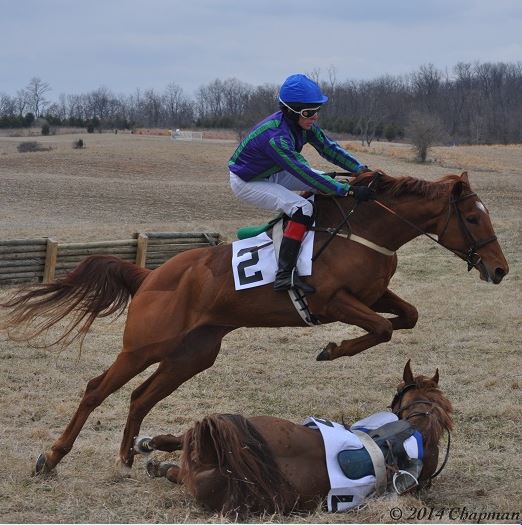
The still-fresh images of American Pharoah’s victorious jockey Victor Espinoza standing in his irons, fist in the air, cruising past the stands of cheering spectators, legs bobbling to absorb the shock of each footfall, provide a perfect segue into this article by Betsy Parker.
A jockey isn’t really an athlete, After all, the horse does all the work, right? / David Chapman photo
Overheard railside at the Foxfield Races near Charlottesville: One pastel-clad college kid to the next as they rummage for beer in their cooler before noon on Saturday: “Jockeys aren’t really athletes. They just sit in the saddle for a few minutes. I could do that!”
I almost fainted. Here the most provocative lede of the decade just dropped in my lap, and I couldn’t get to the jock’s room fast enough to dangle the mother of all conversation-starters like a tenderloin in front of a pack of hungry dogs. Hustling up the hill, I tried the assertion on jockeys Gerard Galligan and Brendan Brooks. They laughed.
“Anyone who’d say that has never ridden a race,” Galligan sniffed.
“Anyone who’d say that has never ridden a horse!” Brooks countered. “There’s so much more to racing than ‘riding.’”
As the Irishmen trailed off to walk the Barracks Road course, I jotted some interview questions. There was more to the story than laughing at a schoolboy’s boast. It’s not only athletic endeavor that drives competitiveness, as I’d soon find out. It’s part will to win, part boldness. Part athletic concentration, part love of sport. It’s a certain level of excitement tempered by highly-honed mental agility.
A 1980s University of North Carolina study measured that pound-for-pound, jockeys are the strongest, quickest, most agile and most hardcore athletes on the planet. Had the researchers studied jump jockeys, they’d’ve doubled it.
Is the Jockey Really an Athlete?
The still-fresh images of American Pharoah’s victorious jockey Victor Espinoza standing in his irons, fist in the air, cruising past the stands of cheering spectators, legs bobbling to absorb the shock of each footfall, provide a perfect segue into this article by Betsy Parker.
A jockey isn’t really an athlete, After all, the horse does all the work, right? / David Chapman photo
Overheard railside at the Foxfield Races near Charlottesville: One pastel-clad college kid to the next as they rummage for beer in their cooler before noon on Saturday: “Jockeys aren’t really athletes. They just sit in the saddle for a few minutes. I could do that!”
I almost fainted. Here the most provocative lede of the decade just dropped in my lap, and I couldn’t get to the jock’s room fast enough to dangle the mother of all conversation-starters like a tenderloin in front of a pack of hungry dogs. Hustling up the hill, I tried the assertion on jockeys Gerard Galligan and Brendan Brooks. They laughed.
“Anyone who’d say that has never ridden a race,” Galligan sniffed.
“Anyone who’d say that has never ridden a horse!” Brooks countered. “There’s so much more to racing than ‘riding.’”
As the Irishmen trailed off to walk the Barracks Road course, I jotted some interview questions. There was more to the story than laughing at a schoolboy’s boast. It’s not only athletic endeavor that drives competitiveness, as I’d soon find out. It’s part will to win, part boldness. Part athletic concentration, part love of sport. It’s a certain level of excitement tempered by highly-honed mental agility.
A 1980s University of North Carolina study measured that pound-for-pound, jockeys are the strongest, quickest, most agile and most hardcore athletes on the planet. Had the researchers studied jump jockeys, they’d’ve doubled it.
What Do Huntsmen Want from their Whippers-in?
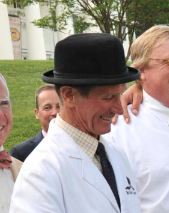
Bill Getchell, a whipper-in for the Nantucket-Treweryn Beagles, a foot pack in Virginia, attended the MFHA-sponsored seminar for whippers-in held on Saturday, May 23, 2015 at Morven Park, the day before the Virginia Foxhound Show, and filed this report.
MFHA Executive Director Dennis Foster opened the day’s program, introducing Moderator Andrew Barclay and Panelists John Gray, Richard Roberts, Stephen “Reg” Spreadborough, and Charles Montgomery.
Lauren Giannini photoHuntsman John Gray, Hillsboro Hounds (TN)
A good whipper-in, said huntsman John Gray, must like hounds, know the hounds in his/her pack, and trust them.
He/she must be a good rider who understands how and when to save his horse over the many miles to be covered during the course of the day, so there will be reserves if needed at day’s end.
A good whipper-in knows his country and the landowners, and knows where he can and where he must not go.
Gray wants his whipper-in to tell him concisely, precisely, and simply what he saw, not what he thinks. The good whipper-in stays ahead of hounds in position to stop riots before they start.
Advice From a Junior Whipper-In
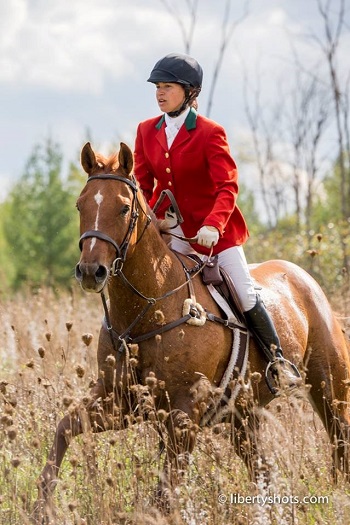
Here’s astute, peer-to-peer advice for juniors aspiring to become honorary hunt staff. I can’t help but wonder how many huntsmen out there would love to have Carmen on his/her staff!
We, juniors, are the future of foxhunting. It is our responsibility to be knowledgeable and to keep this fantastic sport alive and traditional.
Have you ever peered past the first Field Master at those tiny white specs in the distance—the hounds—and wondered what’s going on up there, what that blast of the horn meant, where that scarlet-clad rider is galloping off to in such a hurry? Ever think about whipping-in?
What to Think About Before You Decide to Whip-In
Whipping-in can be the most exhilarating, amazing adventure ever, or it can be the most terrifying, stressful experience ever. It largely depends on how you handle the thrills and horrors that being a whip sends your way.
Whipping-in doesn’t only take place on your horse in the hunt field. It takes place in the kennels, in the stables, at home with a mountain of books, and in the mud on your backside watching your mount vanish into the distance.
The Keswick Hunt…In Motion!
Here’s Phil Audibert’s cleverly edited video montage of the Keswick Hunt’s 2014/2015 foxhunting season, set to the music of the Ryegrass Rollers. The fox, the hounds, huntsman Tony Gammell, Masters, staff, and the Keswick field members all play the starring roles in this fast-paced romp through the Virginia countryside.
Maryland Hunt Cup 2015: One for the Books
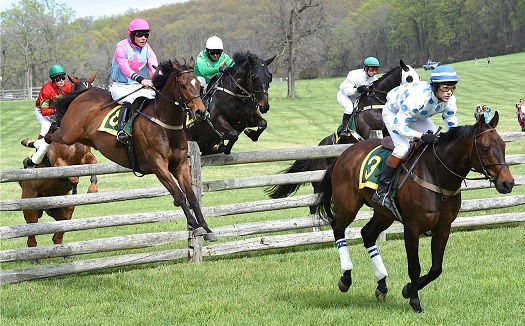
Fence 3: (l-r) Imperial Way (Bethany Baumgardner up) about to jump; Raven’s Choice (Mark Beecher up) 1st; Almarmooq (James Slater up); Guts For Garters (Jody Petty up) 2nd; Twill Do (James Stierhoff up) / Douglas Lees photo
Ten minutes after crossing the wire first, a half length in front of Raven’s Choice, Imperial Way was disqualified. His jockey Bethany Baumgardner failed to weigh out with all the weight she carried into the race. Somewhere, during the course of the race, a twenty-pound weight slipped out of her saddle pad—a first in the 119 runnings of the Maryland Hunt Cup.
It was a double disappointment for Imperial Way, who was beat by just a nose in last year’s race by Stewart Strawbridge’s Guts for Garters. The odds-on favorite this year, Guts for Garters was trying for his second consecutive win, but placed second to Raven’s Choice by six lengths after the disqualification.