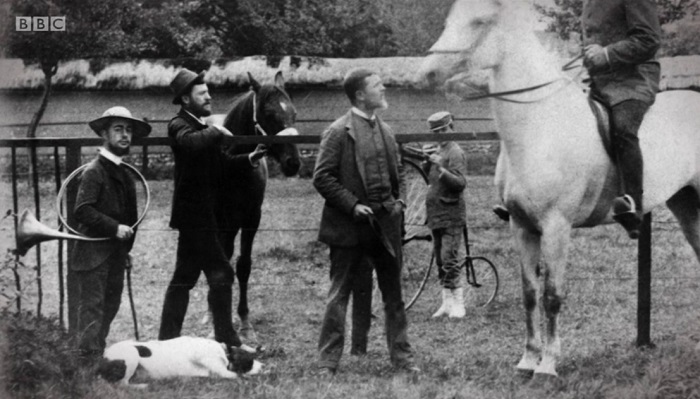
 This astonishing photograph, sent by Debra Pring, shows Henri de Toulouse-Lautrec standing by horse and hound and holding a French stag hunting horn.
And here we thought that the Master Post-Impressionist spent all his spare time at the Moulin Rouge with wine, dancers, prostitutes, and his fellow artist friends. Not so! Henri de Toulouse-Lautrec was well familiar with horses, hounds, and stag hunting.
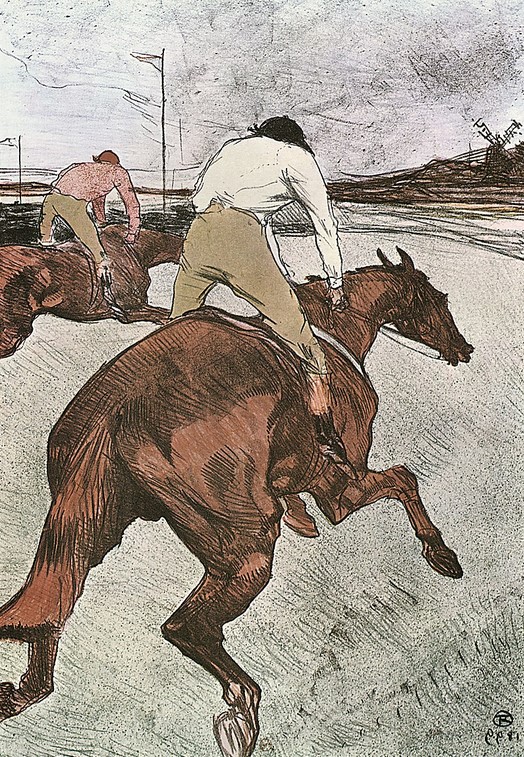
Lautrec studied and painted many horses―racing, hacking, parading, and performing at the circus. Classically trained, he is known for working in multiple media: painting, printmaking, drawing, draughting, and just plain illustrating. Prodigiously. All, while suffering under the cloud of his deformity.
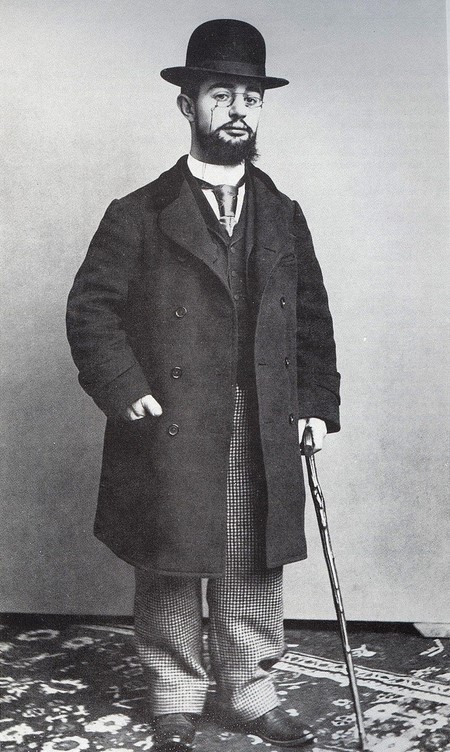
He was born to privilege in the Midi-Pyrénées region of France on November 24, 1864, the first-born child of an aristocratic family. His grandmothers were sisters, however. His parents, the Comte and Comtesse, were first cousins.
Had Henri developed normally, it is logical to suppose that he would have ridden ponies as a youngster and had ample opportunities to hunt the stag. Surely, family and friends hunted, and that may be what we see in this surprising photo.
A younger brother was born three years later but died the following year. His parents separated after that, and young Henri was brought up by a nanny.
At age eight, he went to live with his mother in Paris. The family quickly recognized his talent in drawing and painting, and an artist friend of his father, René Princeteau, who specialized in equine art visited occasionally to give him lessons. Lautrec is considered by some to be one of the famous horse painters.
His mother, concerned with his health, sent him at age eleven to thermal baths at Amélie-Les-Bains and consulted doctors in the hope of finding a way to improve her son’s growth and development.
At the age of thirteen, he fractured his right femur. At age fourteen, he fractured the left femur. The breaks did not heal properly, and his legs stopped growing. His torso grew to adult size, but his total height topped out at just four feet eight inches.
Unable to participate in the usual activities of boys of his station, Henri immersed himself in art and progressed. His work impressed his father’s friend Priceteau who arranged for him to return to Paris to study with the acclaimed portrait painter, Léon Bonnat.
At his new Master’s studio in the heart of Montmartre, Henri was captured by the bohemian lifestyle and the artists, writers, and philosophers who frequented the district. His mother’s hopes for a fashionable and respectable career to develop for her son from his time with Bonnat were dashed. Once in Montmartre, he rarely left over the next twenty years of his life.
At age eighteen, Toulouse-Lautrec moved to the studio of Fernand Cormon, with whom he studied for another five years. Cormon’s methods were more relaxed than Bonnat’s and students were allowed the freedom to roam Montmartre and choose their own subjects to paint. He became friends with Cézanne, Gaugin, and Seurat. He met Émile Bernard and Vincent van Gogh during this period and had his first experience with a prostitute. The door was opened to one of his oft-painted subjects.
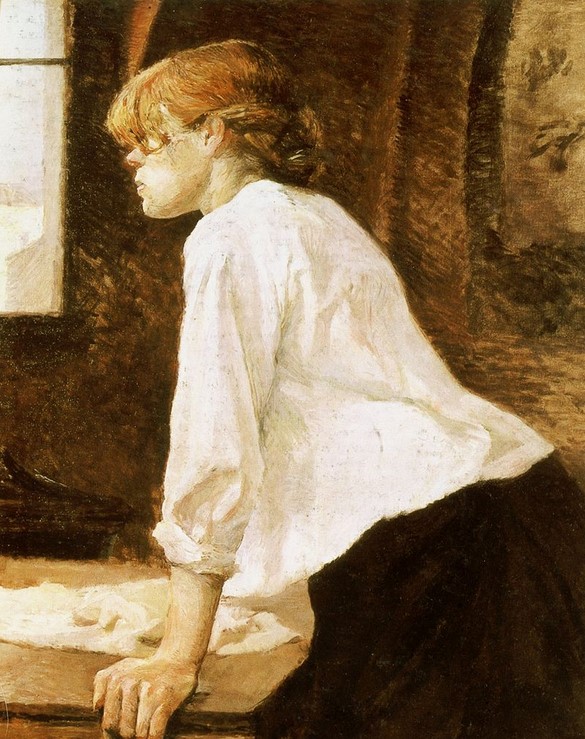 A favorite model was Carmen Gaudin, painted in “The Laundress.”
He was invited to show his work in Belgium and regularly took part in the activities of the French Société des Artistes Indépendants. He painted scenes of Montmartre and a series of plein-air paintings of Carmen Gaudin, the same red-headed model who appears in The Laundress, which he painted in his twenty-second year. In 2005, that painting was sold at auction by Christie’s for 22.4 million dollars.
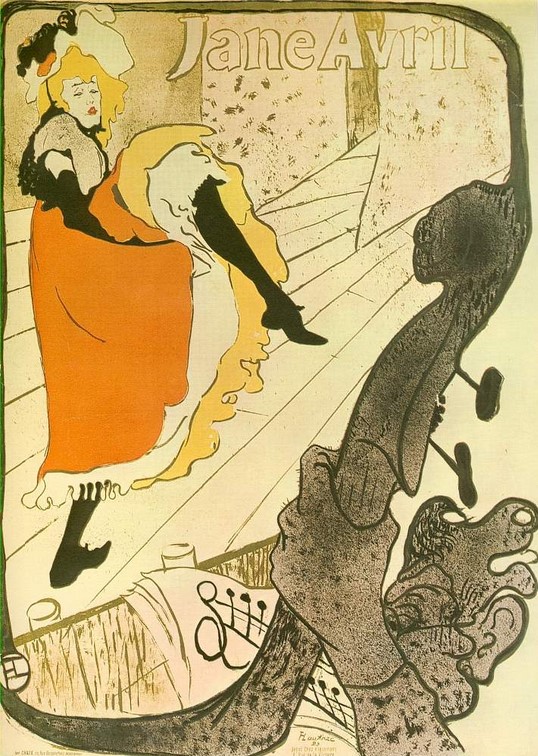
He was commissioned by the Moulin Rouge upon that cabaret’s opening to produce a series of promotional posters. Though still receiving a regular income from his mother, and while other artists looked down on such work, Lautrec took it on. The posters represented income of his own making. The cabaret reserved a seat for him and displayed his paintings.
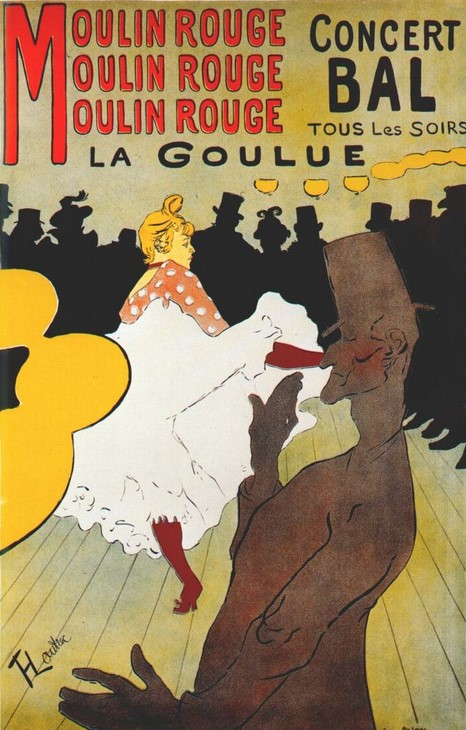
And just imagine the painterly subjects…the characters…that came through the Moulin Rouge for his interpretations! He memorialized singer Yvette Guilbert, dancer Louise Weber (La Goulue) who invented the Can-Can, and dancer Jane Avril.
Haunted throughout life, however, by his physical deformity, alcohol was a refuge. At the age of thirty-four, he suffered a collapse due to exhaustion and the effects of alcoholism. He reportedly contracted syphilis from Rosa La Rouge, a prostitute who was the subject of several of his paintings.
Henri de Toulouse-Lautrec died at his mother’s home on September 9, 1901. He was thirty-seven. Death was attributed to the complications of alcohol and syphilis upon his long-time fragile health.
One version of his last words was reportedly from the hunting field. Using the word, “Hallali,” the French huntsman’s term at the kill, he is reported to have said to his father, “’Je savais, papa, que vous ne manqueriez pas l’hallali.”
“I knew, papa, that you wouldn’t miss ‘the death.’”
Posted September 7, 2021