
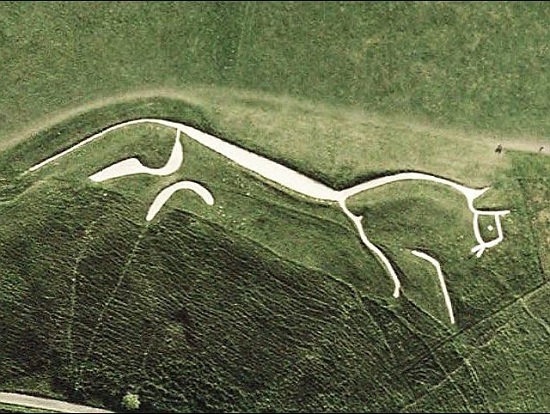
 It takes a village to maintain the White Horse of Uffington
Not all art restoration is done with mild cleaners and painstaking brushwork every hundred years or so. In Oxfordshire, England, it takes a village equipped with hammers, buckets of chalk, and kneepads every few years.
Carved into the chalky grasslands of the Berkshire Downs three thousand years ago by an ancient people, the White Horse of Uffington covers the size of a football field and is visible from twenty miles away. And were it not for the people who originally created it, and all the tribes people and villagers who have resided in the vicinity ever since and maintained it, this amazing artistic accomplishment would have completely disappeared thousands of years ago.
On a day this July, villagers, families, and children of all ages trudged up the hill for chalking day. Under the guidance of members of the National Trust, they knelt, spilled some chalk, and smashed it into a paste with their hammers to whiten the image, inch by inch. It was simply a mammoth job of coloring between the lines. If not for this ritual—the periodic chalking or “scouring” over these many thousands of years—the grass would have grown back just twenty or thirty years after the creation of the White Horse and obliterated it.
The horse was long thought to be about two thousand years old since the abstract image is very similar to those on ancient British coins of that era. In the 1990s, excavation was performed that showed the carving was not simply scratched into the surface of the hill, but actually cut into the hill about a meter deep. Using a technique called optical stimulated luminescence, layers of quartz in the trench were dated to the beginning of the Iron Age, if not the end of the Bronze Age, nearly three thousand years ago. It remains a mystery how the makers, using antler picks and wooden spades, were able to create this artistically graceful, highly stylized, abstract image which can only be seen in its entirety from miles away.
During World War II, the White Horse was camouflaged with a covering of turf and hedge clippings to prevent German bombers from using it as a navigational aid, London being only an hour-and-a-half’s drive distant. The site is scattered with other prehistoric remains: a Neolithic barrow and chamber tomb, Uffington Castle built in the early Iron Age, and an ancient road, the Ridgeway which runs along the Berkshire Downs.
One might stop and wonder why these ancient people would go to all the trouble to create a monument of such scale as to require periodic maintenance. But could that have been the very point? Was part of their mission aimed at the desire to encourage a social group of individuals to work together? If so, today’s chalking days provide an echo from the past of an early human need, as well as the continued restoration of the world’s most prominent work of equine art.
Posted July 14, 2017