The Whipper-In Is the Huntsman’s Right Hand
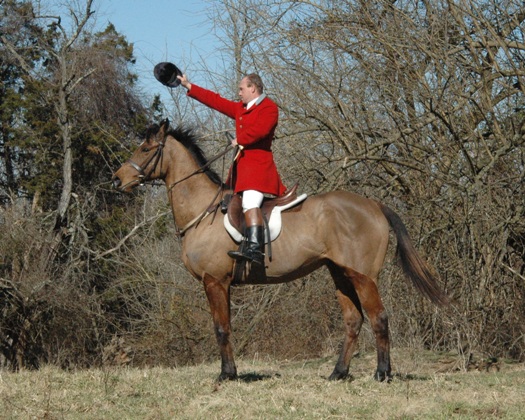
Neil Amatt, professional whipper-in, Piedmont Fox Hounds (VA): “Anticipation, punctuality, how you present yourself—all these things are drilled into you in the English system. You start in the kennels, and you have to really want it before you’re even allowed on a horse.” / Nancy Kleck photo
With the start of a new season just around the corner, we bring back this article, first published in 2013, not only for the benefit of all new and aspiring whippers-in, but also for those field members who wish to appreciate all that happens in the hunting field.
Last season, after forty-five years of hunting, I witnessed a simple act of sophisticated whipping-in that left me shaking my head in admiration. For a huntsman or an experienced whipper-in, it was perhaps no big deal.
My hunt fielded an all-new professional staff last season—huntsman and whipper-in—both of whom were learning the country on the fly. Hounds had checked in a thick covert, and we in the field could see them, heads down, trying to recover the line. The whipper-in came galloping by headed for the end of the covert.
“Over here,” called the Field Master, pointing to a concealed trail. “You can get in over here.”
The whipper-in came back, talked urgently to the Field Master, then turned his horse and continued in the direction he was originally going.
After the meet I asked him what that exchange was all about.
Radnor Hunts the Big Bend

Radnor huntsman Joe Cassidy and hounds at Big Bend / Diana Rowland photoThe gray uncertain sky and falling barometer suggested that winter was not yet finished with us. Nevertheless, I had rearranged my previously planned trip to Aiken after Joe Cassidy called. Joe hunted Mr. Stewart’s Cheshire Foxhounds (PA) for eighteen years and is currently huntsman for the Radnor Hunt (PA). This was an opportunity for me to hunt in his back pocket.
Joe had taught me to hunt hounds while I was MFH at Loudoun Hunt (VA), and he hunted with me when I carried the horn for a couple of years, making the drive with his wife Leslie and their very large dog Luca each weekend.
The meet was at Big Bend, the long-time residence of Frolic Weymouth, well-known for his immense contributions to open space conservancy. It was a Saturday meet, March 16, 2013, and as we sat waiting for the last of the field to mount and the clock to strike 11:00, Joe turned in his saddle, handed me his horn, and quietly told me that I was hunting the pack that day. I confess to a moment of stage fright, made some knuckle-head comment about strike hounds to which he replied, “Really,” and then we headed off to the first covert—a thick patch of brambles, ground cover, and trees about the size of a football field.
Foxhounds With a Difference
Mr. Stewart’s Cheshire Foxhounds (PA) boasts a sporting field of superb horsemen and women that love to gallop and take their own lines over the post-and-rail line fences in their country. Seven years ago, the Cheshire Masters and staff embarked on a bold experiment to breed a new foxhound for that country. Our feature article below tells of their decision to cross the The Old English (also called the Traditionally-Bred English) foxhound and the Penn-Marydel foxhound.
Their plan was a gamble because the two breeds are about as dissimilar in type as foxhounds get, and the crossing of the two types would produce litters that varied greatly from pup to pup. However, the Cheshire Masters and huntsman believed that the strong points of each type would tend to compensate for the perceived weaknesses in the other and result in a foxhound superior to either type.
Here are some examples of the perceived differences between the types. Just remember that generalizations are only generally valid!
The Cheshire Crossbred: A Bold Gamble
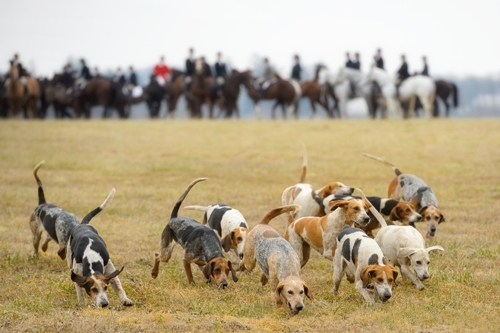
The new Cheshire Crossbreds combine the best traits of two disparate foxhound types / Jim Graham photo
When an established hunt with a reputation for showing the best of sport to the best of horsemen in the best of countries comes up with a novel idea for breeding a better foxhound, and sees it through to fruition and success, one has to pay attention.
The venerable—one hundred years this season—Mr. Stewart’s Cheshire Foxhounds in Unionville, Pennsylvania traditionally hunted the Old English foxhound under the hunt’s founder W. Plunket Stewart and the active Mastership of his step-daughter, the late Mrs. John (Nancy Penn Smith) Hannum. Masters and members know the breed very well.
Ireland’s County Galway Foxhounds (The Blazers), another venerable hunt renowned for showing world-class sport, also hunts the Old English foxhound. Cheshire huntsman Ivan Dowling grew up following the Blazers, and he too knows the Old English foxhound very well.
History and familiarity notwithstanding, seven years ago the Cheshire Masters and their Galway-born huntsman Dowling decided to continue a breeding experiment begun two years earlier by former huntsman John Tullock. They committed to the notion of crossing the English foxhound with the Penn-Marydel foxhound—two disparate types—in the hope of making a better foxhound for their country. This was a chancy endeavor, understandably fraught with controversy within the hunt.
The Cheshire in Winter
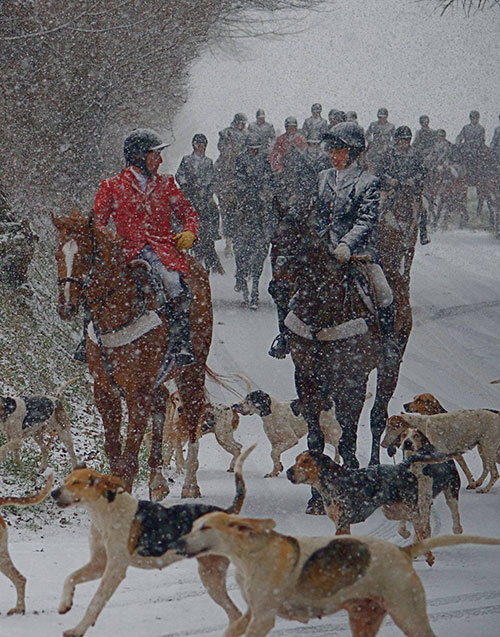
I can get lost in a photo like this. There is so much to see and so much that is felt rather than seen. In the foreground are huntsman Ivan Dowling and whipper-in Stephanie Boyer, obviously communicating. Hounds, though bright and lively, are squinting to keep the snow out of their eyes. The horses and […]
The Future of Foxhunting: We Have Seen the Enemy and He Is Us
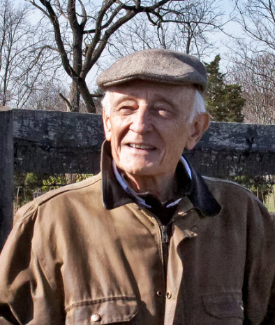
Foxhunting is and will continue to be embattled on two fronts: (1) animal rights activism and (2) loss of open space. The good news is that we have strategies for dealing with these pressures. The uncertainty rests with our own will and dedication, as Walt Kelly’s cartoon character Pogo told us many years ago. Now and in the future, we need to look harder within…at us.
Thoroughbreds: Kings of the Hunting Field
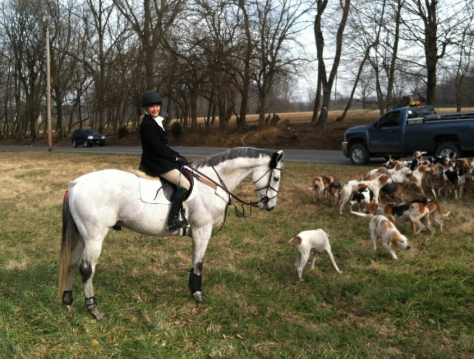
Nina Siepel on Steppenwolfer, out with the Cheshire hounds this year
Consider the happy life of Steppenwolfer (by Aptitude out of Wolfer): lots of treats; a big field with clover and buddies; and, from September to March, running around the countryside with a lot of other horses chasing a pack of hounds. A far distance from running third to Barbaro (by Dynaformer out of La Ville Rouge) in the Kentucky Derby and second in the Arkansas Derby in 2006.
Gelded and purchased by Gail and Dixon Thayer as a steeplechase prospect, his short steeplechase career wasn’t as stellar as hoped for. But he’s one happy puppy now. And Nina Siepel, who hunts him with Mr. Stewart’s Cheshire Foxhounds (PA), always wears a big grin, as if she still can’t really believe her good fortune. I’m not sure who is the luckier of the two.
Thoroughbreds: Kings of the Hunting Field
Nina Siepel on Steppenwolfer, out with the Cheshire hounds this year
Consider the happy life of Steppenwolfer (by Aptitude out of Wolfer): lots of treats; a big field with clover and buddies; and, from September to March, running around the countryside with a lot of other horses chasing a pack of hounds. A far distance from running third to Barbaro (by Dynaformer out of La Ville Rouge) in the Kentucky Derby and second in the Arkansas Derby in 2006.
Gelded and purchased by Gail and Dixon Thayer as a steeplechase prospect, his short steeplechase career wasn’t as stellar as hoped for. But he’s one happy puppy now. And Nina Siepel, who hunts him with Mr. Stewart’s Cheshire Foxhounds (PA), always wears a big grin, as if she still can’t really believe her good fortune. I’m not sure who is the luckier of the two.
Cheshire Centennial Meet at Brooklawn
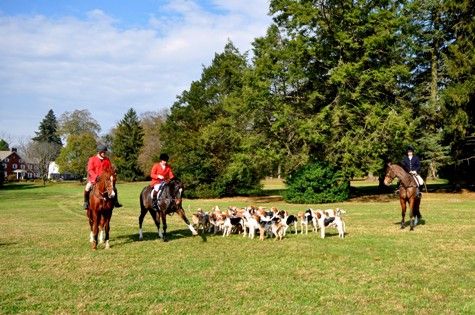
Cheshire Honorary Whipper-In Paddy Neilson, Huntsman Ivan Dowling, and professional whipper-in Stephanie Boyer at Brooklawn / Noel Mullins photo
Mr. Stewart’s Cheshire Foxhounds (PA), founded in 1912, are celebrating their Centennial this season. W. Plunkett Stewart, a Philadelphia banker, set out to find the perfect hunting country and settled on the rolling hills, rich pastureland and extensive woods around Unionville. As what in modern terms could be classed as a committed environmentalist, he purchased thousands of acres of land and, before reselling, amended deeds to restrict development and nurture conservancy, clean water, and natural habitat. As a result of his efforts and the culture of conservation he passed on, the Cheshire hunting country today boasts thirty square miles and twenty-six thousand acres free from ribbon residential and commercial development that has allowed foxhunting and National Hunt racing to thrive.
For the Joy of It!
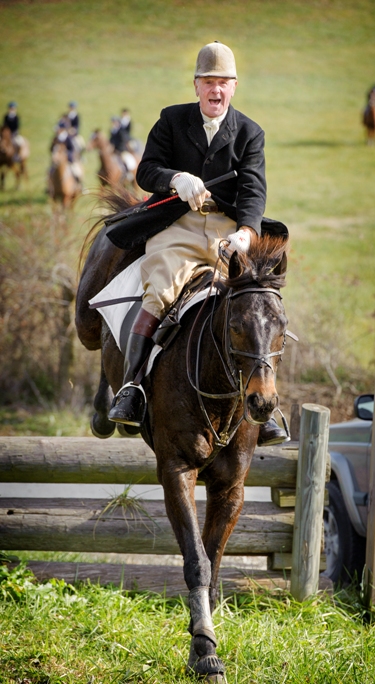
Jim Graham photoPhotographer Jim Graham captured an exuberant Bruce Miller—MFH and Field Master of Mr. Stewart’s Cheshire Foxhounds—in a moment that conveys by expression and posture the pure joy of galloping cross country. From Miller’s dainty grip on his stick to the loop in his reins, this is a picture of a confident rider on […]