Hounds Came First for Cheshire’s Ivan Dowling
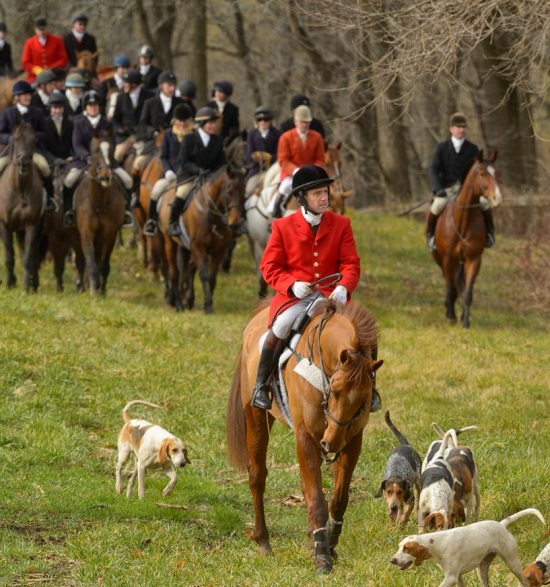
Huntsman Ivan Dowling implemented a daring — and successful — hound breeding experiment for Mr. Stewart’s Cheshire Foxhounds. / Jim Graham photo
“I’d spent several minutes trying to describe my job as huntsman to a friend” recalled Ivan Dowling, the forty-two-year-old recently retired huntsman for Mr. Stewart’s Cheshire Foxhounds (PA). “The friend looked at me and said, ‘Ivan, you mean you’re the guy on the place mat?’”
Dowling cringed a bit and smiled, “Yea, that’s me.”
Huntsmen On the Move: 2016
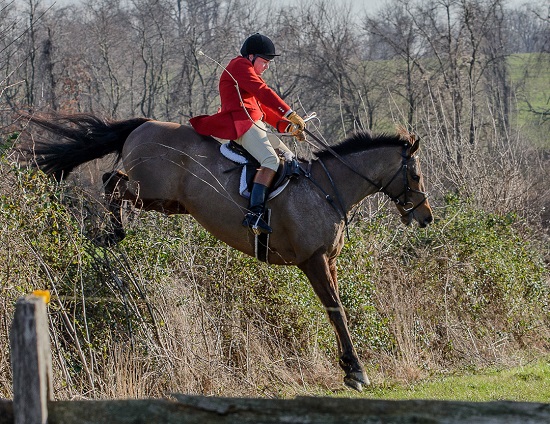
Barry Magner is the new huntsman at Mr. Stewart’s Cheshire Foxhounds. / Middleburg Photo
As we approach the 2016/2017 season, Foxhunting Life reports on recent huntsmen moves around the hunting countries.
Round I
Ivan Dowling has retired from hunting Mr. Stewart’s Cheshire Foxhounds (PA). After ten seasons (and before that as first whipper-in), this comes as a major change at Cheshire because the Irish-born Dowling was a key figure in implementing a bold, highly unusual, and successful hound breeding program there. With Dowling’s departure, Cheshire loses a professional whipper-in as well—Stephanie Boyer—who will wed Dowling in September.
Barry Magner is the new Cheshire huntsman. Irish-born Magner’s professional career includes whipping-in at the United Foxhounds (IRE) and a stint whipping-in in England. In the U.S., Magner whipped-in to the Howard County-Iron Bridge Hounds (MD) for a season and became huntsman there in 2007 upon Allen Forney’s retirement. He came to Virginia as huntsman for the Middelburg Hunt where he remained for five years until leaving two years ago for Australia. Back in the U.S., Magner joined the Cheshire as professional whipper-in last season and was named huntsman upon Dowling’s retirement.
George “Frolic” Weymouth (1937–2016) Inspired Conservation-Minded Hunts
George A. “Frolic” Weymouth, visionary conservationist, philanthropist, artist, and sportsman, died on April 24, 2016. In 1967, Weymouth and two friends purchased two parcels of land in Chadds Ford, Pennsylvania totaling forty-seven acres that were threatened with industrial development. That act of preservation marked the start of the organization that was to become the Brandywine Conservancy. That conservancy, led by Weymouth, and the nearby Mr. Stewart’s Cheshire Foxhounds, led by Mrs. John B. Hannum, MFH, saved the Cheshire hunting country when the King Ranch was sold off. Their success served as a model and inspiration for other conservation-minded foxhunting clubs across North America to preserve their open space and educate their juniors.
Today, the Brandywine Conservancy is one of the leading land trusts in country, with 62,000 acres of land permanently protected in Pennsylvania and Delaware. Weymouth received the MFHA/Chronicle of the Horse Conservation Award in 2013, just one of numerous other awards received for his contributions to land preservation and the arts.
Southern Hound Show Champion Is a Sober Demon
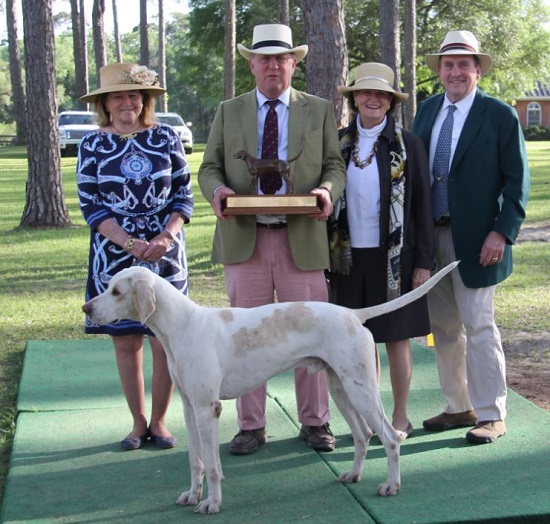
Grand Champion Midland Striker 2015 (Midland Rocket ’11 ex Staffordshire Moorland Stunning ’11) with (l-r) Daphne Wood, MFH, LIve Oak; Mason Lampton, MFH, Midland; Mary Lu Lampton; and Marty Wood, MFH, Live Oak / Leslie Shepherd photo
“I can’t take credit,” admits Midland huntsman Ken George, “because I didn’t breed him, but he’s one of a kind!”
A sober demon could be considered a contradiction in terms, but Ken describes Midland Striker 2015 as a foxhound possessing surprisingly contradictory traits. The handsome Crossbred dog hound was judged Grand Champion of Show at the tenth annual Southern Hound Show on April 9, 2016 at Live Oak Plantation in Monticello, Florida.
“The whole litter is fantastic,” continued Ken. “As an unentered hound last season, Striker was in on ten kills. He’s always right there.
Huntsmen sometimes worry about a first-year hound being too precocious. Often, by the second or third year, such hounds begin to think too much of themselves as individuals to fit in as good team members of the pack. Ken’s not worried about Striker in that way.
The Irish Hunter: An Exceptional Horse Across Any Country
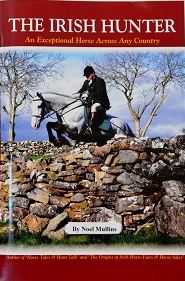
The Irish Hunter by Noel Mullins, 2015, Forewords by Professor Patrick Wall, Chairman of Horse Sport Ireland and Hugh Leonard, Chairman of The Traditional Irish Horse Association, color, 208 pages, CaseboundThe Irish Hunter: An Exceptional Horse Across Any Country includes a portfolio of some five hundred photographic images taken at more than sixty hunts by photo/journalist Noel Mullins in his travels in Ireland and abroad over the last twenty years. More than two hundred of the images illustrate the exceptional jumping ability of this marvellous horse tackling a wide variety of natural cross country obstacles such as stone walls, ditches, hedges, streams, and double banks as well as man-made obstacles such as gates, concrete railings, metal barriers, wire, pallets, and even the bed post and church pew that one might occasionally come across hunting in the Irish countryside!
In hunting fields in North America, Mullins has photographed the Irish Hunter out with the Green Spring Valley, Genesee Valley, Orange County, Mr Stewart’s Cheshire, Lowcountry, and Palm Beach Hounds.
In his Introduction the author looks at how horses originated in Ireland from wild horses 28,000 years ago to domesticated horses circa 2,400 BC, and some of the various breeds that graced the Irish countryside since, such as the Irish Hobby, the Garraun, Donegal, Cushendall, Rathlin, and the Kerry Bog Pony. Then there’s the Irish Draught Horse, the Connemara Pony and the Thoroughbred, whose offspring give rise to what we know today as the Irish Hunter, also known as the Irish Draught Cross and the Irish Sport Horse.
Junior Field Hunter Championships: More Than a Competition
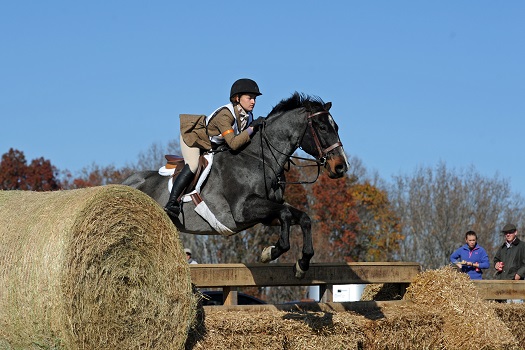
Heather Feconda, Loudoun-Fairfax Hunt (VA), was Champion, 13 & Over, on Yogi. / Richard Clay photo
The Junior North American Field Hunter Championship competition that began modestly twelve years ago between a handful of geographically-close Virginia hunts continues to expand in scope. This year’s competition involved juniors from twenty-seven hunts located across six MFHA Districts.
The program is succeeding because it’s purpose rises above just competition. Founders Douglas Wise, MFH, Old Dominion Hounds and Iona Pillion from the Blue Ridge Hunt had a larger dream: bring children to new hunting countries and open their eyes to the fact that these playgrounds don’t just happen to be there for them by chance, but have been nurtured and conserved for the perpetuation of wildlife, open space, and for those who treasure the natural world.
“We want these kids to know what a conservation easement is,” said Marion Chungo, one of the organizers.
The East Galway Foxhounds at McDonagh’s Pub
What follows is a report on a fine day’s hunting, a description of a brilliantly executed new kennel complex that any hunt contemplating new kennel construction will appreciate, and an opportunity to become Joint-Master of an Irish pack for any foxhunter yearning for more adventure!
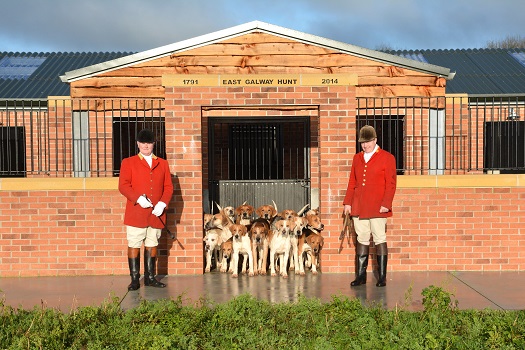
(l-r) East Galway Foxhounds Joint-Master Joe Cavanagh and huntsman Liam McAlinden with hounds at the New Kennels / Noel Mullins photo
The history of the East Galway Foxhounds goes back to Giles Eyre of Eyrecourt who kept a pack of hounds from about 1790. The East Galway Foxhounds was founded in 1880.
In addition to those milestones, the year 2014 will go down as a proud year for the East Galway followers. A brand new state of the art kennel complex was developed and financed by Joint-Master Joe Cavanagh and handed over to the hunt recently. Cavanagh, a successful businessman and a former owner of Cavanagh Foundry in Birr, is passionate about hunting. A former Master of the Ormond Hunt for twenty seasons, he joined the mastership of the East Galways eight seasons ago. Joe bred the international eventer Comanchee who with his rider James Robinson was third at Burghley and fourth at Badminton, the latter which he competed in ten times, and the last time at nineteen years of age!
The project of building the new kennels has taken Cavanagh three years from purchasing the site, visiting kennels in the UK and Ireland for ideas of what mistakes to avoid, securing planning permission, and then building. Meticulous about detail, his top priorities were the welfare of hounds and horses and comfortable surroundings for the huntsman to do his work.
Mr. Stewart’s Cheshire Foxhounds: A History

Scarlet on Scarlet: 100 Years of Hunting with Mr. Stewart’s Cheshire Foxhounds 1912-2012, Prue Draper Osborn, 278 pages, Illustrated, color, $100.00 (benefits The Cheshire Hunt Conservancy)
As many of our North American hunts reach their hundredth anniversary milestone, some have produced history books rich with photos and other memorabilia to tell their stories. One of the best is Scarlet on Scarlet: 100 Years of Hunting with Mr. Stewart’s Cheshire Foxhounds 1912-2012 by Prue Draper Osborn. This handsome coffee-table book is not only the history of the legendary hunt, but it’s also the story of the many families who have hunted with the Cheshire Foxhounds, often through three and four generations.
The history of Mr. Stewart’s Cheshire Foxhounds could be divided into three phases: its founding by Plunkett Stewart in 1912; its five-plus decades under the leadership of the late Nancy Penn Smith Hannum; and the latest and perhaps most controversial, the transformation from an all-English pack to a Crossbred pack.
George Briscoe: Grand-Master of Hounds
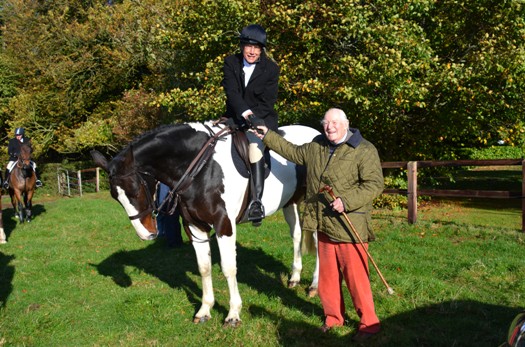
George Briscoe, MH of the Tara Harriers for 71 years, greets Charlie Noell of Ardbraccan House, County Meath, and the Elkridge-Harford Hunt (MD). / Noel Mullins photo
If there were a title of Grand Master of Hounds in our hunting world, George Briscoe would certainly fit the bill. This season George Briscoe hosted his seventy-fifth consecutive opening lawn meet of his beloved Tara Harriers at Craystown, County Meath. The occasion marked his seventy-first season as Joint-Master, making his period as Master and for a time huntsman a world record. Especially when you consider that the majority of the hunt followers were not even born when he succeeded his father in the Mastership in 1942 at age twenty-one.
George is one of nature’s gentlemen, with a broad welcoming smile, a kind word for everybody, and unbounded passions for hunting, the farming community, and the Tara Harriers. He never misses an opportunity to remind followers of the illustrious history of the Tara Harriers. His sitting-room window looks out onto the Hill of Tara, the royal seat of the High Kings of Ireland—probably the most important ancient site in Ireland, the history of which goes back as early as 5,000 BC. George has penned two books on the life of a country gentleman which is a record of life around the big house, hunting, shooting, and fishing, as well as a few racy references just for good measure!
George was a great friend of Betty Bird and her husband Charlie, who was Joint-Master of the Meath Foxhounds from 1956-59 when George was hunt chairman. Later he hunted with the Bird’s home pack, Mr. Stewart’s Cheshire Foxhounds in Pennsylvania, USA. Interestingly one of George’s neighbours, Anne Kelly, left Ireland to work with Betty Bird producing horses for showing and hunting and settled in Pennsylvania. She married racehorse trainer Michael Moran whose mother Betty owned the Aintree Grand National winner, Papillion. Anne is now a Joint-Master of Mr. Stewart’s Cheshire Foxhounds.
The Whipper-In Revealed
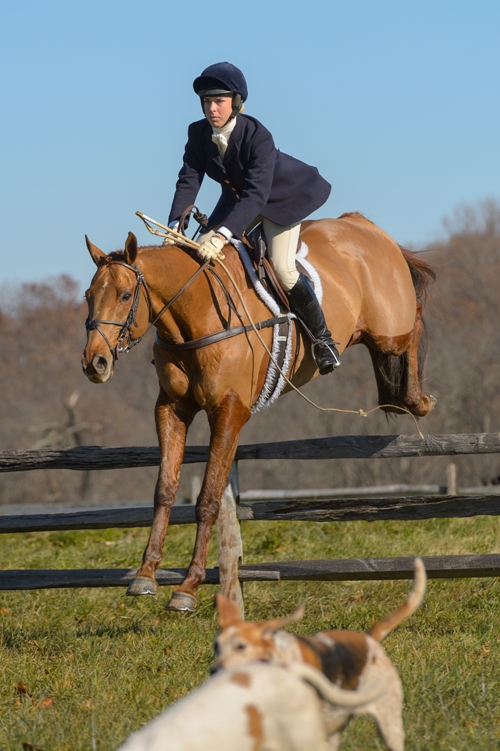
Stephanie Boyer, professional whipper-in, Mr. Stewart’s Cheshire Foxhounds (PA): “I am the huntsman’s eyes and ears, and I have to be honest with him at all times concerning what I see, whether he wants to hear it or not!” / Jim Graham photoYou may have noticed that the whipper-in has been Foxhunting Life’s theme this week. We field members watch these heroic figures, intent in their mission, standing in the irons, galloping on, claiming their “right-of-way” when passing the field, but what do they actually do?
For the answer to this question, read “The Whipper-In Is the Huntsman’s Right Hand” below.
The article “Whipper-In: What’s in a Name?” compares the differing agendas of the professional versus the honorary whipper-in and examines the best use of the whip they carry. “The Galloping Whip” by Brooksby is a poetic tribute to Charles Isaac, a nineteenth century whipper-in with the Pytchley (UK).
For anyone with aspirations to whipping-in one day, a particularly useful book devoted to the subject is Whipper-In by Dennis Foster, Executive Director of the MFHA. Indeed, it’s a good read for anyone interested in how the whipper-in, huntsman, and hounds work together in the field.
According to Peter Beckford, the whipper-in can be the decisive ingredient in turning a mediocre hunting day into a brilliant one. Here’s what he had to say in his classic, ageless 1781 treatise, Thoughts on Hunting.