The Hare that Must Be Fox
A third condensed installment from We Go Foxhunting Abroad: A First Venture with the Irish Banks and English Downs, Charles D. Lanier’s 1924 account of a father-daughter sporting trip to Ireland and England.
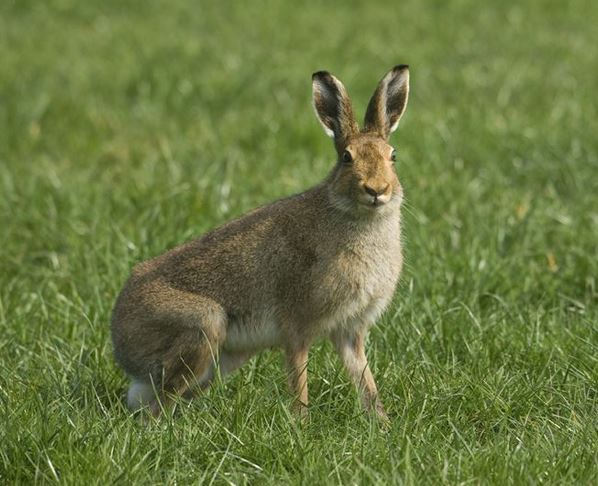
Irish hare
We decided that our new sensation would be a trial of Irish harehunting, so to Watergrass Hill we flivvered, to the meet of Mr. Robert Hall’s private pack of harriers. The Master was a slender, wiry, grey-haired man of seventy years, aquiline of countenance, with a singularly winning eye and smile under his velvet cap. He and his whipper-in were, of course, in green, and a dozen or so of the field of thirty or forty also wore the correct harrier colors.
Mr. Hall had the pride of an Irishman and a sportsman in his fifteen couple of huge Kerry “beagles,” and I think it would have been a hard blow to him if luck had been denied us that day. But it turned out to be a red letter day; I think we enjoyed having it so even more for the intense satisfaction it gave our enthusiastic host than for the sport intrinsically, which was of the very best and a revelation to us, who had not before followed a strong South Irish hare.
Sheep May Safely Graze

Sheep May Safely Graze, L.M. Clancy, 2015, 423 pages, paperback, $14.95, available at AmazonIrish sporting artist Liam Clancy has expanded his repertoire. He’s written a novel.
While foxhunting, prodigious drinking, and sex are well-handled ingredients of Clancy’s story—which takes place mostly in Ireland and England—those ingredients are only a framework upon which hangs a larger story of people, relationships, and the times. Our times: the Millennial, hunt sabs, the pathos of the hoof and mouth epidemic, the runup to the hunting ban, the dagger thrust into the heart of the English countryside by a government focused elsewhere.
If the publishing industry were not in turmoil, as it has been for the last decade at least, and if publishers would give first-time novelists half-a-chance, Clancy’s book could well replace titles by authors with household names that now occupy undeserved spots on the Best Seller lists. His dialog crackles, and his characters are wholly-formed individuals that you will care greatly for. Think of Maeve Binchy on steroids.
Our First Foxhunt Over the Irish Banks
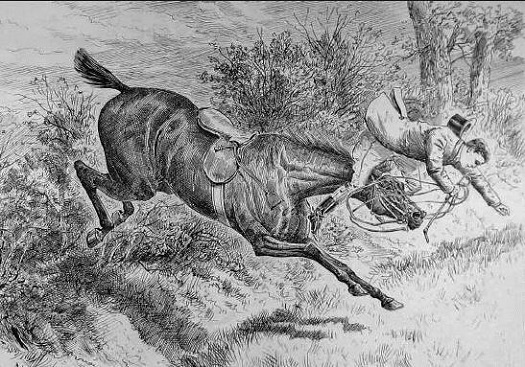
Here’s a second condensed installment from We Go Foxhunting Abroad: A First Venture with the Irish Banks and English Downs, Charles D. Lanier’s 1924 account of a father-daughter sporting trip to Ireland and England.
We put on our hunting things Saturday morning and climbed into the flivver for our first hunt with the United.
B had taken care to remove from her coat the orange collar of our home hunt colors, and I wore the regulation “visiting” dress of American custom—dark Oxford grey coat, cream colored Bedford cord britches, plain black jack boots and hunting bowler. I have never become an authority on the niceties of hunting etiquette and was simply aware one could not go amiss in these unpretentious togs.
Our flivver soon began to overtake people bound for the meet, gentlemen and ladies jogging along on short-tailed beasts with enormous quarters and hocks, grooms leading horses with their riderless saddles carefully protected by slip covers from the showers, which appear in South Ireland without a moment’s notice or a discernable cloud; showers that pass away, generally, as quickly as they come, with no one paying the slightest attention.
Sure, And the Going Was Soft!
As the owner of a multi-media production studio, Steve Toepp knows what he wants to convey in his foxhunting videos but he finds it to be a challenging task. “Filming while mounted is the most difficult type of videography I have ever encountered,” Toepp says. “I am trying to develop riding techniques that keep […]
The East Down Foxhounds: Wearing the Saint Patrick’s Blue
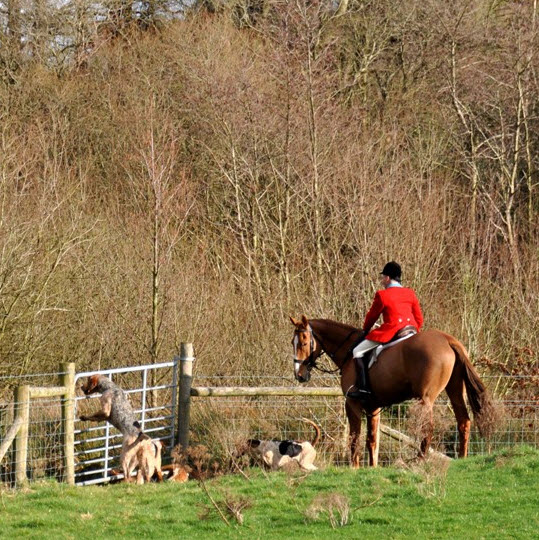
Huntsman Declan Feeney / Noel Mullins photoSaint Patrick arrived at Strangford Lough in 432 AD from Wales. He quickly converted the local chieftain Dichu, who gave him a barn in which to hold his services. On the site known as the cradle of Irish Christianity on the Hill of Saul (meaning Patrick’s Barn, or in Gaelic, Sabhall Phadraic), there remains today a church and round tower where services are still conducted each Sunday. Saint Patrick died on March 17 in 461 AD, and his remains are interred in nearby Downpatrick Cathedral.
The East Down kennels are in County Down, on the outskirts of the village of Seaforde, southeast of Belfast in Northern Ireland. Hounds were originally kennelled there by the Forde family from 1768 to 1837 and were known as Mr. Forde’s Hounds. They later became known as the Lecale Hounds, and subsequently the East Down Foxhounds. The hunt members wear the St. Patrick’s blue collar.
In Mr. Knox’s Country
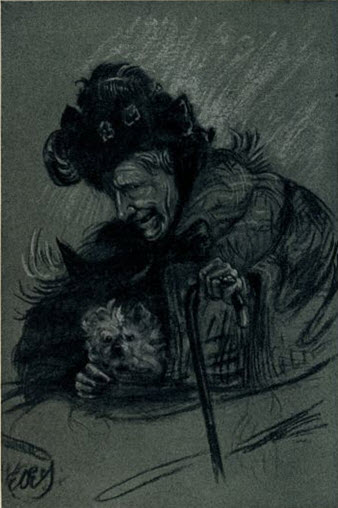
Mrs. Knox -Illustration by E. Somerville“‘He’s sleeping at Tory Lodge,’ said Mrs. Knox. ‘He’s cubbing at Drumvoortneen, and he has to start early. He tried to torment me into allowing him to keep the hounds in the yard here this season, but I had the pleasure of telling him that old as I might be, I still retained possession of my hearing, my sense of smell, and, to a certain extent, of my wits.’
‘I should have thought,’ I said discreetly, ‘that Tory Lodge was more in the middle of his country.’
‘Undoubtedly,’ replied Flurry’s grandmother; ‘but it is not in the middle of my straw, my meal, my buttermilk, my firewood, and anything else of mine that can be pilfered for the uses of a kennel!’ She concluded with a chuckle that might have been uttered by a scald-crow.” -Excerpt from “The Finger of Mrs. Knox”
Foxhunting Life is pleased to bring you downloads of short stories by some of our favorite sporting authors. These works are in the public domain and may be downloaded by you, enjoyed, copied, and shared as you see fit.
Killinick Harriers Point-to-Point Attracts American Visitors
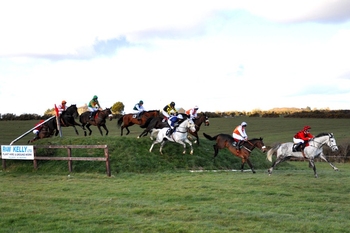
The Killinick Harriers Point-to-Point Races in County Wexford, Ireland are probably the last point-to-point bank races still run in Ireland. Traditionally, point-to-points featured members’ and farmers’ races that were run over natural fences such as the double bank fence in the photograph. Now most Irish point-to-points are run over standard chase fences. Martha C. Wadsworth, Ann […]
The Ballymacad Foxhounds at Castlerahan
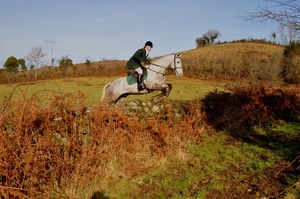
Huntsman Kevin Donohue at Carrichavee RockThe area around the Ballymacad Foxhounds meet at Castlerahan on the outskirts of Oldcastle, County Meath in Ireland is steeped in Irish history. It is part of the old Royal Capital of Ireland. There are many hunting references to be found in the area. The entrance to the town of Oldcastle is over Sliamh na Callaigh which looks out on Loughcrew, the five-thousand-year-old site of the Summer Solstice, where one of the most important High Kings of Ireland, King Ollamh Fodhla was buried in 1277 BC. He officiated at the Feis Teamhrach or The Great Fair held on the Hill of Tara, where in addition to legislative affairs of the ancient Brehon Laws, he introduced horse fairs, horse racing, and hunting.
Abandoned Horses at Dunsink to Be Helped
A coalition of local government and a private trust will help the abandoned horses at Dunsink, a common grazing ground near Dublin. The Fingal County Council and the Irish Horse Welfare Trust drew up the plans jointly. According to Sharon Newsome, spokeswoman for the trust, there are approximately sixty horses on the 160-acre site at […]
Thousands of Horses Abandoned in Ireland
The Daily Mail reports that thousands of horses—perhaps as many as one hundred thousand—are being abandoned in Ireland as a result of the financial crisis there. Many are brought by their owners to common grazing grounds, such as Dunsink tip near Dublin, and left to fend for themselves. Some too weak to survive have had […]