
“Dr. Joe”: An Appreciation
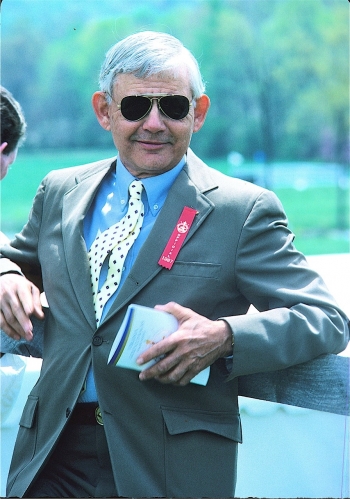
“Dr. Joe” Rogers, MFH / Douglas Lees photoDr. Joseph M. Rogers, who died March 8 at his beloved Hillbrook farm near Hamilton, Virginia, was of a rapidly disappearing breed of Virginians whose financial resources made possible the pursuit of a mission to preserve the countryside before it passed from reality to a lithographic memory.
These Virginians did not keep score with coin. The acquisition of land was not an egotist’s pursuit, and its preservation was not a beauty contest. Land was acquired and cared for because it represented an irreplaceable resource. That it provided the setting for pursuit of agricultural business and field sport was a cherished benefit, not a root rationale. To do otherwise, he believed, was to leave God’s earth to the vagaries of the marketplace.
“Dr. Joe,” as he was known by all, was at heart a man of that earth. He admired a craftsman who could build a proper four-panel fence or shoe a horse as much as he respected a man who made his fortune in business. In many cases, more so. He took pride in being able to train one species of canine to be capable of pursuing another much craftier, quicker, and agile species—a sport called foxhunting, in which the hunted had nearly insurmountable advantage over the hunter. It is a picturesque sport, photographed, illustrated, written about, and otherwise memorialized. But it was also a lot of hard work when you were in charge of bringing the show to the field.
Dr. Joseph M. Rogers, MFH, Dies at Home on Hillbrook Farm
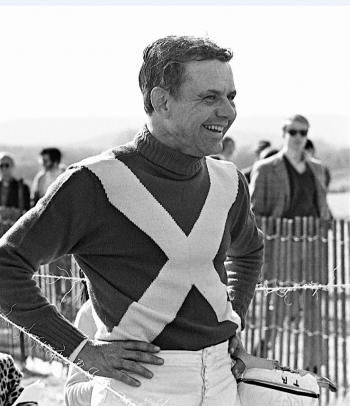
At the Piedmont Point-to-Point in the 1970s / Douglas Lees photoDr. Joseph Megeath Rogers, 90, died on Saturday, March 8, 2014 at his Hillbrook Farm near Hamilton following a stroke. While he occupied a gigantic space in the world of foxhunting, that world was but a small part of his very full, productive, and generous life.
Physician, farmer, Master of Foxhounds, steeplechase rider and trainer, businessman, rural land conservationist, and philanthropist, Dr. Rogers was a tireless advocate and practitioner of country living whose contributions in a broad range of interests were made quietly and with little fanfare.
His public persona was most closely connected with remarkable success as an owner, trainer, and rider of some of Virginia’s most successful steeplechase horses running under his familiar red with white cross sash silks. But his success in that rugged and dangerous sport was merely a visible extension of his commitment to protect Virginia’s rural countryside, a mission he often defined as a moral obligation.
A Story Lately Told

A Story Lately Told: Coming of Age in Ireland, London and New York, Anjelica Huston, Scribner, 2013, 253 pp, ill., $25.00Anjelica Huston seemed to have it all—a famous and talented father whose wealth gave her an idyllic childhood in Ireland and whose many contacts exposed her to some of the world’s most exciting people; a beautiful mother; success as a model; fox hunting with the Galway Blazers. But her memoir, A Story Lately Told: Coming of Age in Ireland, London and New York, reveals the dark detours her life took after her parents separated and her thirty-nine-year-old mother was killed in a car crash.
Huston eventually followed her father, renowned director John Huston (Joint-MFH of the Galway Blazers), and her grandfather, actor Walter Huston, in finding success as an actress and a director. The American actress became the first third generation winner of an Academy Award, for her performance in the 1985 film, Prizzi’s Honor.
But acting was not a path she originally wanted to take, she reveals in this memoir. She adored her father, yet feared him, too, resisting his domineering attempts to push her into becoming an actress. Instead, she opted for a modeling career, knowing it would displease him. And she fell into a relationship at age eighteen with a brilliant but troubled fashion photographer twenty-four years her senior.
Hedge Hopping with the Blackmore Vale
Here’s a view through the helmet-cam of a day with the Blackmore Vale (UK)—a hunting country where riders are free to take their own line over the hedges. Catch a ride with this young lady from Virginia jumping the hedges for the first time. Is she tickled, or what? Posted March 8, 2014
Elliott Roosevelt, MFH
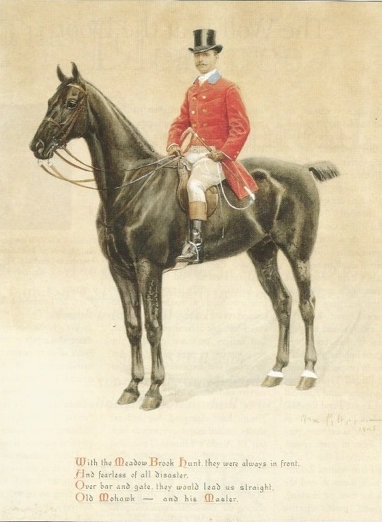
This portrait of Elliott Roosevelt, MFH of the Meadow Brook Hunt, Long Island, NY, was painted in watercolor by Max Klepper in 1915. Roosevelt was the father of First Lady Eleanor Roosevelt. (Yes, that was her maiden name as well.) The Master led his field over thick and unyielding post-and-rail fences that started at four […]
Foxhound in the House: Redux
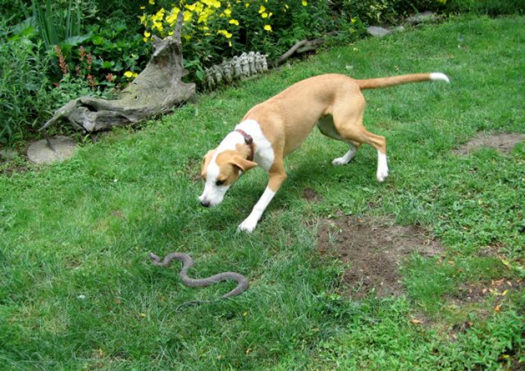
Just about one year ago, Cathy Eising wrote and asked Foxhunting Life if we could help with advice on how to raise her young “mostly foxhound” as a family dog in a suburban environment. She was especially concerned about whether or not she could curb its hunting instincts to the point where she could take it for long walks in the woods off the leash.
We submitted her question to our FHL Panel of Experts, the consensus of which cast some doubt on prospects for the achievement of Cathy’s goal, primarily because of the hound’s young age. Our Experts were right! Cathy has written to bring us up-to-date on her project:
“I’m not sure I would adopt another foxhound as family dog,” Cathy reports, “but I have learned much, stayed in good physical shape, and grown to appreciate the world of foxhunting.
“Although my first goal—having this animal walk off-leash and follow me in wooded areas—has not been achieved, much has been learned in the ongoing efforts to fulfill his energy and redirect his drives!
How Disney Inspired the MFHA Conservation Award

It was the Disney Company that inspired the creation of the Chronicle of the Horse/MFHA Conservation Award, but for the wrong reasons!
And it’s most fitting that George Ohrstrom III was presented with the Conservation Award at the 2014 annual meeting of the MFHA, for he is connected through his family to the genesis of the award. Ohrstrom currently serves as co-chairman of the Piedmont Environmental Council (PEC), the respected and influential Virginia-based conservation organization that the Ohrstrom family was instrumental in forming in the 1970s.
The PEC gained national attention when they demonstrated how local grassroots efforts—combined with a clever strategy of enlisting the support of the nation’s most prominent historians—defeated the Disney Company’s efforts to build a theme park in Virginia’s historic countryside in the fall of 1994. At the time the PEC went to war, Disney had already quietly amassed political support in the Virginia legislature, had seduced the local Chambers of Commerce and real estate boards, and had secured the rights and promises of approval to the land they wanted, on the eastern border of some of Virginia’s prime foxhunting country.
George L. Ohrstrom III Wins MFHA Award
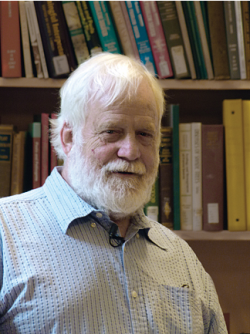
George L. Ohrstrom III / Matthew Klein photoEver since 1888, the Blue Ridge Hunt has pursued foxes through the Shenandoah Valley of Virginia—a verdant, rolling grassland dotted with small woodlands, perhaps fifteen miles across, nestled between the Blue Ridge Mountains to the east and the Allegheny Mountains to the west.
The Shenandoah River flows northeasterly along the eastern edge of the valley, passes under the western slopes of the Blue Ridge, and empties into the Potomac River at Harper’s Ferry, W.Va.—a confluence described three centuries ago by Thomas Jefferson as “one of the most stupendous scenes in nature.”
Home to a mostly rural population, the Shenandoah Valley has long been a destination of unsurpassed beauty to vacationers and sightseers. The northern part of the Valley that is home to the Blue Ridge Hunt also finds itself to be an object of lust to developers from Washington, D.C., and Northern Virginia to the east and the nearby city of Winchester to the west. While many landowners find it hard to resist the potential financial windfall from development, others believe that to relinquish such natural beauty to untrammeled development would be a crime against nature.
Along with its sister landscape just to the east of the Blue Ridge—Virginia’s Piedmont—a passionate calling for preservation has rallied many of its citizens to battle. Few, however, have responded like George Ohrstrom III. The scope and creativity of Ohrstrom’s efforts locally, nationally, and internationally earned him the MFHA’s Conservation Award for 2014.
Douglas Lees to Speak, Exhibit Photographs
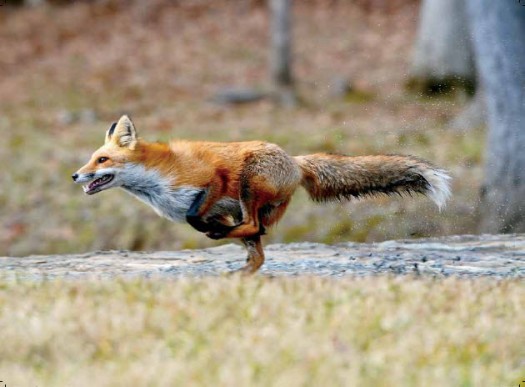
Douglas Lees photo The photography of Douglas Lees has long been a benchmark of such excellence that Lees has earned the admiration of even the best of his camera-toting peers. Lees will speak and exhibit his photographs on Sunday, March 2, 2014 at 4:00 pm at Blue Ridge Farm, 1858 Blue Ridge Farm Road, Upperville, […]
Maryland and Virginia Lawmakers Consider Sunday Deer Hunting
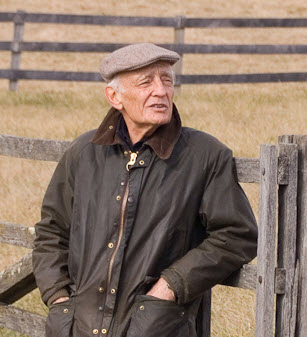
Karen L. Myers photoA bill to allow the hunting of deer and other wildlife on private property and state waters on Sunday has been passed by the Virginia House of Delegates and sent on to the state Senate for their consideration. Proponents of the bill cite the falling numbers of hunting licenses issued in the state, and believe that Sunday hunting will help stem the loss in revenue.
Maryland lawmakers are also considering the hunting of deer on Sunday, but seemingly for a different reason—the culling of the expanding deer herds.
There is resistance in both states to the enabling legislation. Some of the resistance comes from predictable directions—anti-hunting activists, hikers, trail riders, religious leaders—yet some of the resistance comes from a surprising quarter—foxhunters.