March Madness in Montford
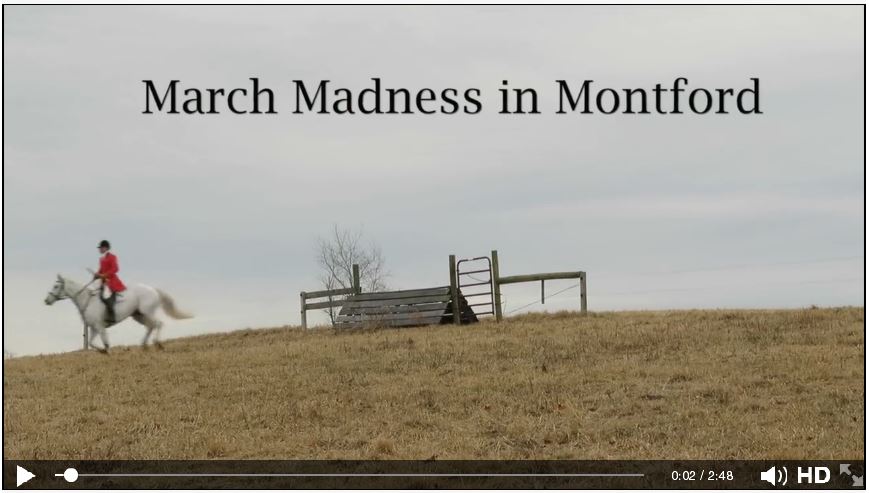
Photographer Phil Audibert in Gordonsville, Virginia has been practicing his artistry with the still camera in the hunting field for some time. Recently he’s been experimenting with the video camera. Here’s the Keswick Hunt (VA) in action with views of the hunted fox, Keswick’s pack of American hounds in full cry, and staff and […]
Hugh Robards to Hunt Hounds for Middleburg Hunt
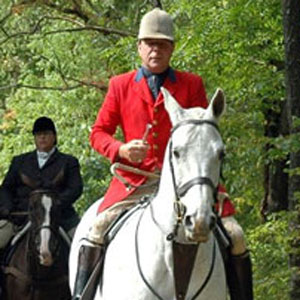
Hugh Robards cubhunting with the Rolling Rock HuntTalk about experience. Hugh Robards has spent fifty-three years in hunt service. He whipped-in to some of the legendary huntsmen in England—Brian Gupwell at the Eridge (later to become huntsman for the Duke of Beaufort), Percy Durno and Captain Ronnie Wallace at the Heythrop, and Charlie Wilkin at the Wynnstay.
Upon Captain Wallace’s recommendation to Lord Daresbury, MFH of the County Limerick Foxhounds, Hugh moved to Ireland to take up his first post as huntsman. There he remained for twenty-seven seasons showing world-class sport to the Irish—none keener—and visiting sportsmen and women from around the globe.
After parting from the Limerick, he came to the U.S. to help rebuild the Rolling Rock Hunt (PA), remaining there as Master and huntsman until 2007. From Rolling Rock he moved to the Saxonburg Hunt (PA) where he served as huntsman until coming to the Middleburg Hunt last year as first whipper-in to huntsman Barry Magner. (Barry is moving to Australia this season, and we hope to catch our readers up with him in another article.)
“Hugh continually reinvents himself because of his love for his work,” said Juli Robards, his wife. “Transcending change is one of his great qualities, and I’m unabashedly one of his biggest fans!”
Those who have hunted behind him are big fans as well. Tony Leahy, who grew up in Ireland, is first vice-president of the MFHA and serves as Master and huntsman of the Fox River Valley Hunt (IL). “Hugh is without question one of the best huntsmen I’ve seen,” said Tony. “I remember hunting behind him at Limerick, and I’ve seen him do amazing things!”
Fox River Valley Convoy Is Grand Champion at Southwest Hound Show
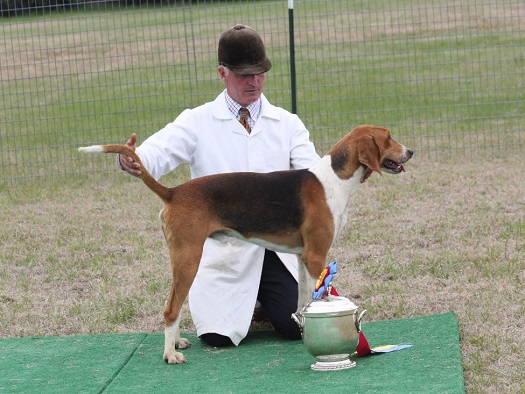
Fox River Valley Convoy, unentered Crossbred dog hound shown by Tony Leahy, MFH, is Grand Champion of Show at the Southwest Hound Show. / Sammy Buczkowski photo
Fox River Valley Convoy, an unentered Crossbred dog hound, was judged Grand Champion of Show at the Southwest Hound Show. Brazos Valley Mystic 2010—Grand Champion of Show for the last three years running—made a hard run at an unprecedented fourth consecutive title, but finished as Reserve Champion to Convoy.
The Southwest Hound Show was held on April 19, 2014 at Greenwood Farm in Weatherford, Texas. All hounds are shown in the same ring, and were judged this year by Tony Gammell, professional huntsman for the Keswick Hunt (VA).
“It’s a lovely, small show; you can walk around and see everyone, said Tony Leahy, Master and huntsman of the Fox River Valley Hunt (IL), who looks forward to entering Grand Champion Convoy in the fall. “It was my first visit to Texas, and the people couldn’t have been nicer, more accommodating, or more welcoming.”
How the Experts Judge a Class of Foxhounds
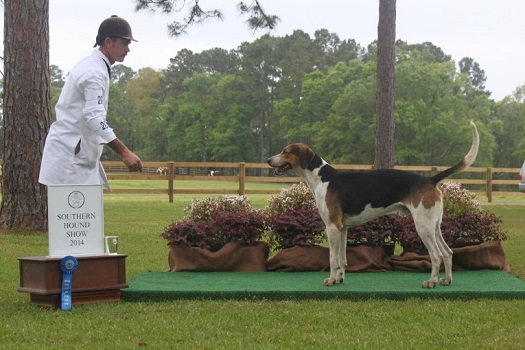
Live Oak Dandy was Grand Champion of Show at the Southern Hound Show this year. / Cathy Taber photo
The hound show season, now underway, provides an excellent opportunity to improve one’s eye for foxhound conformation by judging from ringside just for fun. The exercise not only makes the day more interesting, but educational as well. Especially when you can collar a friendly judge after the class and ask him why he didn’t like the hound you adored, or why he picked a hound you thought was common. (Obviously, you must frame your question such that the judge understands that you are seeking an education and not leveling criticism!)
It can be intimidating to watch a procession of foxhounds enter and leave the ring and wonder how in the world the judge can sort them all out. For example, how does he compare a hound he is looking at to one he saw ten minutes ago? Ten years ago, I asked some top judges how they judged a class, and here’s what I learned.
Excerpt from “Reynard the Fox”

This joyful image of foxhounds arriving at the meet, conscious all the while of the attentive whipper-in, is an excerpt from the chapter, Hounds, in John Masefield’s epic poem, Reynard the Fox, written in 1919. John Masefield was Poet Laureate of the United Kingdom from 1930 to 1967. [Note: Dansey is the whipper-in, and Maroon is his horse.]
There was a general turn of faces,
The men and horses shifted places,
And around the corner came the hunt,
Those feathery things, the hounds, in front,
Intent, wise, dipping, trotting, straying,
Smiling at people, shoving, playing,
Nosing to children’s faces, waving
Their feathery sterns, and all behaving,
One eye to Dansey on Maroon.
Antique Hunting Scene or War?
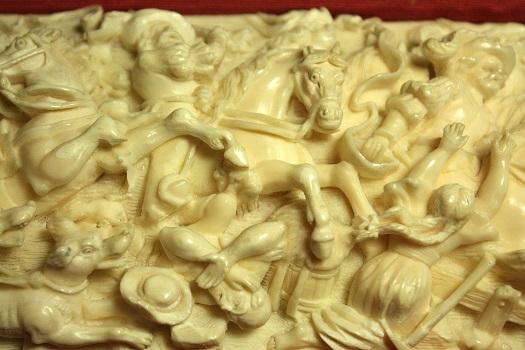
Closeup view
Grotesque as this sculptured scene may appear—men and women trampled under a rush of mounted riders on horses, accompanied by dogs on leads—the collector believes that this antique ivory carving is a fox hunt, not a war scene, because of the dress, dogs, and accouterment. He has asked Jaynie Spector at Dog and Horse Fine Art in Charleston, South Carolina to offer this carving.
Ms. Spector has studied with Sotheby’s in London, worked as an art advisor, worked at Christie’s Contemporary Art Department, and spent years at a Soho art gallery in New York before starting her own art gallery in Charleston. While the carving boasts provenance from a gallery in Paris, Spector believes it is the work of a German sculptor.
Forrard Aloft!
Photographer Adrian Jennings has discovered a unique way to follow hounds. Enjoy this short video clip of the Mooreland Hunt foxhounds in Alabama. Posted April 8, 2014
Outrageous Fortune
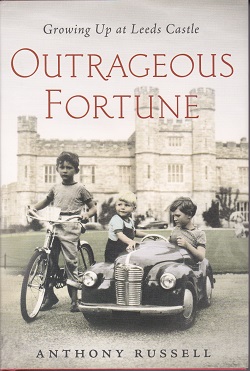
Outrageous Fortune: Growing Up at Leeds Castle, Anthony Russell, St. Martin’s Press, New York, 2013, 306 pages, Illustrated, $26.99Imagine having two grandmothers who both live in their own castles. Anthony Russell, a writer, musician, and composer in Los Angeles, comes from a family that served England’s kings and queens for five hundred years, which left them very, very wealthy…wealthy enough for his grandmums to purchase castles in England and Ireland.
Russell tells the story of a childhood at the highest levels of British aristocracy in Outrageous Fortune: Growing Up at Leeds Castle. His father, Lord Ampthill, was Prince Philip’s roommate at boarding school. Lord Ampthill also was known as “the Russell baby,” whose paternity and conception were at the heart of a sensational divorce case in the 1920s and a court challenge to his right to the title.
Lord Amptill’s mother (Lady Ampthill, she of the castle in Ireland) swore that he was the son of her husband, despite the fact that their marriage was never fully consummated. (It all had something to do with a bath sponge.)
Lady Ampthill (the author’s grandmother) was a well-recognized figure hunting with the County Galway Foxhounds (the Blazers). She rode side saddle well into her later years, until suffering a fatal accident in the hunting field in 1976.
Why We Cover the Hunt Races
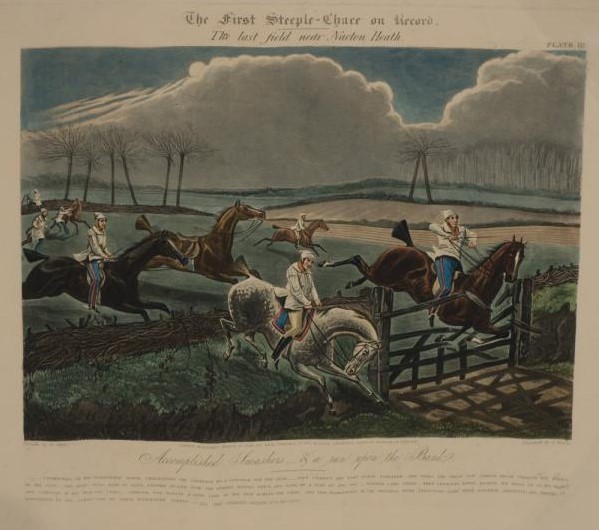
The first point-to-point race of the 2022 season is scheduled in Virginia for March 5 (rain date, March 12). The eighth and final hunt point-to-point of the season will be run on May 1. Foxhunting Life reports on most of these jump races as the season progresses. Some readers across North America might wonder why.
My answer is threefold: first, the very notion of a steeplechase race originated with foxhunters; second, many of our great field hunters have come from the ranks of the timber horses and conversely, many of the best steeplechase horses have their start in the hunting field; and third, most of the steeplechase jockeys are foxhunters as well.
Why We Cover the Hunt Races
My answer to the question is threefold: first, the very notion of the point-to-point race originated with foxhunters; second, many of our great field hunters have come from the ranks of the timber horses, and conversely many of the best steeplechase horses have their start in the hunting field; and third, most of the steeplechase jockeys are foxhunters as well.
As Catherine Austen reminds us in Thoroughbred Owner & Breeder, “Hunt racing has its roots firmly lodged in the hunting field. Point-to-pointing started when two hunting men, Edmund Blake and Cornelius O’Callaghan, challenged each other to a race in 1752 for four-and-a-half miles across country from Buttevant Church to Donraile Church in County Cork. They jumped everything in their path, and by keeping the steeple of Donraile Church in sight (steeple-chasing), the two men kept to the planned route along the banks of the Awbeg River. The same line can still be taken while hunting with the Duhallow Foxhounds now.
“Amateur jump racing evolved from there….”