Hedge-Hopping in England
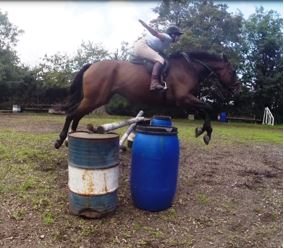
My top moment of any Blackthorn & Brook holiday comes as our guests pull up after a run having encountered their first hedge. They make a fuss of their horse, turn to me and grin.
“I see what you mean about sitting up!” is a recurring comment.
Hedge-hopping is a much discussed feature of our holidays. The subject is met with excitement, trepidation, anticipation, fear, bravado, and everything in between, as it really is an unknown quantity for the majority of our American guests.
With this in mind, we have put together a short video and accompanying blog below, explaining a little of how we prepare ourselves and our horses for popping the hedges in style. What follows is a collection of basic principles that work for us. If anyone has questions or comments—challenges, improvements, ideas—we’d love to hear from you.
Thoughts on Field Hunter Competitions
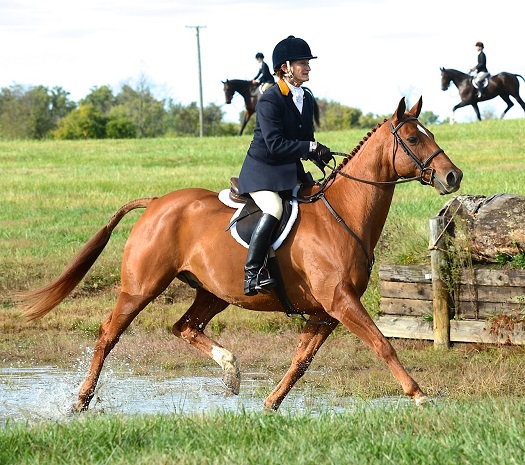
A competent horse and rider, confidently and comfortably crossing the country: what we all aspire to! Laurie Ambrose and Stretch, winning the Theodora A. Randolph Field Hunter Championship in Virginia. / Douglas Lees photo
The recently held Theodora A. Randolph Field Hunter Championship in Virginia is a unique competition. It differs from the more usual one-day hunter trial in which foxhunters ride individually over a course of obstacles, often including lead-overs, trot fences, fast gallops, and hold-hards.
In the Theodora A. Randolph Championship format (see Susan Monticelli’s report in separate article), field hunters are observed by mounted judges for several days during a series of actual foxhunts behind different packs of foxhounds. The judges’ task during these hunts is to select those horse/rider combinations they wish to see in a final day of competition. The finals, held each year at Glenwood Park in Middleburg on the morning of the Virginia Fall Races, consist of a mock hunt following a Field Master over a course of obstacles, and then individual tests similar to those in a hunter trial for the final ten or so selected.
While some avid and capable foxhunters believe that foxhunting is not a competitive sport and decline to participate, and while I can appreciate and respect their view, I also see benefits from these competitions. From one aspect, it’s a great value. If you want a hunting holiday in Virginia, you get to hunt with four different packs for an entry fee of not much more than the cost of a single cap at some of these hunts. And parties all week to boot!
Piedmont Pair Are 2014 Field Hunter Champions in Virginia
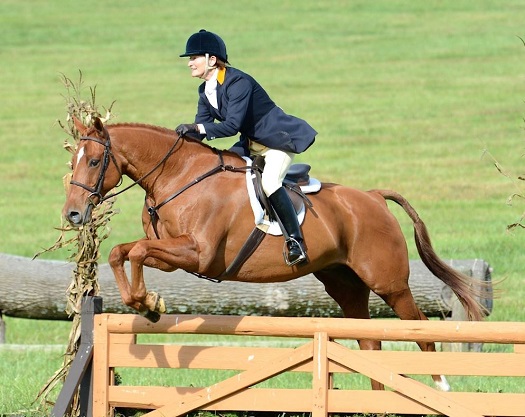
Laurie Ambrose and Stretch from the Piedmont Fox Hounds won the 2014 Mrs. Theodora A. Randolph Field Hunter Championship. / Douglas lees photo
In a hark back to bygone days, the Theodora A. Randolph Field Hunter Championships combine a whirlwind week of foxhunting and socializing against a backdrop of sporting estates, well-bred foxhounds, and passionate foxhunters. Always held the last week of September and ending the first weekend of October, this year’s event attracted seventy-four entries with a brilliant card of hosting hunts: Orange County Hounds, Blue Ridge Hunt, Loudoun Fairfax Hunt and the Piedmont Foxhounds. Judges ride alongside the field to observe the competitors in action before selecting several riders each day, based on how well their horses performed, for the finals on Saturday. Every hunt hosted a tailgate, and there were social functions every evening.
Foxhunters from twenty-two hunts and eight states rode in the event: Andrews Bridge, Belle Meade, Blue Ridge, Bull Run, Casanova, Deep Run, Elkridge-Harford , Farmington, Glenmore, Hillsboro, Keswick, Loudoun Fairfax, Lowcountry, Middleburg, Newmarket-Middletown Valley, Old Dominion, Orange County, Palm Beach, Piedmont, Snickersville, Warrenton, and Whiskey Road. Riders came from Florida, Georgia, Maryland, Pennsylvania, South Carolina, Tennessee, and Virginia. The six judges were Helen Brettell, Middleburg; Snowden Clark; Liz McKnight, ex-MFH, Elkridge-Harford; Ginny Perrin, MFH, Deep Run, and the husband-and-wife team of Lincoln Sadler and Cameron Sadler, MFH, Moore County.
British-Inspired Rabbit Hunt Took an Odd Turn
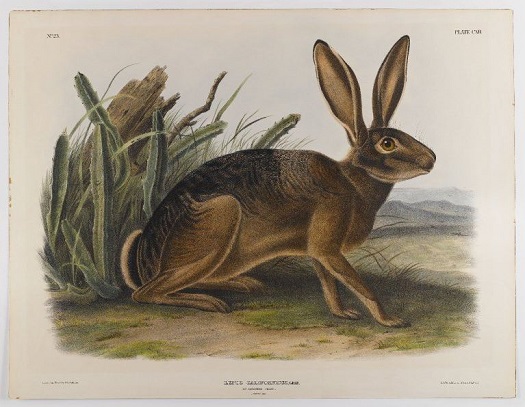
California hare by John J. Audubon
The early part of the last century saw the people of Riverside, California looking towards Great Britain for inspiration for their leisure activities.
This was chiefly because of the many British immigrants who had begun arriving here about 1889, primarily to invest in, among other things, the fast-growing orange industry. English customs were held in the highest esteem, especially among socially ambitious Americans, Tom Patterson wrote in his book, A Colony for California.
Riversiders engaged in such British activities as polo, high tea, and foxhunting. The latter did not usually include a fox, because foxes were not common in the area. Instead they substituted a more common animal, the jackrabbit. These hunts were conducted wherever a large area of open land could accommodate horses, hunters, hounds, and the prey.
Mongol Derby 2014: In the Hoofprints of Genghis Khan
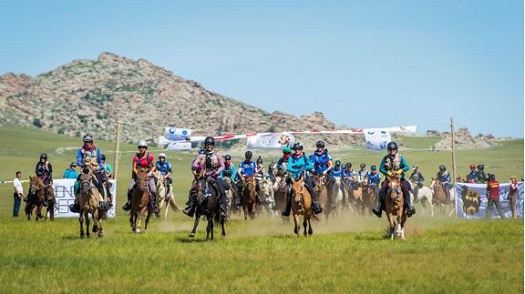
Day-One, Time-Zero, The Start! Foxhunters, race riders, and racehorse trainers were the frontrunners by Day-Three. / Richard Dunwoody photo
I am bent over at the waist, hands on knees, gulping air as the vet checks my pony. His heart rate is seventy-two and will come down to the required sixty-four in about five minutes. Mine is about two hundred beats per minute and no one cares. I used to watch my basketball player son stand like this during timeouts, trying to recover, and now I completely understand. I am exhausted and have only twenty minutes to recover before leaving on the next jet-fueled pony! This is Day-Six of the Mongol Derby and the urtuus (horse stations) are starting to blend into one.
I imagined myself romantically naming each pony and remembering everything about the rides between stations. As it happened, I not only forgot to name them—as half the time I was hanging on for dear life as they rocketed out of the stations and bolted for the next ten to fifteen kilometers—but I do not remember individual urtuus. I remember moments of complete panic as I thought I was going to die, or moments when I feared my comrades-in-saddle were going to die. Interspersed are memories of lovely meadows and fragrant pine forests, incredible views across mountains, and long, long rides when we wondered if we would ever get there.
Vaughn Clatterbuck, Whipper-In to Twelve Virginia Huntsmen
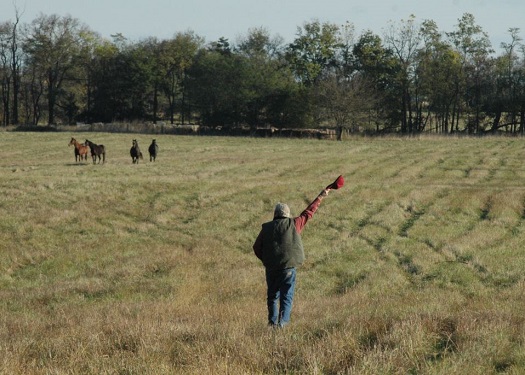
Vaughn Clatterbuck signals a view for the Blue Ridge hounds across his Bartley Farm // Nancy Kleck photo Vaughn Clatterbuck, who whipped-in to twelve Virginia huntsmen, died at home on his cattle farm in Millwood, Virginia at age seventy-six on September 24, 2014 after a lengthy illness. Among those huntsmen to whom Vaughn whipped-in are […]
Huntsman Walter Perry Dead in UK
Retired huntsman Walter Perry died in his nineties on September 17, 2014 in Crowcombe, Somerset, UK. Walter hunted the Devon and Somerset Staghounds from 1963 to 1971, the Dulverton East Foxhounds from 1971 to 1978, and accepted his final post in 1978 as kennel-huntsman and huntsman for the Quantock Staghounds. He retired from the Quantock […]
Remembering the Irish War Horse
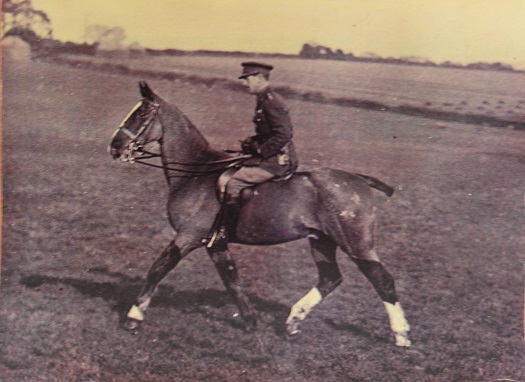
Fascinated by our summer series of articles about the WWI war horses on the occasion of the centennial of that horrific conflict, Noel Mullins, a regular contributor to Foxhunting Life, sent us this story that he wrote for this year’s Souvenir Programme of the Dublin Horse Show. Noel is a Member of the Royal Dublin Society Library & Archives Committee. His story is about Gladeye, a field hunter that went to war, survived, and returned to jump at the Dublin Horse Show in 1926.
War Horse Gladeye and Brigadier Walter Brooke
This year marks the centenary of World War I, and ceremonies around the world remember the nine million human casualties lost in the conflict. But it is often forgotten that eight million War Horses also lost their lives, going through the most terrifying experiences known to any living creature. War was declared on the July 28, 1914 and was expected to end by Christmas 1914, but sadly it lasted another four years until November 11, 1918.
Probably the two most well known Irish War Horses in history were Emperor Napoleon’s white horse Marengo and the Duke of Wellington’s Copenhagen who met at the Battle of Waterloo. Both are said to have been purchased at an Irish horse fair. War Horses in the mounted cavalry units were deployed in many battles in the first years of WWI, amongst them, the battles of Mons, First and Second Battles of Ypres, Festubert, Aubers Ridge, Marne, Vimy Ridge, the Somme Hill, and Cambrai.
Your Human Faces Are Showing
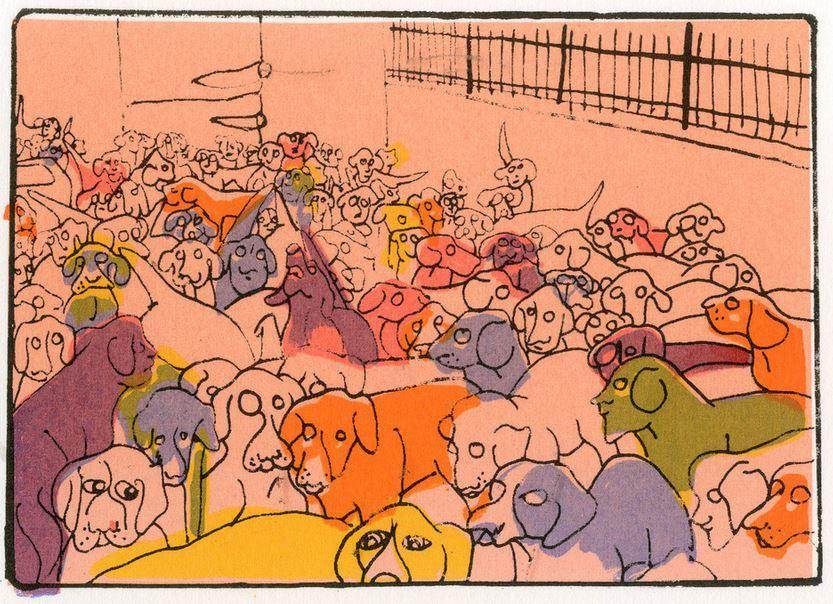
Perhaps because I’ve seen so many serious photographs of hounds in kennels, I was arrested and amused by this whimsical print by Emily Robards, daughter of a well-known huntsman and author. Emily’s dad has hunted hounds in Ireland and in North America, and Emily has whipped-in to him and spent most of her younger years in or near the kennels. I asked her to tell us about her art.
“Your Human Faces Are Showing” by Emily Robards
I am a visual artist who works in a variety of media such as photography, printmaking, collage, embroidery and paint. My work draws from dreams and memories, linking the spiritual, human, and animal worlds together with an underlining narrative of innocence and the uncanny. The work arises from the self, drawing from my past, while trying to take control of the present. I also work a lot with vintage photographs and text combining them to create new narratives.
The piece, “Your Human faces are Showing,” is a seven-colour limited edition screen print, approximately 11.4 x 8 cm. The print is slightly off register so they are not all exactly the same, which is called a print variable.
The print is based on an old photo my grandmother took of the County Limerick Foxhounds. The piece started out as a doodle in my sketchbook a few years ago, and stayed that way until my last year of college when I made it into a print. The drawing is relaxed, almost comical. I wasn’t worried about it being exact or anatomically correct. This relaxed idea towards the drawing I feel is what makes it a success.
Mountain and Muse: A Bicentennial
 The Port of Baltimore earned a place in American history two hundred years ago this month during the War of 1812. The British, after burning and sacking Washington, D.C. in August of 1814, turned their attention to Baltimore with an assault by naval and ground troops in September. Francis Scott Key, a witness to the naval bombardment of Fort McHenry, jotted down the words to what became our national anthem, “The Star Spangled Banner.”
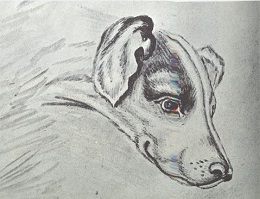
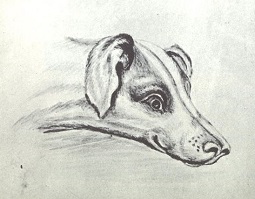
The Port of Baltimore earned its place in American foxhunting history that very same month—September, 1814. After the British fleet withdrew to make its final assault of the War of 1812 on New Orleans, a merchant ship entered the Port of Baltimore and disembarked two foxhounds from Ireland, Mountain and Muse.
Unusual for their appearance, speed, aggression, hunting style, and pre-potency, Mountain and Muse turned out to be progenitors of our principal American foxhound strains: July, Birdsong, Trigg, Bywaters, and Walker. The Midland Crossbred, developed by Ben Hardaway, MFH, found today in kennels all over North America as well as England, and having its roots in the July strain, also goes back to Mountain and Muse.