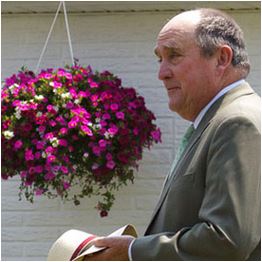
 C. Martin Wood, MFH / Karen L. Myers photoWhy do most huntsmen make up their packs for a day’s hunting with an odd number of couples, e.g., twelve-and-a-half couples rather than just twelve couples. Is there any practical reason? asked Kathy Rubin.
Three members of FHL‘s distinguished Panel of Experts offer not only their opinions, but expand their answers with sound hunting advice.
“There is no basis for the extra half couple,” says Marty Wood, “except perhaps for superstition. I have heard that it might just be that one extra hound that finds the fox for you on a day. I have seen lots of good sport provided by an even number of hounds, and, in my opinion, the correct number is made up of those hounds that should be hunting out of your kennel on a given day with no preference given to old favorites. It is especially critical for all of the pack to hunt evenly throughout the season, especially the puppies who need the experience most of all.”
Martin Scott subscribes to the superstition. “The extra hound catches the fox!” he says. “I always had a minimum of seventeen-and-a-half couples, and before Christmas I would often have more than that—even up to twenty-three-and-a-half to make sure that all the hounds I bred went hunting regularly. ( I probably bred too many you might say, and you might be right).
Scott continues, “If the pack did split then there was a choice of which lot to go with, i.e., with the older ones if I knew they were leading one lot and were less likely to change, or if early on in a hunt the ones heading for the best bit of country. Although the numbers may appear too many, I rarely had any problem, and only once in a while did the other lot have a better hunt than the main lot I had gone with. This was thanks to excellent staff work and the huntsman making his mind up quickly which lot he wanted to go with, and good teamwork saw the other lot quickly joining the main body.
“One of the advantages of line breeding is having the pack all the same in make and shape and thus enabling them all to keep together naturally and arriving at a point of crisis (a check) at the same time.
“To go back to the question it is partly superstition, but I always wanted that extra single hound.”
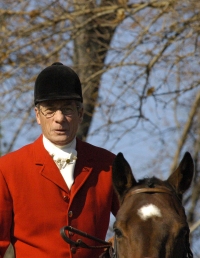 The late James L. Young, ex-MFH / Mark Kunkel photo
In answering Kathy’s question, Jimmy Young reinforces the same message we hear from Wood and Scott. “An important thing to learn here,” says Jimmy, “is that huntsmen don’t just go into kennels and empty out the building every hunting day. The overall size of the pack (ten-and-a-half couple versus twenty-two-and-a-half, etc.) is decided based upon country type, and making sure that every hound in kennel gets out to hunt at least once or more every week. Young and shy hounds will never have a chance to develop if they don’t have plenty of outings. They can’t learn anything about hunting in a kennel.
Young also suggests a practical reason for the extra half couple. “The huntsmen I know always draw a pack of “so many” couple plus a half couple. That extra, single hound acts as a ploy to make themselves and the whippers-in make accurate counts of hounds,” he says.
First Published July 10, 2010
Re-Published August 12, 2020