
 Aeron Mack / Middleburg PhotoAeron Mack is an honorary whipper-in. Recently she was bewildered by conflicting statements concerning martingales. She writes:
“According to Wadsworth [Riding to Hounds in America, 1962], running martingales are dangerous and not permitted, but I can’t find anyone who can explain exactly why. I recently took a clinic with Aidan O’Connell who explained the dangers of a standing martingale, which I agree with. Personally I do not use a martingale of any sort, but would like to be able to better explain to people why they can be dangerous. It would seem to me that, in the event the horse stumbles or falls, a running martingale would better allow him to keep/regain his balance. I also like that if I slip my reins over a tricky jump, the running martingale is also released, where a standing cannot be. Any words of wisdom on this topic would be greatly appreciated!
FHL
I’ve often been intrigued by the divide between the proponents of both types of martingale. In the hunting fields of England or Ireland, you’ll scarcely ever see a standing martingale. Those folks are aghast at its popularity here. They feel that when a horse really gets in trouble, it needs its head to be free and unencumbered to save itself and its rider.
On the other hand Wadsworth clearly took the opposite view. And certainly, standing martingales strongly outnumber the running variety in North America (unless the rider is English or Irish!).
Two members of our Panel of Experts weigh in on the question. Author/editor Steven Price is a first-class researcher and devoted student of horsemanship. Paul Striberry is a professional riding instructor specializing in riding and schooling for the hunting field. His home base is in Southern Pines, South Carolina, and he gives clinics around the country during the off-season.
 Steven Price
First, a refresher course: Martingales 101. A standing martingale, which attaches to the cavesson, prevents a horse from raising its head because of the pressure on the nose band. A running martingale, which is attached to the reins, exerts pressure on the bars of the horse’s mouth when the animal raises its head.
A standing martingale is effective against a horse’s throwing up his head to whack you in the face, especially when you get to a jump wrong, and you’re in an extreme forward seat position—not an enviable cosmetic surgery procedure.
A properly adjusted standing martingale allows a horse sufficient neck-room to regain his balance when you slip the reins under almost all circumstances.
The running martingale should be used only by experienced riders. A snaffle bit normally applies pressure to the corners of a horse’s mouth. However, catching the horse in the mouth over a jump or leaning on the reins for support causes the martingale’s pulley-like action on the bit to exert downward pressure against the much more sensitive bars of the mouth, and that’s likely to discourage even the most willing horse. (Rubber stoppers on the reins prevent the martingale’s rings from slipping too close to the bit and putting pressure on the bars during normal riding conditions.)
 Also, if you fall over your horse’s head and carry the reins with you, reorganizing the reins and running martingale can be a frustratingly time-consuming process, which may be why Mr. Wadsworth took such a dim view of them.
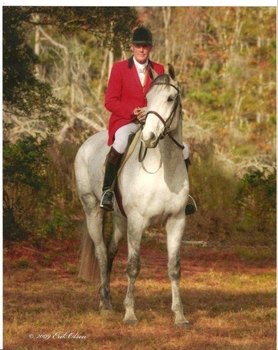
Erik Olsen photoPaul Striberry
Running martingales work for me. I use them every time. When the horse has his head in the air all bets are off. I like to have a handle to the horse to keep him in a frame and balanced. I think the objections to running martingales are that they can get caught on bushes, branches, or gate posts, but I have never experienced or seen this happen.
Readers’ comments are invited.
Posted November 10, 2011