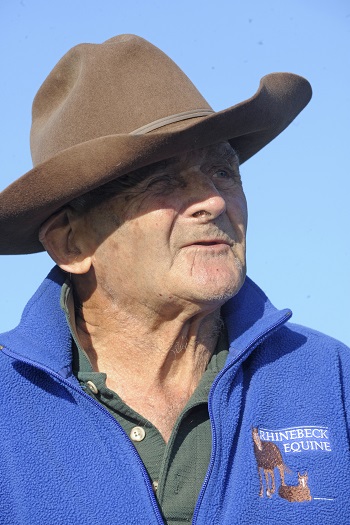
 Betsy Burke Parker photoRobert L. Smith Sr. (Bob), an institution in New York State’s horse world, died on February 19, 2015 at his home farm, Netherwood Acres. Bob is responsible for introducing countless riders to the foxhunting fields of the Millbrook and Rombout Hunts over his long career. The love and respect so many sportsmen and women hold in their hearts for this man will endure long after his ashes are spread over his beloved farm this spring.
Bob’s career with horses began in 1928 at age ten, when he began taking tourists from the city for trail rides into the Catskill Mountains on horses from his father’s farm. He was a member of Millbrook and Rombout as early as the 1950s, and his riding students of all ages rode in horse shows, hunter paces, hunter trials, and were taken foxhunting.
Bob studied agriculture and veterinary science and played on the Polo Squad at Cornell University for two years before leaving to strike out on his own and pursue his dreams in the horse business. Early in his career, Bob was involved in the breeding program for the Remount Service, which provided horses for the U.S. Calvary during and after World War II. Bob also trained a horse named Holy Smoke to jump through a ring of fire for the Disney movie Run Appaloosa Run.
In 2009, prize-winning photo/journalist Betsy Parker wrote a personal profile of Bob Smith for Covertside, which we published in the Winter edition. That story is re-published here with Betsy’s kind permission:
Keep On Keepin’ On
New York horseman Bob Smith’s legend looms large as he enters his seventh decade in the horse business.
By Betsy Burke Parker
2:31 a.m. Duchess County, New York
The alarm clock buzzes angrily in the darkened bedroom. Lisa Smith rolls over, punches the button, and climbs out of bed. Husband Bob rolls over. Lisa decides to let him sleep while she starts a pot of coffee, the first of many.
Moving quietly, Lisa steps into the jeans and shirt left at the foot of the bed last night. If she’s learned nothing else from decades in the horse business with one of New York’s most beloved—read, busy—professionals, she’s embraced efficiency, wasting no motion as she prepares for the long day ahead.
Lisa lets the dogs out for a morning romp in the moonlight around their Netherwood Acres, a big open expanse of fields, meadows, and trail-laced woods. The moon shimmers on the big lake down the driveway.
“Gonna be a nice one,” she says to no one in particular, looking out into the jet black night, made darker yet with no visible street lights or glow from a nearby town in this rural corner of New York. Just over a hundred miles north of the city, Dutchess County remains largely farmland, with careful conservation and preservation protecting the tidily tended horse, cattle, and crop operations.
Lisa hits “start” on the coffee pot and watches out the farmhouse window for daughter Kristin’s headlights in the long driveway. She hears a squeak from the bed upstairs and considers getting Bob up to help feed the horses, but decides against it. After all, she says as she pushes out the door, “He’s eighty-two. He’s earned a few minutes rest.”
2:40 a.m. Bob Smith hears the screen door slam, listens as daughter Kris Smith, just arrived from her nearby home, and Lisa confer on the porch of their black-shuttered farmhouse. Quiet returns as the pair heads down to the main barn, cream cement block gleaming in the moonlight. You can hear a scrape as Lisa heaves open the heavy rustic red door. Nickers from a few of the fifty-some horses float up the hill to the house as Kris dishes up oats. Pre-planning, again, makes it an easy operation, and soon the pair hurries back to the house to review orders for the day.
They know Smith will have a long list of riders paired with horses hired out for a day with the Millbrook Hunt, and another list outlining the afternoon of training. Bob Smith is widely considered a New York institution with more than seven decades as a professional. He’s still at it today, slowed down only slightly as an octogenarian, and merely inconvenienced—rather than stopped—by a recently broken leg.
With help from his wife and daughter, Smith’s Netherwood Acres provides green and made foxhunters for sale, boarding, training, lessons and hirelings for hunts, hunter paces, trail rides and hunter trials in New York’s “upstate” region north of the city. He runs a tight ship; he has to; the city’s elite measure saddle-time in minutes and hours, not days and weeks. Most of his clients travel by train or car to their country homes each weekend, arriving Friday afternoon and departing after the Monday morning Millbrook meet. As Smith explains, the hunt cards those Monday meets early expressly for the commuters. Few of his riders get out during the week, so Bob understands the importance of a “broke” horse. Manners, he says, are the most important component of a good hunter.
2:47 a.m. Smith swings out of bed, careful on that thigh. He broke it a few months ago. It shouldn’t have happened, he says. Lisa had told him to be careful on his newly knitted hip, the one he had replaced last fall. This he knew. But ever the horse professional, Smith also knew the green horse needed some exercise, and he wasn’t about to climb aboard a frisky youngster. Longeing, he figured, was a safe compromise.
When Smith clucked him into a canter, the young horse popped his outside shoulder and bulged his neck. Smith leaned into the line to steady against the fractious exuberance. Slightly unbalanced on the weakened hip, he buckled, femur bone giving way as he slid sideways, twisting his leg and toppling over.
2:51 a.m. “I knew better,” Smith explains the slight gimp as he sits down and tucks into his coffee. It’s not so much of a limp as favoring the leg. But if he were a horse, you’d call the vet for certain.
Watching Smith move around his familiar world of horses, you can’t help but compare him to an elf—not that he’s so short as much as spry and spare, fit and trim, with the slightly bowed gait that comes from eighty-odd years on horseback. Smith moves lightly, whisper quiet in everything—manner, voice, comportment. You know just from talking to him that the mien extends to his horses.
“You just have to move on. I can’t ride, but horses still gotta get out.” Blue eyes flash with an enthusiasm uncommon early enough in the morning to be considered by most to be the middle of the night. “We’ve got a bunch to get ready for hunting this morning.”
2:57 a.m. Lisa and Kris clomp into the kitchen. Smith is already studying his daybook at the kitchen table, coffee half-finished as he compares a horse list to the riders planning to hunt with Millbrook this fall Saturday.
“They move off at six a.m. this time of year,” he mumbles in explanation, speaking more to his dayplanner than to his audience. “Makes for an early start.”
Netherwood is sending out four this morning, two boarders and two hirelings. All need to be groomed and tacked; the riders will meet the rig at the fixture, half an hour north of the farm.
“I’ve got lots of things in my favor,” Smith says with a sideways smile, not too many teeth, you can’t help but notice. Still, it’s a warm grin. “I have a wife of the right age.” He chuckles quietly. She’s fifty. Lisa doesn’t react. “I have a daughter in the business. And she’s the right age.” Kris, thirty, is looking at the timetable for the Millbrook Horse Trials later that afternoon. “Obviously, my influence on our business is tremendous, but I have a head start with my family involved. Lisa makes it easy for me.”
Horses, Smith adds, can be tough on a marriage. Likewise, a marriage can be tough on a horse business. He should know; he’s been married three times. “I had lots of wives.” His eyes shine with what’s obviously an inside joke. “I’ve lost track. But this one should stick.” No one is paying any attention. They’re already on the move. Smith stands up from the table and grabs a dusty leather cowboy hat, dark tan patina from years of use. He shrugs into a Rhinebeck Equine Clinic jacket and zips it up against the morning chill. “Time to go.”
3:14 a.m. Horses take turns on the cross-ties as Bob, Kris and Lisa perform the intricate, well-choreographed dance. Kris distributes saddle pads; bridles and saddles are sorted; brushes sweep across glossy rumps; combs pick out tangled tails. It’s hard work made easier since Smith has already clipped each of the hunters, first time of at least twice per horse for the season.
“He does, like, a hundred hunter clips a year,” Lisa says in awe. “That’s important to note. He’s the only one allowed to do it ”
In the barn aisle, few words are spoken. There’s no need. Decades—more than half a century—doing the same thing, in the same place, Smith’s program is an oiled machine. Barely an hour later, Smith starts the truck while Kris and Lisa load the horses into the big trailer. It seemed like a lot of work this morning, but, Lisa says, sometimes they send their two eight-horse trailers, both full, to a meet. Four horses seems like a holiday.
Smith drives off into the inky blackness, headlights cutting the dark of the empty country road. He’s got a half-hour drive to the meet. Time enough, Smith says, to recount his early history in New York’s storied hunt country. “If we talk fast.” He laughs, loud this time. “Let me start at the beginning.”
A PROFESSIONAL AT TEN
Bob Smith was born in 1927 near rural Catskill, New York of tough, self-reliant Dutch and English stock who’d settled the area back in the sixteen hundreds. The family founded the village of Smith’s Landing nearby, their farmland spreading out towards rolling foothills west of the Hudson River that tucks against New York’s part of the grand Appalachian range. The Hudson courses along the mountains’ eastern front. Ancient glaciers receded hundreds of thousands of years ago to create a rolling landscape, rock outcrops peppering loamy soil. The shrinking river created a fertile, hilly region that early settlers found good for crops and grazing.
Like most in rural America, the Smith family scratched out a living from the land. Summers in New York were relatively short, winters long, but not as harsh as further inland, further upstate. Hay had time to mature—two cuttings most years—and vegetables and fruit flourished. Pastures were rich and lush spring, summer, and fall.
Smith remembers his grandfather’s successful gristmill, water-driven stones grinding local grains. He recalls dad Leon’s postal route, rural delivery which he started out on horseback. His family had always been involved with horses, for work and for hire, Smith explains. “Granddad had a dairy, too. And a livery stable.”
Hiring horses for carriage rides on the quiet dirt roads leading from Catskill up into the mountains, Smith’s livery also provided trail hacks, which young Bob Smith often led. “We’d pick ’em up at he pier,” he says. “People’d come up for a weekend away from the city. We’re just a hundred miles. It was an easy trip on the train or on the river.” Little has changed, he agrees.
At age ten, he began his professional career with horses. “My role was taking Catskill tourists for trail rides in the mountains,” he says. “I had several camps in the area that supported and encouraged me. It was hot, buggy, and the days were long, but I made about sixty dollars a day, which was a very good wage.”
Smith smiles and stares out the window, a faraway look drifting across his face when it’s pointed out that he’s doing the exact same thing now, well into a new century. As his granddad, by hiring horses to busy city dwellers, provided quiet respite for those trading the bustle of Wall Street for the relaxed pace of upstate, so Smith does likewise.
“I always liked the thought of providing city folks with some country quiet,” he says. “Riding is therapy.”
CATERING TO THE WEEKEND RIDER
He continues, recalling his father’s interest in horses. “Dad used to get horses from out west. They’d ship up from the city, Newburgh, Kingston, Catskill, on the river or on a railroad car. They called ’em western horses, but most of ’em came from Ohio… Kentucky. Not what we think of as the wild west. They were some good horses.”
Today, to find quality horses, Smith prefers to import Irish hunters—fifty or more through the years—but he also gets yearlings from Canada, many of them from the disbanded pregnant mare urine (PMU) herds of draft-cross mares formerly used to create replacement hormones. Bred to rangy Thoroughbred stallions, the part-draft mares often produce a good-footed, even-tempered, weight-carrying horse, Bob explains, perfect for the Millbrook territory.
“I find quarter-Percherons are your best cross. That’s a perfect amount of blood for most amateur riders. It’s up to guys like us to make the horses safe for anybody to ride.”
Half-breds, Smith finds, don’t have quite enough stamina to get through the hilly terrain nor enough speed to stick with the keen Millbrook hounds. Pure Thoroughbreds often have hoof issues.
“It’s a little rocky in places,” he motions out the window into the pastoral countryside. “Shoes can be an issue.”
As any horseman knows, no hoof, no horse, and Smith likes that small infusion of draft horse blood that upsizes the Thoroughbred and adds a bit of hardiness, hooves in particular.
Breeding is very important, but, too, so is early training.
“You want to get them early, as yearlings,” Smith maintains, “before they get off course. You don’t want potbellied yearlings. People make the mistake of not feeding their young stock, not treating them like horses.”
He likes to keep his horses stabled, with plenty of turnout to be sure, but not forgotten for years “to grow” in some back pasture.
“They need hard feed,” he says, admitting that his highly opinionated views of how to “make” a horse are not universally popular. “Takes years to make a horse.” That cuts into profit potential, naturally. “We want to make horses that will take care of their riders. Manners are most important. You gotta start early for that.
“I like to break them at two, two-and-a-half. We longe them a lot, and free longe. We have a jumping chute we build, too. I like to see a horse learn to think for himself,” jumping with no rider.
“Then they get their flatwork, teaching them to steer and work off the leg, then we take them out into the woods, on the trail.”
Flatwork continues outside the arena, with trail rides comprising short stretches of lateral flexion and engagement connected by longer, relaxed walks and trots on long rein to build self-carriage. Before he was injured, Smith had a hand in starting most of the young horses. Daughter Kris helps, more now that her dad has been hurt.
“We have a great relationship,” Kris says. She events the horses that show more scope and better movement. “If you get a horse up that’ll hunt well, and event up to, say, training level,” Smith says, “you’ve really got something.”
Hunters and eventers are always for sale at Netherwood, but Smith tries not to fall into the trap his granddad did.
“My grandfather was proud of his horses, unduly so, sometimes. He had his favorites. As a professional, you’re not supposed to do that,” Bob adds, a trace of irony creeping into his voice. “You try not to, but you do.”
6:14 a.m. At the hunt meet, mist pools like spilled milk over the rolling landscape. One by one, the Netherwood riders had driven up, pulled on their helmets and stepped up on the tall mounting block Smith had set out for them. There was plenty of laughter in the still-dark air. The clutch of Netherwood horses stood patiently, like they’d been taught through endless practice and repetition at the farm. Then they moved off with the pack, clopping down the road to the first covert as Smith settled in for more conversation in the warm truck cab.
“I hate not hunting, myself,” he says, readjusting the angle of his squashed hat. “I’ll be right back at it.”
Smith studied agriculture and veterinary science, and played on the polo squad at prestigious Cornell University, class of 1950. He did two years at their highly-regarded vet school before quitting to strike out in the horse business.
“I knew to make money in the vet world I’d have to do small animal medicine. Didn’t want that.”
JUMPING THROUGH FIRE
Smith’s horsemanship took national spotlight in the early eighties when he trained a horse, Holy Smoke, to jump through a ring of fire for a Disney movie, Run, Appaloosa, Run. Smith says the trick was not hard, it just took equal parts horsemanship and innovation.
“First, of course, you jump the horse over the jump,” he explains the process with the same saintly patience it surely took with Holy Smoke. “Then you add the ring, [a metal hoop] bit by bit. Then you add the rags [torn flannel bandages he’d customized for the stunt]. Then you lower the jump and start by lighting one of the wraps on fire [using diesel fuel]. Then you add another, and another.”
By the end of it, Smith was leaping the horse back and forth over a pretty big jump, through the hoop now engulfed in flames.
“I train people and I train horses.” Smith turns back to the story. “I’ve never done anything besides horses. Is there anything else?”
Smith and his crew have hunted the past two decades almost exclusively with the Millbrook.
“They have the country; I have the horses.”
Smith says that the Millbrook country lends itself to “making” a foxhunter. Well-maintained stone walls, coops, rail jumps and natural log fences lead to good jumping. The territory—half open, half wooded—is laced with trails. Big fields most days mean that young horses learn quickly to handle themselves in a crowd.
“Some of your other hunts in other areas run more, their country is more open,” Smith explains. “Here, you’d better have a horse with manners, because when you find yourself standing around, a horse has to behave.”
Millbrook’s Penn-Marydel and Crossbred pack has terrific voice, imperative for hearing and following across the half-wooded, rolling terrain. “Hear ’em over there? I think they’re comin’ back now.” Smith notes the hunt stays out just an hour or so in the very early season. Lucky, because he has a list of things to do.
Smith gives his hat a push. “Here we go again.” He steps carefully out of the truck. If there’s any sign he’s eighty-two or broken-legged, it’s impossible to see.
7:46 a.m. Smith takes a gray hunter from one client, carefully walking the horse up the ramp of the trailer. Max Greenberg hands him the reins of his dark gelding.
“This area has remained open because of the land conservancy,” explains Greenberg, a stockbroker with Morgan Stanley who works in the city all week but looks forward to weekends at his Dutchess County place. He motions toward the open field and adjacent woodland. “The country has hardly changed in a hundred years. And I think it will stay this way.”
Greenberg hooked up with Smith fully twenty years ago. He’d taken a riding trip to Claremont in Ireland and upon return was steered to Netherwood.
“Someone told me I had to hook up with Bob Smith. I’m glad I listened. Not being a ‘country’ person, I’m lucky to have Bob. I appreciate what he does for me and his other riders.”
Smith double-checks the tack room door before he pulls out.
“We’ve got a few horses to get out before the horse trials.” If Smith is tired from the early morning and long afternoon ahead, it doesn’t show. “Krissie is competing this afternoon. We’ll all be there to watch.”
Smith looks forward to watching her on a young Irish horse he imported.
Without a backward glance, Smith drives off, efficient in manner as much as time schedule. Greenberg waves at the receding trailer.
“He’s old-fashioned—slow, direct, honest,” Greenberg says of Smith. Five days a week a busy executive in the city, Greenberg has little time for anything else. “I love that about Bob.”
“Bob is an old-fashioned horseman in every sense of the word,” adds friend Nancy Estes, a longtime manager of the Millbrook Horse Trials. “His were some of the first hirelings for Millbrook, and they’re some of the best. He takes care of the horses and the riders equally well.”
“You just can’t keep him down,” Lisa Smith says. “It’d kill him if he couldn’t have his horses or riding. He’s one of a kind. They don’t make them like that anymore.”
Posted February 25, 2015
Click for Bob Smith’s official obituary published on the website of Sweet’s Funeral Home in Hyde Park, NY.