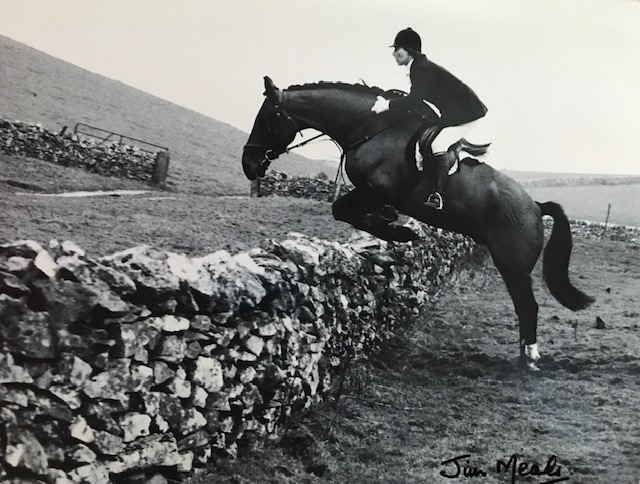
 Linda Armbrust, MFH, High Peak Harriers (UK), leads her field. / Jim Meads photo
Years have passed since I was resident and MFH of two hunts in England. Now, as a married and ex-MFH in Virginia, I reflect on my fourteen years of English hunting. All the dark moments—rain, rain, and more rain, difficult farmers, and monumental mistakes—have faded now, leaving me with thoughts of good friends, outstanding hunts, great hedges and walls, and lovely hounds.
I had the luck to hunt with thirty-five different packs—many regularly—behind some of the best huntsmen in England, including Captain Ronnie Wallace, Captain Ian Farquhar, Nigel Peel, Tony Younghusband, Brian Gupwell, David Barker, Jack Dark from the Seavington, Michael Farrin, Tony Austin, Johnnie O’Shea, and many others who gave great and memorable sport. I was also lucky to have had good horses and two exceptional yards. Vets were almost never required, only three shoes were lost, and an extremely high standard of turnout and fitness were maintained. Ivanhoe, a 16.2hh bay half-bred did me for ten seasons, and Callahan, a 16.3hh Irish horse carried me for eleven seasons. Several others drifted in and out of the picture, but these two gentlemen gave me the best sport of my life—hunting days that are the stuff of dreams.
My first few seasons were spent hunting with the Mendip Farmers, of which I later became Joint-Master. Tony Younghusband was an outstanding horseman, fearless across country. One early morning on the top of Burrington Combe, he attempted a rather direct descent to the bottom. When he felt his horse sliding from underneath he dismounted, and let him continue downwards until he became suspended in the top of a small tree. He calmly took off the saddle, lit his pipe, and sat down to wait. Eventually the tree gave way, the horse rolled to the bottom, and started eating grass—without a scratch.
Tony remounted, extinguished his pipe, pulled out his horn, and we were away. He loved his hounds and hunting, but considered the field to be a necessary evil. His greatest delight was to enter a large wooded covert and slip quietly away on his own private hunt. The mounted followers soon learned to keep their ears and eyes open, their gossip to a fleeting whisper, and to stick like glue.
Hunting Around
Telephoning hunt secretaries to ask permission to cap can be quite a daunting proposition for a new comer.I hope he will forgive me for saying so, but it always took me about three days to gather courage to ring Major Dallas of the Duke of Beaufort’s and ; and then I had to get my timing exactly right. Between his drinks before dinner and sitting down at the table was perfect. Why this feeling, I have no idea. He was always gracious and extremely friendly when one arrived in the hunting field. Perhaps it was his military bearing.
A most unusual end to a day’s hunting with the Tedworth occurred when we finished on Salisbury Plain. Hounds and staff headed in the opposite direction from where we had unboxed, and we were given only a vague idea which way to return. Dusk was falling, all tracks looked alike, and there were no roads in sight. My companion, Barry, and I were getting slightly apprehensive, when out of nowhere rumbled two military tanks. Barry, gallantly galloped after them, waving his hunting whip. The British Army obligingly stopped and an officer arose from the turret complete with map. We were soon headed in the right direction and arrived at the lorry without further mishap. Even now I smile as I recall my knight in scarlet coat on his grey charger.
Exmoor, the perfect way to end the hunting season. In spring I would try to save a week or so to hunt with the Exmoor Foxhounds, Minehead Harriers, and the Devon and Somerset Staghounds. I loved the village of Exford and became a regular of Sally Lee’s. She ran her hotel with an iron hand and was always telling me what I could and could not do. One evening things were extremely busy in the Dalesman Bar, and Sally was waiting table. When she brought me my fish it was underdone and I said so. She snapped back, “No it isn’t. Don’t be a rude American and eat!” I made do with chips and bread and butter. But there was always a welcome in her kitchen for soup and fresh bread after hunting. It’s just not the same without her.
It seemed to me that the weather was either beautiful or windy with horizontal rain; so I either loved it or hated it. The hunting, though, was excellent and it amazed me how Captain Wallace and Tony Wright would always be with hounds among the many combes, hills and bogs.
The largest mounted field I ever saw was more than 250 with the Devon and Somerset Staghounds on a gorgeous day from Alderman’s Barrow—and probably fifty motorcycles as well. One good friend visited me from Virginia for ten days. We did very little sightseeing but managed seven days hunting with the Exmoor, Beaufort, South and West Wilts, and Mendip Farmers.
She had great difficulty in adjusting to the rain and mud. Our friendship was put to a real test when I would not let her wear a plastic cover over her hunting hat. I shall never forget the look of horror when she saw me scrubbing my boots with a brush under running water. She almost had tears in her eyes when the time came to do her own. It was a long way from a damp sponge.
High Peak Harriers
Before taking on the Joint-Mastership of the High Peak Harriers, I was a subscriber both to them and the Meynell and South Staffordshire. What a contrast in countries and styles: the stark Derbyshire uplands with their open, windswept fields and miles of beautiful stone walls: the lush, green fields and hedges of the Meynell country lower in the contours. Martin Brocklehurst, with his sharp little harriers and his great enthusiasm, jumping his fortieth wall of the day with as much ease as his first; David Barker with his wonderful bi*ch pack and his expert horsemanship a picture of perfection crossing the country.
We had some brilliant hunts that season with both packs, but the groom never had to ask, ‘Which one?’ when I returned at night. The High Peak was ‘top of the ground,’ and we came home almost as clean as when we left. The Meynell was mud, mud, and more mud, but worth every inch.
Bakewell Market was alight when the farmers heard that an American lady was replacing John Brocklehurst as MH. They had known him since he first started selling trousers and jackets out of the back of his van, and had seen him build up a large, thriving business. Where had I come from?
The first season was a real learning experience for them and me. May 1 arrived, the staff was moving in, the flesh van had broken down, and the phone was ringing with farmers wanting dead stock collected. Armed with a map, a mobile phone, and pulling a borrowed trailer with tarpaulin, my Joint-Master David Pearson and I set off to ‘pick up.’ It was almost 8:00 pm before we delivered our last load to the flesh house, where Tony and Mike had been skinning all day. While sharing a bottle of Champagne, we decided that it had been a unique way to start meeting farmers.
I spent the summer driving non-stop around the countryside, meeting more of them and trying to understand the Derbyshire accent. I learned to drink milk in my coffee and how to decline graciously a large whiskey at 9:30 am. I answered hundreds of questions about America. And I spent so much time on back lanes peering through binoculars at the hunting country that I was stopped by the local police three times.
It was difficult country to learn as there were no large coverts; one stone wall looks pretty much like the next and there are lots of small fields with very few hunt jumps. I tried to walk the country before hunting it, tucking wire under rocks, making a place to get out if needed, and other stratagems because the harriers were fast. One had to stay right with them for they could jump a wall, turn sharp left or right, and just disappear. They were an extremely biddable pack, as happy to hunt fox as hare, and we had some of our best hunts from Charlie.
After I had been there for almost two seasons, I had a unique exchange with one of my favorite farmers. It was Saturday and we were having an outstanding day from Sheldon. Unfortunately, a fox had run through a flock of in-lamb ewes with hounds not far behind. The ewes were huddled up in the corner, making the most awful noise. Henry’s son had charged across the field on his tractor, stopped by the gateway, and was making his feelings known to the entire world. The air was blue and he was positively apoplectic. Hounds and huntsman were long gone, David was more than happy to leave it to me, and he took the field. There was absolutely nothing I could say, for I could not get a word in edgewise. I remounted, saying I would stop by later.
After we had put hounds up, I drove back to the farm at about 5:15. Henry was standing in the yard and I was met with a growl and a “Wot you doin’ ’ere?” Before he could say another word, I said, “Henry, I really stopped by to congratulate you on your son’s command of the English language.”
‘Wot you mean?” said he, “He never even finished school.”
“Well I think he’s terribly impressive. It’s the first time in my life that I have heard the word, f…, used fourteen times in one sentence.”
Henry put down his buckets and started to laugh., and I ended up saying Yes to a rather large whisky. I’m sure he told that story a dozen times at Bakewell market, for lots of farmers asked me the following week about my day from Sheldon.
One of my most moving moments came when the family of a good friend asked me to bring the hounds to see her for the last time. She had hunted with the High Peak for more than forty seasons and was terminally ill. A few of her closest friends joined us with staff and hounds for a final farewell. It was a lovely Sunday morning at 11:00, the horses were plaited, and everybody beautifully turned out. We stood with the pack on the front lawn, drinking an excellent port. While the grandchildren played with the hounds, she watched from her bedroom window. After about twenty minutes, Going Home was blown and we hacked back to the horse boxes. No one spoke for the longest while, and I’m sure no one had a dry eye.
The following Wednesday was one of the best days I ever had. Hounds never stopped, and ran through country where they had not for years. We blew for home just after 3 o’clock as no one had any horsepower left. When I returned to the house the phone was ringing. It was her daughter: my friend had died about 3:15 that afternoon. What a strange coincidence.
After four years, I wanted to return to my house, friends, and hunting in Somerset. When I had left to go north everyone told me that it was an “overcoat colder in Derbyshire.” I was becoming tired of wearing that extra coat, but I had met some wonderful people, had some great sport, and hunted with almost a dozen different packs. However, I was to miss the hounds and farmers most.
The following season I subscribed to the Duke of Beaufort’s—and once again to the Mendip Farmers. Captain Ian Farquhar, MFH and huntsman of the Beaufort, reminded me of a cavalry officer in battle as he hunted his hounds—galloping full tilt across the country with great flair and dash and a large thrusting field behind. Yes, there were lots of people, seeds, and plough; but also plenty of foxes, beautiful country, and keen followers who knew what hunting was all about.
People here in America ask what hunting in England is like. The first picture that comes to mind is a Saturday from Badminton. Hounds in full cry, 150-plus people taking their own line through mud and over hedges. Empty saddles and loose horses. Washing off in the lake, and the smell of coal fires on the hack back to the horse box. I find it difficult to describe in words, and Americans find it difficult to visualize. One has to have been there.
Mendip Farmers
Two of the three hunting farmers at the Mendip decided not to stay for another season, so the Mendip Committee decided to take on three ladies to cope with Ken Osborne. Ken maintained his seniority and let us do the work, but he was excellent in a crisis. He knew absolutely everybody and could be relied on to bring out the whisky bottle to ease any tension. Jo Durie and Annie Maw did half the country and I did the other half. And I was able to indulge myself with hounds.
I walked out with our huntsman, Andrew Phillis, almost every day, getting to know each hound and its hunting abilities. We discussed breeding and stallion hounds, puppy walkers, farmers, country, coverts, and hunting. I found the time invaluable. It had been quite a while since anybody had taken any interest, and Andrew was glad to have someone to discuss things with.
Martin Scott was the biggest help ever, and came to the kennels several times to look at the hounds with me. He has the most incredible memory for bloodlines—who sired what and when—and helped me with stallion hounds. I was aiming for a more level pack and one that would hunt a more difficult scenting country. Andrew and I both liked the Fell line, and I introduced Beaufort Ranger ’90 and Daystar ’91 for a touch of class.
Nigel Peel, whom I had known at the Chiddingfold, Leconfield and Cowdray, judged several of my puppy shows and kindly pointed out our good and bad points—as well as being a friend. Ian Farquhar gave me a lovely brood bi*ch—Random ’92, who had won at Peterborough. While not the most brilliant hunting hound, she had beautiful litters of which most hunt like mad. I was most grateful to Ian for adding some ‘looks’ to the pack. Sue Perkins gave us Meynell and South Staffordshire Coast-Guard ’95 by West Somerset Vale Cottager ’91 who is by Cotswold Glencoyne ’84. Andrew says he is hunting brilliantly and will probably use him to breed.
Nobody deep into breeding hounds can do with out a trip to Exmoor and Captain Wallace. He was extremely helpful and generous with his advice. He had imported Orange County Barbar ’89, and, having hunted with that pack and Melvin Poe in Virginia, I could not resist. I bred Damson ’92 to Exmoor Bacchus ’91. The entire litter has entered well, and those who made disparaging remarks at the Puppy Show—“Don’t they have funny ears,” and “Peculiar color, that,” and “Can’t you detect an American twang in their voices,”—have since become avid admirers.
I feel privileged to have had the help of so many knowledgeable hound breeders. We showed at the West of England Hound Show at Honiton for the first time in more than twenty years, and managed to bring home a few rosettes. I ring Andrew every few months and he brings me up to date as to how the hounds are hunting. We still discuss brood bitches and stallion hounds, but I miss being there.
Andrew was mad to hunt. As lady Joint-Masters, our biggest problem was to get him to go home. Whenever he saw one of us with ‘The Look,’ he would turn tail and trot furiously to another covert. He also would develop severe hearing loss. Mrs. Firbank, our secretary, thought the four of us ‘totally useless,’ and was fond of telling us so. However, she was a tremendous help, and did so much that we would have been hard-pressed without her. After almost three seasons, she begrudgingly admitted once or twice that we were not so bad.
Most hunting days went quite smoothly, but have you ever had one where everything went wrong? Torrential rain at a very popular Saturday meet in some of your best country; no foxes where expected; and when hounds do find, foxes run in the wrong direction (such as through village gardens and committing suicide in front of Lord Waldegrave’s luncheon guests); and jumping into a sown field with almost one hundred horses behind you. I was seriously thinking of resigning, when a marvelous late-afternoon hunt saved the day.
The field of then only a dozen had a lovely run across Joe Killen’s, Duncan Green’s, and Ray Selway’s—going to ground in the tip near Old Down. When Andrew blew for home, there were only three of us. I had a great smile on my face until I remembered what messes I had to rectify before going home to change. Fortunately, an abject apology, a few tears, and a contribution to the Sheep Fund put the seeded field to rest; a box of chocolates and the promise of a new rose bush was enough for the garden; and a handwritten letter of explanation to his Lordship was accepted. I’m afraid I was too tired to consider what to do about the foxes.
Being back on the Medip had been great fun. I was back in my own home, among friends, and doing what I enjoyed most. It was a relatively hassle-free Mastership and we managed some excellent hunting. However after fourteen years, business and family demanded my return, and I regretfully made the trip back to America.
Taking with me my aged terrier, my two horses, and wonderful memories, I arrived in Virginia. I am still hunting four or five days a week on English hunters behind English huntsmen—Chris Howells from the Middleton, Middleton-East and Cottesmore now hunting the Blue Ridge Hunt (VA) foxhounds and Bay Cockburn from Warwickshire, who spent eight seasons with the Kildare, now hunting the Loudoun West (VA) foxhounds.
May 4, 2020
This story was previously published in the December 1996 issue of England’s CountryWeek Hunting and is published with the permission of the author, who served as Joint-Master of the Blue Ridge Hunt (VA) from 2000–2016.