Virtually every coop, bridge, landmark, or covert in the Belle Meade Hunt foxhunting country (GA) has a name, so that huntsman, mounted whippers-in, and road whips can accurately and concisely communicate where the action is by radio. What does this have to do with the late Major Kindersley, MFH of Ontario’s Eglinton Caledon Hunt? Only that one of the coops very often in the middle of the hunting action is named “Major Kindersley’s Coop,” and virtually everyone who has hunted at Belle Meade is familiar with the name. Here’s the Major’s story.
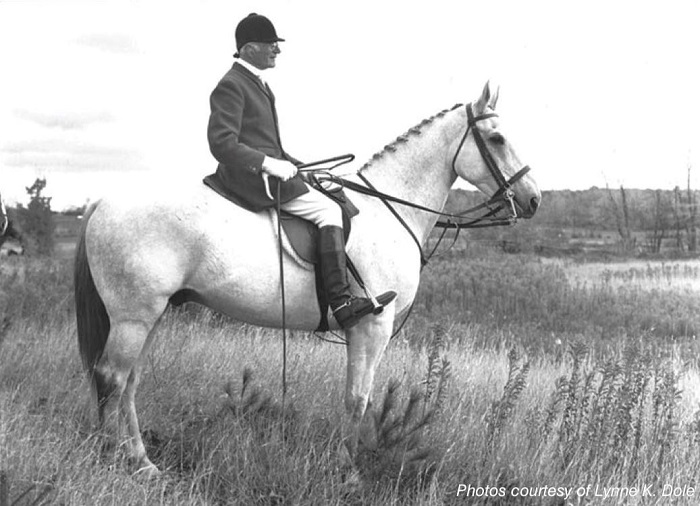
In 1919, George Beardmore, MFH of the Toronto and North York Hunt (ON), bought the old World War I aerodrome land on Avenue Road and Eglinton Avenue for the purpose of setting up a riding establishment, including a drag pack. Most of the Toronto and North York members lived in Toronto and travelled the twenty-five miles to the kennels in Aurora only on weekends. These new facilities gave members the opportunity to ride during the week, hunt with the drag pack, and still keep up with their day’s work at the office. Over the years that pack became known as the Eglinton Hunt. Between the wars, the Eglinton Hunt also acquired land on Leslie Street north of Toronto.
During World War II, horses and hounds were forced to relocated from the Avenue Road stables to the St. Andrews Golf Club property at Hogg’s Hollow. Captain Peyton, who had run the Avenue Road property ever since 1919, took over the job of converting the large barn into stabling for the members’ horses, and the farm house was turned into the new Club House.
During the latter years of WWII, Terence Morton had taken over hounds as amateur huntsman with Dick Rockwell whipping-in. (Dick and Adele Rockwell were internationally famous for their Welsh ponies from their Ardmore Stud.) Sadly in 1947, Terry Morton had a horrific fall which prevented him from ever riding again. It was at this time that Charles Kindersley began to hunt hounds. During his tenure, he also introduced joint meets between his hunt and Toronto and North Hunt.
But we back up to how Charles Kindersley became interested in hounds and hunting. Born in Dorset, England, in 1900, he had grown up with the traditional family pony in the South Dorset Hunt country. When World War I broke out, the nearby army camp had to give up its beagle pack. The hounds were rescued by the local vet who, after seeing Charles’ interest, let him hunt the pack. This bit of experience would turn out to be very valuable to the future Eglinton Hunt.
After a short time as a pilot in the Royal Flying Corps, Charles went out to the Canadian West where he worked on a ranch, an open-faced coal mine, and for a polo player in British Columbia. On his way back to England he had an interview with the CEO of Imperial Oil in Canada. After Charles told him about his experience out West, Mr. Smith asked to see his hands. When he saw all the calluses, Mr. Smith promptly hired him. Mr. Smith later told Kindersley that he had only agreed to see him as a favour to someone else!
Back in England, Kindersley met Chrissie Crawford at a Hunt Ball held at the house of A. Henry Higginson, the American Master of Foxhounds who had taken over the Cattistock Hounds. Chriss, riding sidesaddle, and her father, Colonel James Crawford, hunted regularly with these hounds. Kindersley’s job took him to oil interests in Colombia, but letters travelled back and forth, even when Chriss went to visit friends in India. Upon learning that Chriss was returning to England, Charles also went back to England and took the pilot boat out to meet the liner coming in! Needless to say, her parents were extremely surprised when they went to meet the liner in Southampton to see both these two waving from the deck. When the pair approached Cattistock Master, the well-known Parson Milne, to marry them, Milne was heard to mutter, “I hope that there will be a frost on that day,” meaning that therefore it would not be a good scenting day for hounds!
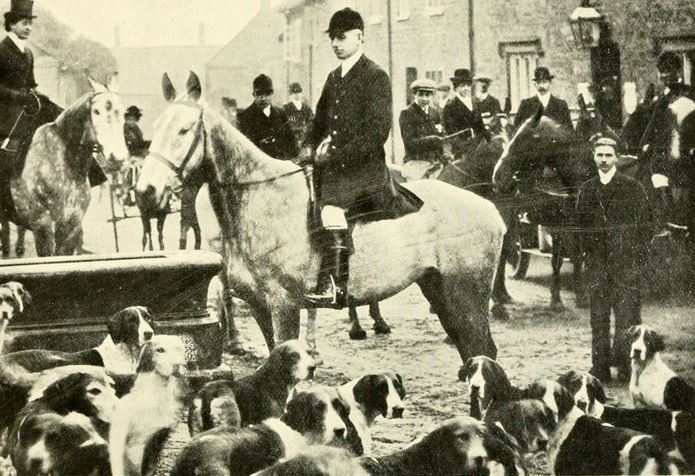 The Reverend E.A. “Parson” Milne, MFH, Cattistock Foxhounds (UK)
After Colombia, Charles was sent to the International Petroleum refinery in Peru. He continued his interest in horses by setting up stables. His daughter Lynne remembers long rides on the beaches and inland over the sandy, dry countryside. Her father also started polo, the teams travelling to Lima for competitions. When the British Navy docked at Talara, horses were provided so that the crew could play polo. Lynne’s brother, Richard, was christened on the H.M.C. York when it made a stop at the Talara harbour. There were no hounds but paper chases provided some fun.
Moving to Canada in 1939, war soon broke out and Kindersley joined up with the Royal Canadian Engineers, shortly thereafter going overseas. His family settled in London, Ontario for the duration. “But,” said his daughter, “fate interfered when my grandfather in England suffered a bad stroke, and my mother went over to help look after him. Once there she could not come back to Canada because of wartime restrictions. She stayed there, separated from her children, more three years for the rest of the War. My brother Richard and I remained with friends in London [Ontario].”
“Travel was extremely haphazard and unpredictable at the end of the war with the military still commandeering any ocean worthy vessels to get the forces home. My father was invalided back to Canada through Halifax and then by train to London, Ontario. My mother, with grit and determination, finally secured passage on the Queen Mary to New York City, taking a train from there to St.Thomas, Ontario. The most amazing thing was that they arrived in London, Ontario, within twenty-four hours of each other. You can imagine the reunion after such a long separation,” Lynne said.
By 1947 Kindersley’s back injury had greatly improved. The family moved to Toronto and he became a member of Eglinton Hunt shortly before huntsman Terry Morton broke his leg so badly. After a short interval Kindersley took over the job of hunting hounds. During the War, Eglinton Hunt had had to reduce the pack to a very few hounds which hunted drag only.
One of the first things to do was to obtain a draft from another pack. He was always grateful to Mrs. Nancy Hannum, MFH of Mr. Stewart’s Cheshire Hounds (PA) and to Mrs. Gilbert Humphrey of the Chagrin Valley Hounds (OH), who responded with two generous drafts which made it possible to change from drag hunting to foxhunting. Masters of Foxhounds have always been generous and ready to help other packs, especially in cases of disaster as when distemper hits a kennel. When this happened to the Eglinton Hunt, Toronto and North York was one of the hunts who kindly sent some hounds.
Kindersley, known as ‘The Major,’ continued to breed English hounds, obtaining fresh blood by importing dog hounds from some of the well-known English packs. In later years two hounds in particular passed on their good qualities: Portman Petrarch and Tipperary Grossman.
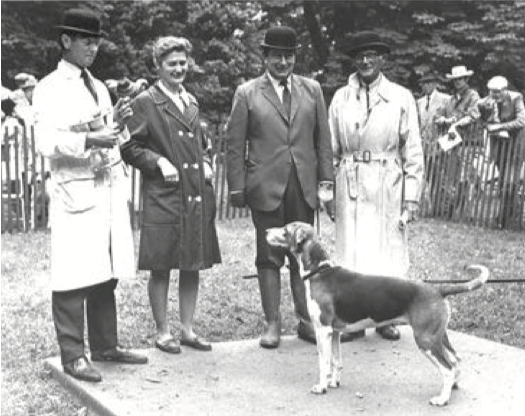 Canadian Hound Show: (l-r) unknown; Lynne Kindersley Dole; Captain Ronnie Wallace, judge; Major Charles Kindersley, MFH
After World War II, the famous foxhunter and father of the Modern English foxhound Ikey Bell introduced some Welsh blood into the heavier, traditionally-bred English hound. Captain Ronnie Wallace, MFH and huntsman of the Heythrop and later of the Exmoor Foxhounds (UK), followed Bell’s lead in streamlining the old fashioned, chesty, heavy English hound. Wallace produced slimmer, faster and better conformation hounds, gaining a worldwide reputation for showing some of the best sport. Other breeders soon followed, producing what is now referred to the Modern English Foxound. Captain Wallace, by the way, also began his hunting career by hunting a pack of beagles as a boy.
The Major, who had a keen eye for both horses and hounds, recognized the benefits of the Modern English Foxhound and began to breed accordingly. At that time there were hound shows in the United States, like Bryn Mawr, but not in Canada. The Major thought that Canadian packs might also benefit from showing hounds. Under his initiative, in 1954, the Sportsmen’s Dog Show agreed to include classes for the English foxhound for a couple of years, after which the different hunts took turns in putting on the yearly foxhound show independently. Masters from England and the States were asked to judge hounds, one judge from each country, a tradition continued today. Over the years the classes expanded to include both English and Crossbred Foxhounds, as Canadian packs started to include American, Fell, and Penn-Marydel bloodlines.
The Major said that the best recommendation to be given a foxhound is that it has a good nose, stays on the line, runs with the pack instead of going off on its own, and heeds the huntsman’s voice and horn. In order to do this the hounds need stamina and good conformation. The Major would look for a sloping shoulder, deep chest, long neck to stoop for the scent, well let down hindquarters, and firm, but not splayed, feet, with weight evenly distributed.
During his forty-two years as Master, the Major was blessed with many excellent Joint-Masters: Mrs. C. Churchill Mann, Lieutenant-Colonel G. Alan Burton, Brigadier F.C. Wallace (who occasionally hunted hounds when the Major was unable to do so), Lieutenant-Colonel George M. Brown, Gustav Schickedanz, and H. Charles Armstrong. After twenty-one years as huntsman, the Major handed over the horn to professional huntsmen, but continued as Master until 1991.
Major Charles M. Kindersley (1900–1993) was inducted into the Huntsmen’s Room at the Museum of Hounds and Hunting in 2003. The Museum’s tribute refers to the Major as a “wise and witty man with a great sense of humor; an outstanding soldier, hound breeder, and foxhound judge; a teacher who shared his profound knowledge of foxhounds and pedigrees with anyone who asked.” The Major passed on this enthusiasm to his daughter, Lynne Kindersley Dole, who hunted with Eglinton and Caledon, and the Blue Ridge Hunt (VA) for many years.
Posted January 9, 2018
Denya Massey and Lynne Kindersley Dole live in Ontario. Denya, a lifelong foxhunter, is the daughter of the late Stewart Treviranus, a member of the Canadian Three-Day Team, who competed in the 1952 Olympic Games in Helsinki. She is also the step-daughter of the late author/sportsman Alexander Mackay-Smith, MFH. Lynne Kindersley Dole was the first librarian of the National Sporting Library, co-founded in 1954 by Alexander Mackay-Smith in Middleburg, Virginia. This article, originally published in Hark! magazine by the Toronto and North York Hunt (ON), is re-published with permission.