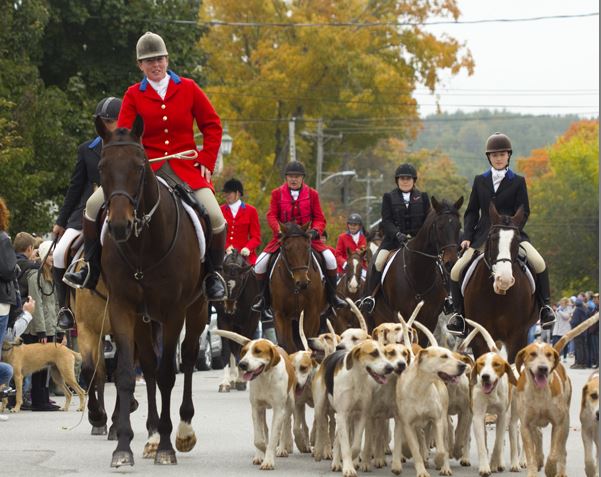
 Huntsman Ros Balding leads hounds and field of the Toronto and North York Hunt / Catherine Davies photo
Rosslynn Balding is sitting on a couch with her wool-sock-clad feet tucked comfortably beneath her. The professional huntsman has a bundle of handwritten notes in her right hand, which she keeps reminding herself, aloud, to refer to, but which she mostly keeps forgetting to check. She admits to being nervous. She has never been interviewed by a journalist before and is wary, in a most open, friendly way that, despite assurances to the contrary, I am an undercover, coyote-loving writer who has come to a 120-acre property, just south of the village of Creemore, Ontario, to blow the lid off an arcane blood sport.
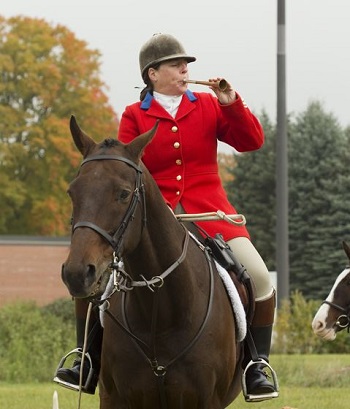 Catherine Davies photoLong associated with the lords and ladies of the United Kingdom, foxhunting—picture men in red coats, women in black coats, horses, hills, dales, baying hounds, and a fox fleeing for dear life—has been around in the New World for nearly three hundred years. And it still is around, a relic from another time, embodied by Balding’s employer, the 175-year-old Toronto & North York Hunt club (TNYH), and by herself, a forty-eight-year-old single mother from Scotland. “I hope your article isn’t about killing coyotes,” she says in a sweet brogue, “because we are not a very effective means of predator control.”
Balding lives on the club’s property with her teenage daughter and son, fifty-two modern English foxhounds, five English cocker spaniels, four horses, one beagle and a deer named Stag. Most of the time, the coyotes that the hounds (and riders) pursue escape, aided by tricky “scenting” conditions. That’s foxhunting-speak for a southern Ontario microclimate with differing soil types and sudden elevation and temperature changes, which pose problems for a dog’s sense of smell. The coyotes’ high survival rate isn’t viewed as a personal failure, and, to be fair, they don’t always survive.
Balding is the only woman employed as a huntsman in Canada, which has ten accredited hunt clubs, and among only a handful of female huntsmen worldwide. “Female huntsmen are extraordinarily rare,” says Polly Winsor, a longtime TNYH member and professor emeritus at the University of Toronto. “Ros is terrifically knowledgeable, honest, cheerful, energetic—and hugely skillful at what she does. She is first rate.”
TNYH has sixty members, who each pay about $2,000 a year in dues, a sum that doesn’t include the costs of owning a horse and a trailer to transport it. There are no lords or ladies among the current membership, although Lady Eaton, of Canadian department store fame, and long deceased, was a past member, while Edward VIII, then Prince of Wales, once rode with a hunt during a visit to Canada in 1924.
Lately, however, the club, is nearer to obscurity than its former majesty, and features a cross-section of (mostly) white-collar professionals—a lawyer, engineer, property developer, marketer, realtor, retired professor, interior designer, anesthesiologist, and even a puppeteer—among its ranks. Balding runs the day-to-day operation. It’s a role that involves caring for the property, four staff horses—her mount is named Molson—wooing landowners to get access to their acreages, and, critically, nurturing, training, and caring for a pack of foxhounds, medium-to-large-sized dogs bred to be athletes and, in theory, if mostly not in practice, coyote killers.
Being a huntsman is an unusual career for anyone, man or woman, to put it mildly. But it’s one made stranger by the path Balding has travelled to arrive at this spot, on a couch, in a small clubhouse full of oil paintings and other hints of past grandeur, a washroom with fox-patterned curtains, and a portable bar with a tips jar.
Ten years ago, Balding was living happily-ever-after with “the love of her life,” Owen Balding, a huntsman in the Lake District of northwest England. The pair worked alongside one another in “hunt service.” He tended the hounds; she looked after the horses. Balding insists that we are all hunters, even if we don’t know it, or care to admit it. Our ancestors ate what they killed, and the pursuit of quarry—galloping across fields, dodging obstacles, feeling the blood pulse in your temples, being surrounded by the wonders of nature—is “thrilling,” an adrenaline rush that taps something deep in our primordial core.
Besides, Balding says, she always loved horses and dogs, and aspired to study animal psychology, but she dropped out of university after a year—with the blessing of her parents, both doctors—to work at a riding school in North Yorkshire. It was her gateway to foxhunting, and it introduced her to the love of her life and, much later, to a terrible loss. Cancer took Owen in 2011, a shattering blow that ultimately propelled a single mom to Canada. “The hardships we have lived are what make us as a person,” she says. “But I am not going to say it has been easy.”
Balding started working at TNYH two years after her husband’s death. She was promoted to huntsman when her male predecessor, also from the U.K., took a job in the United States. Part of being a huntsman involves wearing a redcoat. Part of being a traditionalist from the Old Country—as Balding both is and in some ways isn’t—involves knowing that women aren’t allowed to wear redcoats, according to custom.
Posted December 21, 2018
Republished with the kind permission of the author and Canada’s National Post