
The state of Brandenburg in Germany (formerly a part of Soviet-controlled East Germany from 1945 to 1990) is known for its well-preserved natural environment. Ambitious preservation policies began there in the 1990s, following reunification of East Germany and West Germany. Berlin, which was also divided into East and West Zones until the fall of the Berlin wall, lies as a separate city-state within the borders of Brandenburg. Just a short twenty-five years ago the scenes in this video could not have taken place.
This video of the Brandenburger Hunting Club was recorded by a rear-facing camera attached to my wife’s helmet. The Club was founded in 1991—shortly after the fall of the Berlin wall and German reunification—in Seeburg, close to the capital of Brandenburg in Potsdam. The fall of the wall actually enabled drag-hunting in the area, as the required space was simply not available in the isolated city of Berlin. Needless to say, in socialist East Germany, drag hunting and foxhunting were certainly not sports encouraged by the state.
 Brandenburg Hunting Club Master Bernd Schiel leads the field to start of the first run. / Dana Krimmling photo
The Brandenburger Hunting Club
Club Master Bernd Schiel writes, “After the fall of the wall we rediscovered the surrounding area anew and found with great joy that the vast woodland, field, and grassland around Berlin together with the countless lakes is an optimal ground to organize drag hunts. Numerous affectionately restored castles and mansions provide an ideal backdrop for our sport and to cultivate hunting traditions.
“In Germany we do not hunt after live animals. The Brandenburger Hunting Club rides its hunts in the French hunting tradition, meaning that the signals are given with Trompes de Chasses. Normally two riders—one with knowledge of the area and the other from the equipage—lay out eight to ten drag lines of about 1.5 to 2.5 km, in the course of which there about thirty to forty obstacles. The equipage and the riders follow the pack, jump the obstacles, and observe the work of the hounds. Optimally, the lines will alternate between wood, grass, or fields along lakes and rivers.
“On occasions we organize a Saint Hubertus mass in churches before the hunt, as well as concerts of Trompes de Chasse or chamber music with hunting themes. Our hunts always start with a common breakfast. After Halali (Finish), Curée for the hounds, and caring for the horses, we have a common dinner combined with a concert of the horn players.”
The Brandenburger Hunting Club, of which Bernd Schiel is Master, does not have its own pack of hounds. The pack shown in the video is the Mecklenburger Meute (Pack) of English foxhounds, also founded after the reunification. Most Brandenburger hunts are organized jointly with the Brandenburger Meute (Pack) of Hinrich Mönchmeyer, Master of Hounds.
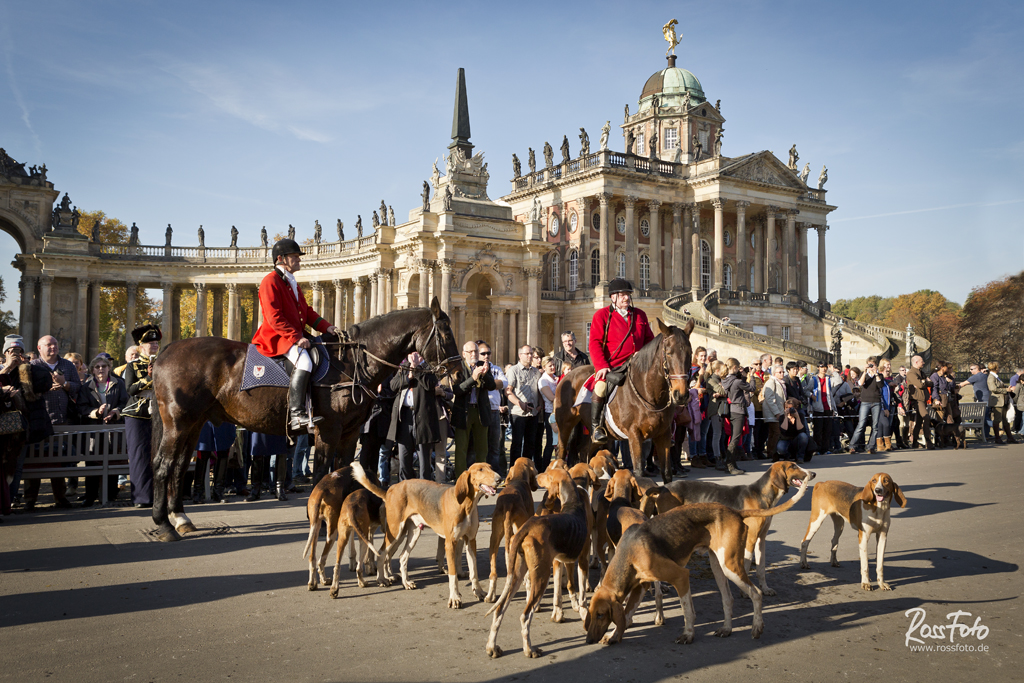 Hinrich Monchmeyer, Master of Hounds, and his Brandenburger Meute in front of the Neues Palais at the first Luisenjagd / Dana Krimmling photo
The Brandenburger Meute (Pack)
Hinrich Mönchmeyer started breeding hounds as a twelve-year-old. He bred Dackel hounds for hunting, which is not uncommon in the rural areas of Lower Saxony where he was born and still lives. In 1989 he started breeding beagles, and 2001 he started with his hunting pack—beagle crosses on the French Tricolor hound.
Hinrich wanted to breed a hound that possessed the stamina to run in a warmer climate. As the hunting of live animals with a pack of hounds is not allowed in Germany, he felt he didn’t need the hard driving characteristics of the foxhound. He liked beagles for their disposition, but felt they are not fast enough for the kind of drag hunting he had in mind.
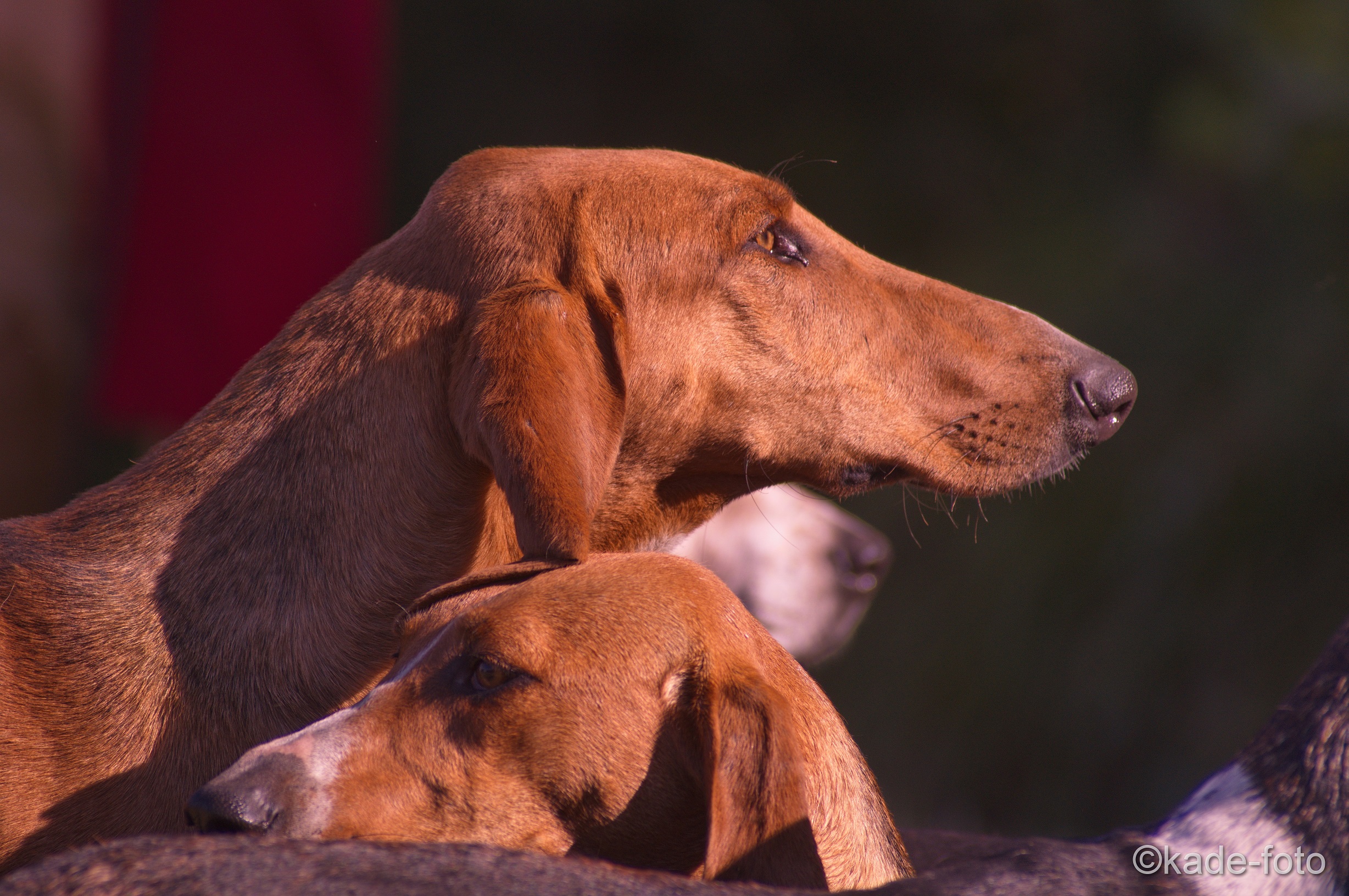 French Tricolor Staghound
At a meeting of staghounds in Fontainebleau, France, Hinrich saw the French Tricolor hound and immediately liked their looks and disposition, as these hounds are raised not to kill the deer but rather to keep them at bay. He talked to the French Masters, explained his idea, and they offered him his first Tricolors. The French Tricolors are delicate, not as robust in health as English foxhounds, and they are later to develop.
The results of Hinrich’s beagle-Tricolor crossings are medium-sized hounds with great stamina in warmer weather. They can be used for hunting before reaching one year of age. They have much greater speed than the beagle, excellent nose, and are extremely friendly towards people. That I can vouch for, as my children can often be seen in the middle of his pack, patting them.
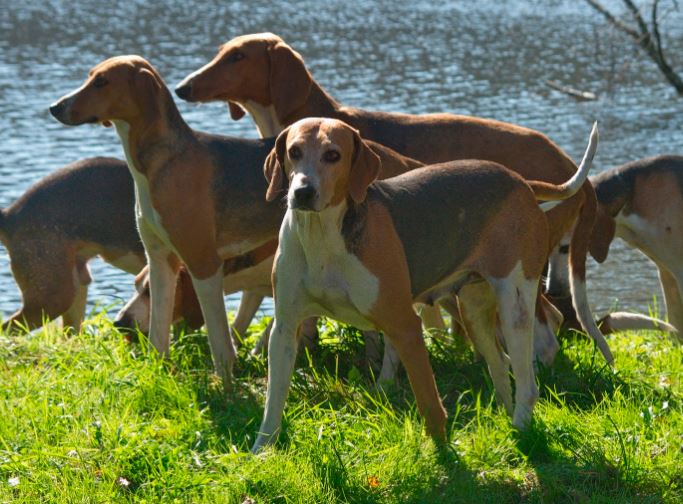 Beagle-Tricolor crossbreds of Hinrich’s Brandenburger Meute / Klaus Dieter Baumgart photo
An Invitation to Foxhunting Life Readers
Just as my wife starts to sigh when she sees the fencing of the Virginia landscape, so might North Americans sigh when they see the gallery of the first Luisenjagd (Luisen Hunt) at Potsdam, which kicked off near the Neues Palais (New Palace). The Brandenburger Hunting Club organized this meet on November 1, 2014 after years of long and exhausting negotiations with the authorities.
The hunt took place in the park adjacent to the castle, which was designed to be the hunting ground for the King of Prussia roughly three hundred years ago. Photographer Dana Krimmling posted a gallery of the hunt online that is for me the most beautiful series that I have ever come across. Click to see video images of the first Luisenjagd.
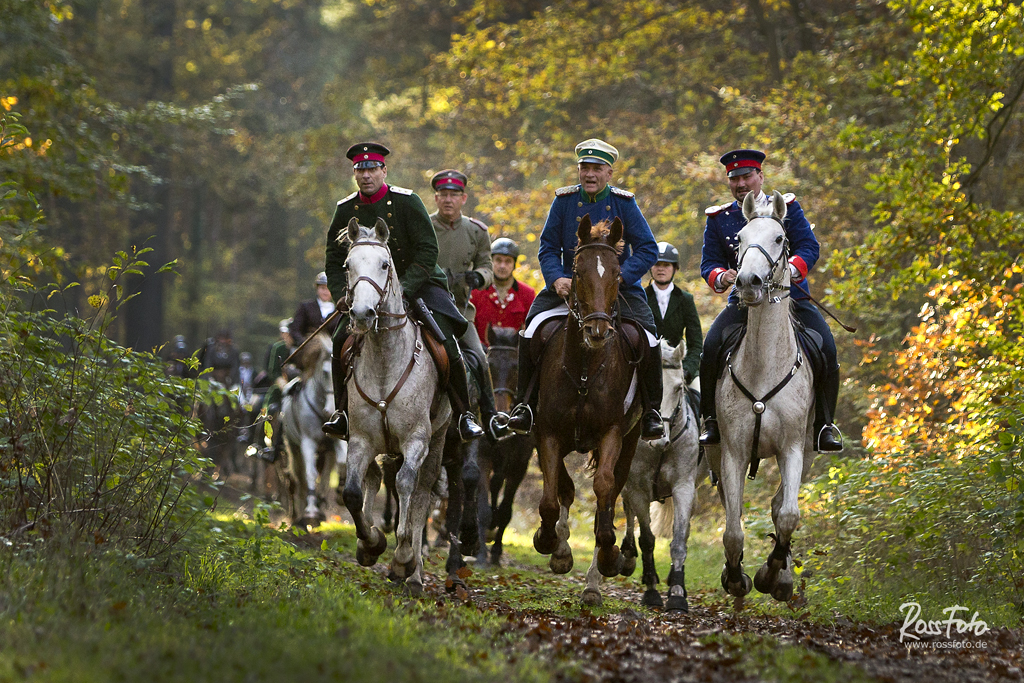 From Dana Krimmling’s photo gallery (link above) of the first Luisenjagd / Dana Krimmling photo
Guests are welcome for next season’s Lusienjagd, but interested parties should let us know early as we must limit the field to fifty riders. Foxhunting Life readers may contact Bernd Schiel directly for information on the Luisenjagd and for connections to other hunting establishments in Germany, especially in the Berlin-Brandenburg area.
The Brandenburger Hunting Club organizes about a dozen hunts per year and a versatility meet for junior riders. We take pride in the fact that more and more young riders (ten to sixteen years old) are active members and show that our efforts to bring children to our sport pay off. Hinrich Mönchmeyer, MH, deserves great recognition for his efforts in the training of our juniors on how to handle hounds. Indeed, one of his sons has his own harrier pack.
Posted January 6, 2015
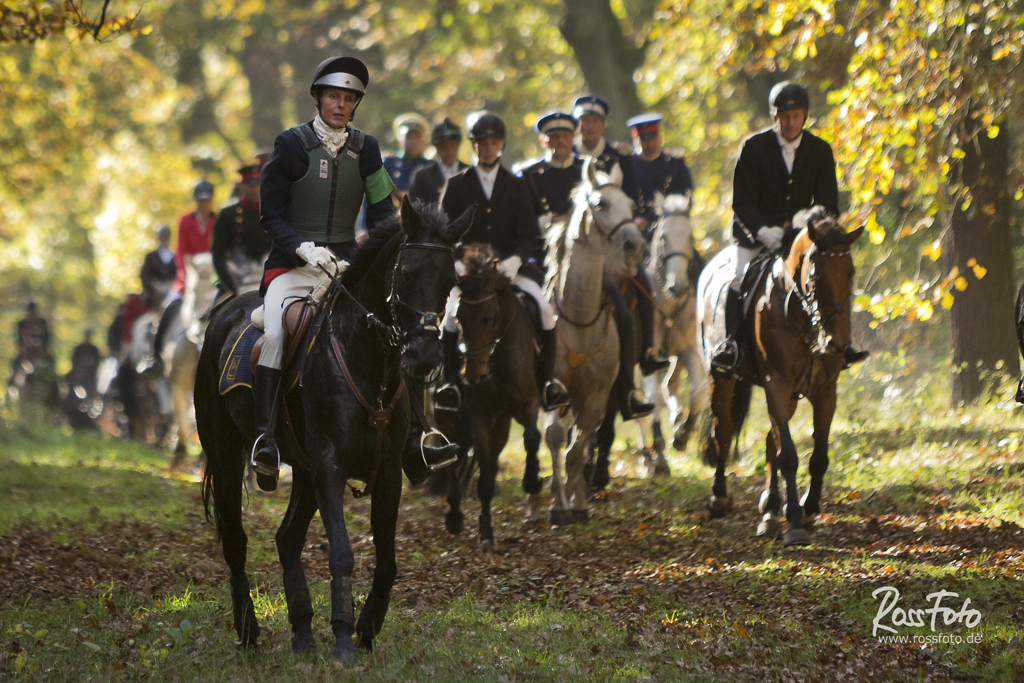 Videographer Antje Feis, wife of the author, leading the second field on her Trakehner mare Betty / Dana Krimmling photo