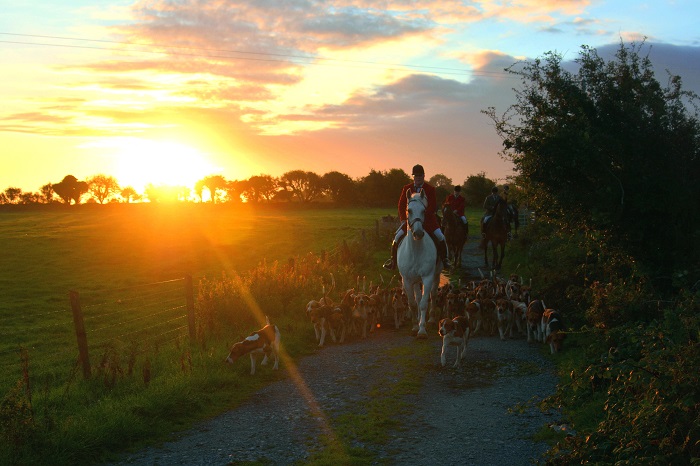
 Huntsman Tom Dempsey and the County Galway foxhounds head to the first draw at Riona and John Naughton’s farm in Newcastle. / Noel Mullins photo
Everything that happens in the hunt kennels and hound shows during the spring and summer seasons are just activities and events that lead up to the first morning of the autumn hunting season. It can be August for some packs and September for others when hounds are allowed to run for the first time.
The huntsman will have planned and implemented the breeding of his new entry probably two years beforehand by selecting a stallion hound that he thinks would match a bi*ch in his kennels, and indeed raise the profile of the rest of his pack. He may want to breed more drive into his pack by selecting an Old English cross, or more voice by selecting an American cross.
It is not always the well-known kennels that produce these class stallion hounds. You may not have seen these hounds at hound shows, as they sometimes come from kennels that produce hounds for hunting only. Such a case is Derek McMahon’s Brosna Foxhounds in Ireland who had the great Old English stallion hound, Brosna Ton Ton 2007, and now has other sought after stallion hounds, Brosna Tailor 2013 and his full brother Brosna Target 2013.
Hound shows are sometimes looked on by many as beauty pageants, where one can possibly study conformation and movement, important qualities to be sure. But for many, the old adage still exists, ‘handsome is as handsome does.’ Often, the experienced huntsman will have paid no heed to the overseas judges at hound shows, as visiting judges who are familiar mainly with the type of hound in their own kennels would often appear to have difficulty judging a mix of Old English, Modern or other breeds of hounds. So the huntsman will rely instead on visiting a number of packs on his non-hunting days to make up his own mind in determining which pack had the best voice and drive and then negotiate with the huntsman on either getting the use of a stallion hound or a draft of pups.
Harrier packs go through a similar routine and one will often see the infusion of a bloodline from one of the Kerry Foot Packs or the Scarteen Kerry Beagles. Huntsmen with open minds know from experience the unique sound-box of the Kerry Beagle and the American Penn-Marydel, breeds designed by nature for delivering rich music.
In Ireland the week after the Dublin Horse Show in August is a good indicator of when autumn hunting will be starting. All summer, the pack will have been lightly conditioned by hunt staff, walking hounds in the mornings and even better if they can be walked twice in the day. Pups—many of which will have come back from walk where families keep them for a number of months and get them used to people and activities around a farm—will have to be trained by coupling them to a more experienced hound until they understand to stay with the pack. When the huntsman is satisfied, it will be then on to bicycles, graduating to horses when the pace and the mileage can be increased in the build-up to hunting fitness.
Nothing is so anticipated as that first morning of autumn hunting. It is so special. Today, factors like harvest time dictate whether it happens in August or September, but every huntsman wants to get mileage into the new entry and fitness into the rest of the pack before he or she starts letting the pack run into the country, sometime in woodland and often in bogs, before drawing the coverts around the hunt country to disperse fox litters.
I suppose one tends to remember their own hunting mentor. Mine was the great Michael Dempsey, Master and huntsman of the Galway Blazers. When he was hunting the Blazers he could be described as a big man who was light on a horse. Autumn hunting in Dempsey’s time meant that the hounds did the talking, as Dempsey just let them work it out—no blowing on the hunting horn, no shouting, whippers-in not allowed to crack their whips. By keeping quiet, he taught them independence and never fooled the pack, so when he eventually blew the hunting horn when they found, or used his voice, they knew he was to be trusted.
Shortly after hounds enter the covert on that first morning, you wait patiently to hear a whimper as a lead hound picks up a line. Then, if luck holds, a sustained whimper confirms the line. The volume increases, and eventually the rest of the pack stop and cock their ears in the direction of the sound and race to the lead hound. What happens next is so difficult to explain to those who have never been there. It is the very thing that stirs the heart of every person that rides to hunt, rather than those who hunt to ride, two very different types of hunt follower. Just thinking about it makes the hairs stand on the back of your neck. That booming crescendo of music like no other, regardless of whether it is the cannon sequence from Tchaikovsky 1812 Overture, Antonin Dvorak New World Symphony, or Paddy Maloney and the Chieftains belting out a version of the Irish Jig, “Banish Misfortune”! Realistically, I love all those pieces of music, but they can never quite match a pack of hounds in full voice as the sun rises at 6:30 in Galway on the first day of autumn hunting. If you still do not understand it, then you don’t know what you are missing, and you will have to take my word for it!
Posted August 25, 2018
Noel Mullins is a lifelong foxhunter and, after a career with IBM, is now a devoted photojournalist covering the sport. His new book, The Dublin Horse Show: Pictures of My Memories has just been published.