
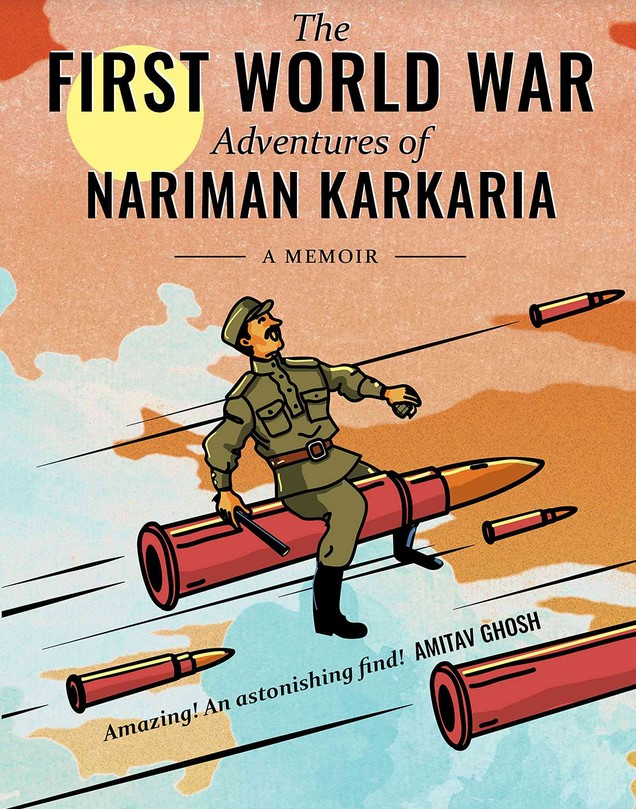
The author, while still a teenager in India, had always wanted to see the world. So with fifty rupees in his pocket, he left home to do just that. After working in Hong Kong and Peking for a few years, he decided, upon the outbreak of World Wat I, to volunteer for the British Army. He struck out for London from China, crossing Manchuria, Siberia (from where we have excerpted a foxhunting piece), Russia, and Scandinavia. Upon arriving in London in 1915, he registered as a private with the 24th Middlesex Regiment.
Over the next three years, Karkaria saw combat action on three major World War I fronts and was wounded only once. After being discharged, he returned home to India and wrote a book about his years of travel and adventure. His memoir was published in 1922. One century later, brilliantly translated into English, it was released in April 2022.
Manchuria
From Manchuria station, a separate line goes towards Mongolia and Inner Manchuria, but we have nothing to do with it. We are going to board the train to Siberia, which leaves at nine in the morning.
Irkutsk
I was rather excited about visiting Siberia; it is not something one does every day. I kept looking at my watch, waiting for six o’clock in the evening when we were scheduled to reach Irkutsk, the capital of Siberia. Finally at 6.35, I could spot Irkutsk station as we edged towards it. Wow! But there was nothing I could see except a small structure in a dilapidated condition.
But what is this? I could hear voices floating in from all directions though I could not see anyone. I went towards the little building, trying to figure out what it was. Imagine my surprise when I entered it. This was the portal to enter the station that had been built underground. As one descended the fifty-odd steps, it was like entering a fish market. People were running hither-thither with their bundles and bags.
What looked like a small place from the outside turned out to be quite an impressive railway station once you entered it. There were all kinds of facilities underground, including the ticket office, telegraph office, waiting rooms and a refreshment room. There was even a tunnel to cross over from one platform to another.
I spent a most miserable night which I will never forget. Just imagine if one has to spend a whole winter here. Forget using a light blanket to cover oneself at night; instead, one would need a heavy rug, weighing a couple of tons. Even during the day, one cannot do without a heavy woollen overcoat lined on the inside with a thick layer of fur. A fur lining on the inside makes a big difference when compared to a coat without it.
These overcoats are not a mere article of fashion to be flaunted. They could be the difference between life and death in this weather. Additionally, one has to wear headgear made from similar material, which covers practically the entire head and face. The outfit would not be complete without a pair of heavy boots that are also lined with fur on the inside. Having donned this attire, one can hardly walk or bend. But if one does not wear all this protective gear, one might end up dead and buried under those mountains of snow.
~
How is one to go around in this cold weather? No motor cars or carriages with wheels are in sight during winter since such vehicles with wheels cannot move on snow. They have therefore fashioned sledges with iron springs, each of which can seat two people. A few sledges are designed to seat four people on seats that face each other. Instead of wheels, these vehicles have two iron runners that slide smoothly on the snow. They can be very easily hauled by horses.
Since they do not have wheels, these sledges are rather low-slung like those little wooden carts on which children drag each other around in Navsari. But it is rather fun to ride these sledges. You just put your hand out and scoop up the snow. And one thing leads to another and we have a snowball fight!
~
The land of snow has got its own exclusive attractions. A roving sportsman could certainly have a good time. One of the more popular sports is the hunting of the Siberian fox. In our country, many hunters think no end of themselves after hiding up a tree and shooting down a passing tiger. They would be unable to shoot down a single fox.
Fox hunting is a long-standing and well-known sport in the northern stretches of Siberia. The fur of the fox is much valued across Europe and fetches high prices. Its fur is considered to generate the most warmth and ladies across Europe feel rather chuffed when they wrap it around their necks.
The Siberian fox is hunted only during the winter season when its fur is most developed. At the same time, the heavy snow prevents the fox from running at top speed. It makes the job of the hunter much easier. After having surveyed the area in the morning and having determined that there are a lot of foxes around, the hunting team stakes the area and surrounds it with a thick rope from which red flags are hung at intervals.
They fire a few rounds in the air to startle the foxes, which emerge from their hideouts and try to run away. But the perimeter of rope and the red flags keep them running around in circles and stop only when they tire out. They are shot dead in that instant.
Posted May 23, 2022