
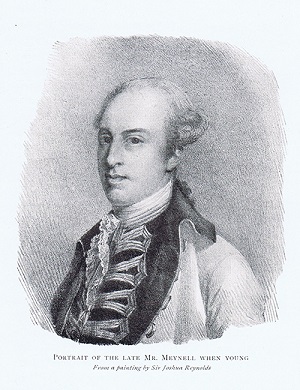
 Hugo Meynell is known today as the father of modern mounted foxhunting. In the eighteenth century he transformed a sporting activity which attempted to control vermin with the slow and plodding Southern hound into an exhilarating chase at speed with fleeter Northern hounds and a scientific approach. In so doing, he set the stage for foxhunting’s Golden Age in the early nineteenth century.
The great Mr. Meynell, designated by his admiring friends “The King of Sportsmen,” or “The Hunting Jupiter,” earned those titles by the sport he had shown. Without owning an acre of land in Leicestershire (his extensive estates being situated in remoter countries), he carried on [his sport in that] best hunting country in the world.
He considered horses merely as vehicles to the hounds. There are different opinions as to Mr. Meynell’s proficiency as an elegant horseman; but it is never disputed that his progress over a country was, like the whole course of his life, straightforward.
It was at the commencement of the career of “the great Meynell” that the dawn of science began to cast its rays upon that system out of which had grown the modern style of fox-hunting. He was, as an old sportsman and excellent judge of hunting, the late J. Hawkes, Esq., has justly remarked, without doubt the most successful Master of Hounds of his time, producing the steadiest, wisest, best and handsomest pack of foxhounds in the kingdom. His object in breeding was to combine strength with beauty, and steadiness with high mettle. His idea of perfection of shape was short backs, open bosoms, straight legs and compact feet as the first consideration in form. The first qualities he considered were fine noses and stout runners.
In the spring of the year he broke in his hounds at hare, to find out their propensities, which when all flagrant, were early discovered, and he drafted them according to their defects. After hare hunting they were, during the remaining part of the summer, walked daily amongst riot. When the hunting season commenced, his hounds were hunted in the woodlands amid abundance of foxes for two months. In November, the pack was divided into old and young. The old pack consisted of three-year-olds and upwards, and no two-year-olds were admitted except a very high opinion was entertained of their virtues and abilities. The young hounds were hunted twice a week, as much in woodlands as possible, and in the most unpopular covers, having always with them a few couples of steady old hounds. The old pack hunted the best country; when any bad faults were discovered they were immediately drafted for fear of contamination. Skirting, over-running the scent and babbling were considered the greatest faults; perfection consisted of true guiders in hard running, patient hunters on a cold scent, together with stoutness.
Every hound has his peculiar talents; and Mr. Meynell’s were sure to have a fair opportunity of displaying them; some had the peculiar faculty of finding a fox, which they would do almost invariably, notwithstanding that twenty or thirty couple were out in the same cover; some had the propensity to hunt the doubles and short turns, some were inclined to be hard runners: some had the remarkable faculty of hunting the drag of a fox, which they would do very late in the day; and sometimes the hardest runners were the best hunters, and fortunate was the year when such excellences prevailed. Mr. Meynell prided himself on the steadiness and docility of his hounds, and their hunting through sheep and hares, which they did in a very surprising manner. He seldom or never attempted to lift his hounds through sheep, and from habit, and the great flocks the hounds were accustomed to, they carried the scent on most correctly and expeditiously, much sooner than any lifting could accomplish. Mr. Meynell was not fond of casting hounds; when once they were laid upon the line of scent, he left it to them; he only encouraged them to take pains, and kept aloof, so that the steam of the horses could not interfere with the scent. When a fox was found in a gorse cover, very little noise or encouragement was made; and when he went away, as soon as the hounds were apprised of it, they did not go headlong after, but commenced very quickly, settled, and collected together gradually, mending their pace and accumulating their force as they went along, completing what was emphatically termed a terrible burst.
When his hounds came to a check every encouragement was given them to recover the scent, without the huntsman getting amongst them, or whipper-in driving them about, which is the common practice of most packs. The hounds were halload [sic] back to the place where they brought the scent, and encouraged to try round in their own way, which they generally did successfully, avoiding the time lost in the mistaken practice of casting the hounds at the heels of the huntsman.
When the hounds were cast, it was in two or three lots, by Mr. Meynell, his huntsman and whipper-in, and not driven together in a body like a flock of sheep. They were allowed to spread and use their own sagacity at a gentle pace, and not hurried about in a blustering manner but patiently. It was Mr. Meynell’s opinion that a great noise and scolding of hounds made them wild; correcting them in a quiet way was the most judicious method; whippers-in should turn hounds quietly, and not call after them in a noisy disagreeable manner.
Mr. Meynell’s hounds had more good runs than any other pack of his day. Mr. Meynell’s natural taste led him to admire large hounds, but his experience convinced him that small ones were generally the stoutest, soundest, and in every respect the most executive.
Posted August August 8, 2019, 2019
From R.T. Vyner’s Notitia Venatica, 1841, as published in E.D. Cuming’s A Foxhunting Anthology, 1928.