
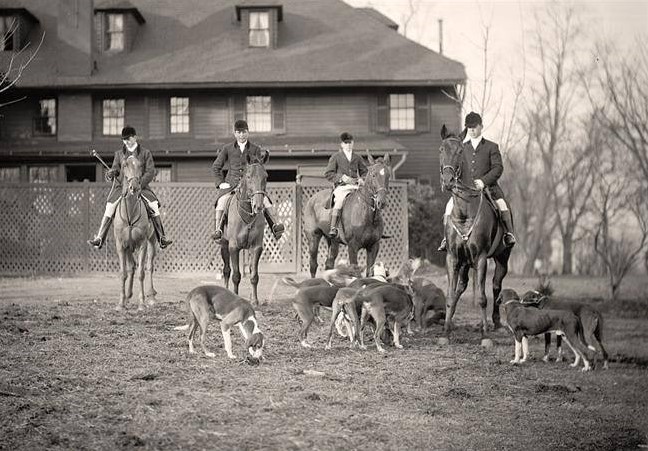
 Photograph discovered by Baily’s in a biscuit tin, dated 1905 on the back, and appearing American.
The historic and well-documented Great Hound Match of 1905 was a face-off between A. Henry Higginson’s Middlesex Hunt (MA) with its English Foxhounds and Harry Worcester Smith of the Grafton Hunt (MA) and his American foxhounds. The Match was held in the then hunting country of the Piedmont Fox Hounds (VA), with each pack alternating hunting days.
Despite the substantial coverage by the press and public interest in the Match at the time―and ever since―something has been missing.
The competition and the colorful characters are wonderfully laid out in Martha Wolfe’s The Great Hound Match of 1905: Alexander Henry Higginson, Harry Worcester Smith and the Rise of Virginia Hunt Country. Yet no photographs of any of the meets or any of the foxhounds competing in the Match have ever been seen.
Photographs do exist of both Middlesex and Grafton hounds, but all were taken at other times and places. The Middlesex pack was, however, comprised entirely of hounds of known breeding imported from England by Mr. Higginson.
Mr. Smith’s Match pack consisted of American hounds acquired by him prior to the Match, primarily in Virginia and Kentucky. Further information on these hounds can be found in Ms. Wolfe’s book and in Alexander Mackay-Smith’s heavily illustrated and sourced The American Foxhound 1747-1967.
Then, in 2017, Baily’s Hunting Directory posted the photograph shown above on Facebook. It had arrived at their offices with a group of others in a Peek Freans biscuit tin. Baily’s commented that the photograph was dated 1905 on the back, appears to be American, and asked if it could be identified. Could this be Harry Worcester Smith’s American Match pack?
There are about six to six-and-a-half couple in the picture, the number to be hunted by the Grafton in the Match. (Due to a lame hound, only six couple were hunted.) And the hound couples that Smith used to keep most of the hounds together when not hunting appear to be visible―practice noted with disdain by Higginson whose English hounds were well-disciplined. But what about these hounds of Smith?
By Smith’s own account, in the years prior to The Match, he bred for “Grafton markings” described as “black saddle, white ring about the neck, white legs, one-half white tail, white strip in face, tan head….” The American Foxhound standard adopted by the National Foxhunters Association in 1894 states as to color, “Black-white and tan are preferable, though the solids and various pies are permitted.” It should be noted that six of the seven members of the drafting committee were from Kentucky and that Smith specifically approved the standard at a meeting of the Brunswick Fur (Foxhound) Club in January of 1905. The standard did not change to “Any color” until 1910.
In 1906, following a bitter fight with Orange County Master John Townsend over the hunt boundary with Piedmont in Virginia, Smith sold his pack―including the members of his Match pack―to Townsend for a tidy sum and departed. Presumably, Smith regretted the sale as he began to rebuild in the following year. Prior to the sale, Smith was striving for the “right” color, saying:
Out of seventy youngsters bred North and South in 1905, I had seven couple of the proper color with good hunting qualities; out of fifty youngsters bred North and South in 1906, I had four couple of the right color which are giving satisfaction in the field.
Although Smith was clearly focused on the Grafton look, in fact, none of the hounds in Grafton’s Match pack were Grafton-bred. Most were acquired in the year or two preceding the Match, some just before, with Smith specifically purchasing individual hounds of outstanding ability. In fact, he acquired over 150 hounds in that period, which he narrowed down to his Match pack, several of which were already field trial winners.
According to Smith, Sinner, Satan, Sin, and Spic were purchased from Charles Bunning in Cold Spring, Kentucky. Sam and Sorry came from Virginia. Sue and Splash were Bywaters blood, also Virginia. Sinbad was bred near Warrenton, another Virginia hound. Simple was a Walker, and Simon and Snodgrass, both one-quarter English were bred by Messrs. McGregor and Bragden respectively.
In the photograph, although the hounds are far from uniform, one couple, on the right, seems to conform to the Grafton color of dark backs, tan upper legs, white lower legs, portions of white on tail, and white markings on the heads. They could be the part English Simon and Snodgrass, who, in Smith’s account, were the least impressive members of the pack in their hunting ability. The others are more varied, mostly colored in conformity with the 1894 standard and clearly of American type.
The photograph is, of course, black and white, and the faces somewhat indistinct. The gentleman second from the left resembles Smith as seen in other photographs, and the rider on the right resembles Claude Hatcher, one of his whippers-in, but something more by way of evidence is needed.
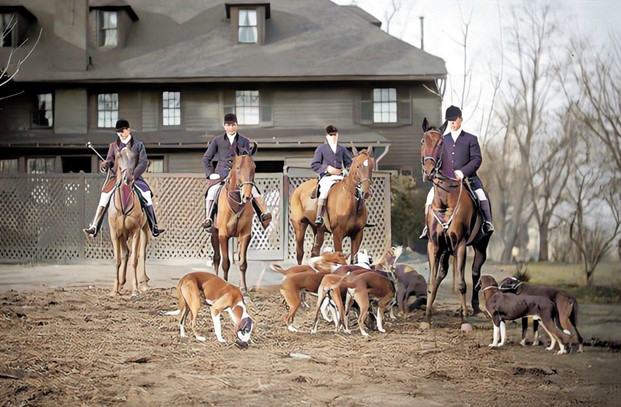
Smith was determined not to conform to English traditions with his hunt. To distinguish the Grafton from those American hunts which were deliberately British in livery and style, Smith adopted a unique livery for the Grafton: grey coat with black collar and dark (patent leather) boot tops.
In recent years, software has been developed and extensively used to recover the natural colors of photographs originally filmed in black and white. Techniques in Artificial Intelligence have also been incorporated to enhance the images. When an AI colorization application analyses the 1905 photograph, with no “tweaking” of the results whatsoever, but allowing the colorization application alone to determine the actual colors in the 1905 scene, the result appears below. A wonderful thing, technology!
Posted August 26, 2021