
Born in Shanghai, China in 1870, the author of this story crossed the Pacific Ocean with his sea-going father three times by the age of four. A goat was carried aboard ship to provide him with milk. Nason Hamlin was the first recording secretary of the Norfolk Hunt and a member of the field on Norfolk’s first day with hounds in 1896. He took to hunting and polo with exuberance, but his hand-written records are more often expressed in seaman’s jargon than in the language of foxhunting. Here’s Hamlin’s record (abridged) of a Christmas Day live hunt on Cape Cod (pp 27–29, “The Norfolk Hunt: One Hundred Years of Sport” by Norman Fine).
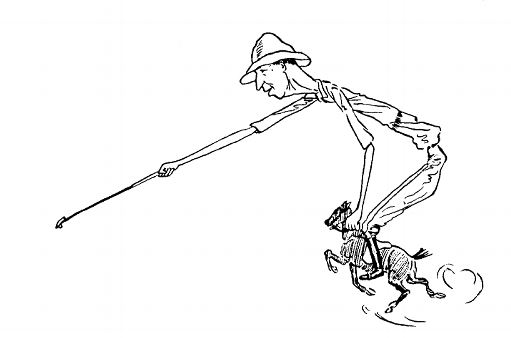
Soapy Sponge, my new dappled-gray runaway, was yet to demonstrate his worth. On Christmas morn, 1899, just as the sun was peeping over the hill, Captain Samuel D. Parker, MFH was hunting the hounds at Eastham, away down on Cape Cod. It was a frosty, sharp morn and hounds were thrown in at the swamp lands fringing the ponds on the bay-side somewhere opposite Billingsgate Island. Shortly we heard a whimper from one hound, and almost immediately the pack took up the find and crashed away in the direction of the shore.
There were some skeptical suggestions that dead fish were the lure, but dead fish by themselves don’t travel, and when the entire pack kept running along the water’s edge in full cry in a northeast point, we all were convinced it was the real thing after all.
We were following at a smart pace and after, say a mile gallop, we were suddenly confronted with a salt-creek which, flowing into the sea, blocked our path. It was no small creek, perhaps a hundred feet across. Added to this was the considerable fact that it was about one quarter on ebb tide and the current was setting out at a rapid flow.
The pack pulled up and sniffed eagerly at the marge. Good old Harry Lee Morse said (I can hear him now): “Well, boys, if they go across, surely we ought to.”
It almost seemed that the pack heard the suggestion, for it plunged in, to a hound, and struck out bravely for the further shore.
This, of course, was enough for Captain Parker, who followed his hounds in a jiffy. The Doctor Morse, then I, made the plunge. I recall growling at my renegade mount Soapy, “Now, damn you, show if you are worth the hundred dollars I expended on you.”
He showed, and I confess it came pretty near the price. It was my first experience swimming a horse in deep water, and it proved well worth taking on. As we struck out boldly, I learned several things heretofore novel to me.
I was surprised to find that instead of swimming on a level, when in deep water the horse remains at an angle of about forty-five degrees. This, of course, brings his head high out and if the rider attempts to pull the reins…back comes the animal, and you are both rolled over, under the water. Instinct told me to stand in my leathers, to drop the reins on the neck, and to grasp the mane with one hand.
Of the five who swam the stream the second whipper-in unfortunately did not refrain from pulling or hanging on by his reins, and when halfway across, over rolled his mount and they both disappeared in a floundering of foam. The current was strong in half stream, and in order not to be swept out to sea it was necessary to steer one’s mount at an angle up-stream to offset the flow. The huntsman, John Magee, following close, went to the whipper-in’s rescue, and although losing a leather, managed to grab the hunt servant by the hair and pull him safely to the bank, where he crawled out a wiser but wetter man.
Meanwhile I was having trouble of my own. I had reached the further bank, only to find that it was a precipitous marsh-bank which allowed no footing for a landing. So we pushed off, so to speak, once more and essayed a spot further up, not daring to take the chance of down stream, for the ocean edge was too near as it was.
I don’t know how it all happened, but without the aid of a derrick, we, Soapy and I, after a long while, found ourselves actually on terra firma (and not so darned firma at that) and wet nicely, though fit to continue.
Those onlookers of the other bank, in recounting the performance, said that the whole thing looked like nothing other than upset boats with propellers going furiously.
Well, the experience was worthwhile, now that I can look back on it, but I do not think I should relish a repetition of the circus at this late day. Certainly not in cold blood or in icy water. It needs the thrill and excitement of hounds running, to attempt one to recklessness. At such moments, one is apt to put aside all considerations of the possibility of mishap and to go it blindly and unreasonably.
Thus standing on the bank with the ice-cold stream conquered, I viewed the frantic saving of the whipper-in, who, by the way, we found later could not swim and feeling sure (selfishly) that he would be saved without effort from me, I scanned the marsh-waste to the west, where the hounds had already disappeared and where some half mile a way, going at a brisk gallop, the Master, too, was disappearing. I set my face against life-saving and the less crazy riders on the nether bank and took up with Harry Morse the long, long trail, which led us, after an hour or two, to the high woods in the adjoining township of Brewster.
The speed of our progress was somewhat marred by the necessity of frequently lifting one boot and then the other, to let the water pour out. This was accomplished at a trot—we had no time to spare—and undoubtedly the water which came out went no further than our breeches and immediately started to drip back into our boots. Add to this the cold and the fact that the salt water had brought my riding drawers to the pleasing condition of sandpaper next raw flesh, and I was not having such a grand time, physically.
There we lost the fox, having viewed him but once during the entire run and then only as he scrambled from the marsh shore up the dunes to the distant hills.
After a long time the rest of the field, save the nearly-drowned whipper-in, joined us by riding over bridges, and we slowly wended our dripping way back to our host’s estates at Eastham.
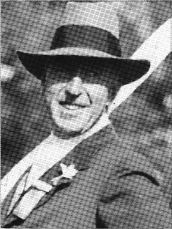 B. Nason HamlinIt was a much chastened plug and a tired, sore, but happy rider which drew up finally about one o’clock noon at Matt Luce’s place, “My House,” where a Captain Nickerson had fresh-opened oysters from the bay—corned beef hash and his own apple pie with raisins. I ate a whole one. Yum!
When the empty pie plate was returned, the Captain limited himself to one remark: “My God! What a feeder!”
Later I visited old Soapy in his stall; letting sentimentality get the better of me, I rubbed his nose, gave him lumps of sugar, and made the following admission—(this time not grudgingly): “Old Soapy, you did nobly and you are worth the hundred I gave for you, and, I’ll add, your board bill, too.”
Posted December 17, 2019
With the kind permission of the Norfolk Hunt.