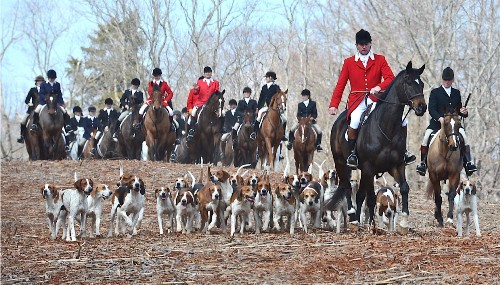
 125th anniversary joint meet for both the Warrenton and the Deep Run Hunts (VA). Front, l-r: Warrenton huntsman Matt van der Woude and Deep Run huntsman Richard Roberts / Douglas Lees photo
Celebration of any centennial is not just a major milestone, it is an achievement in survival. This season Warrenton Hunt marked 125 years of sporting tradition and, making this anniversary even more special, the future of this American pack of foxhounds looks rosy. Leadership and landowner relations are two key elements, according to Rick Laimbeer, who returned to the Mastership after a brief hiatus. He had only good things to say about Warrenton’s newly minted Joint-Masters Celeste Vella and Kim Nash, along with discussing how the board has been infused with fresh energy and vigor.
The Masters
“Celeste Vella and Kim Nash are both extremely bright and well-organized,” said Laimbeer. “Celeste is an attorney. She’s a very clear thinker, personable and well-liked, and a good rider. She has a daughter who is also an excellent young rider. They are vital to the whole junior connection. Celeste is also very talented in the business-sense and has an extremely artistic flair; she has great taste and does all the decorating for all of our functions.
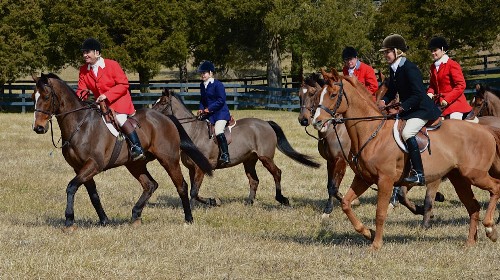 Moving off are (l-r) Warrenton MFHs Rick Laimbeer and Kim Nash, Deep Run ex-MFH Coleman Perrin, Deep Run MFH Polly Bance, and Warrenton MFH Celeste Vella. / Douglas Lees photo
“Kim Nash is married to a farmer located in Warrenton’s country,” continued Laimbeer, “and she understands the fragility of the balance between the desire of those of us who wish to hunt and the potential infringements on the farmers themselves. Kim has a long history in foxhunting. She hunted with Fairfax as a junior. She’s been on the radar to be Master for a few years, but she was very busy as president of the Garden Club of Virginia, which has a huge membership, and she is still very active, but that was a big job. Out of all the people I know, Kim really embodies the tradition of the Warrenton Hunt.”
Kim Nash said, “I was president [of the Virginia Garden Club] for two intense years. It involved a lot of travel, and I didn’t hunt much—maybe once a week. Rick approached me, and he is a sly devil. It’s hard to turn him down. I never wanted to be Master, but I’m having fun with it because of my fellow Masters and the staff.”
The key to this masterly triumvirate is that they share the duties of their office. Communication is vital, not just among themselves but also with their board and with their subscribers. With hounds going out three times a week, they each take charge of one meet every week, and they divide up the land and responsibilities to the landowners according to the fixtures.
The Huntsman
“Our huntsman Matt van der Woude does a lot with our landowners; he’s our feet in the street,” stated Laimbeer. “Every day he checks into and goes to see landowners. The thread of this hunt has stayed pretty much the same. It’s all about landowner relations, and we want to continue having strong bonds with our landowners and making hunting more accessible to a broader range of people.”
Landowners need to feel comfortable with the huntsman and whippers-in. These are the people they will come across when they stay out to gather keen hounds at the end of a day’s sport, exercise hounds during the summer, and during the early part of the cubhunting season introduce young hounds to the joys of hunting.
“I can’t say enough about the magic of our huntsman Matt van der Woude and our whipper-in Clydetta (Poe) Talbot,” said Nash. “The pack is now Matt’s pack. He took up the horn about eight seasons ago. Matt and Clydetta are so enthusiastic. Matt is a very solid family man; his children are very important to him; and he can handle situations with tact and humor. He has a college degree—went to Wakefield where he met his wife Daphrie (Laimbeer). Foxhunting is Matt’s passion, and we are lucky to have him.”
The Juniors
Yet, the demographics of foxhunting in general have the Masters somewhat concerned. They wonder if hunting will be able to provide the entertainment value that justifies the time and dollar investment, especially when other activities don’t require as much time, skill, and money to participate? Warrenton’s juniors are considered a serious asset to the future of sport.
“I came to hunting late and was bitten by the bug immediately, but since I’ve been involved with Warrenton Hunt, there have been a lot of juniors, which is really nice for my daughter, Sophia, who is fifteen now,” said Celeste Vella, who also insisted that she did not feel steeped in the hunting tradition enough to be Master. “Sophia got proficient enough on her Dartmoor pony to start going out when she was seven or eight, and she made friends with the children from the van der Woude, Hogan, Markell and Cantrell families. We’ve been well represented by juniors for the past twelve years or so. Kids are like magnets; it’s key to have more than one or two for companionship and also for their competitive nature.”
Both juniors and seniors are active with the hounds at Warrenton, and each year huntsman van der Woude and whipper-in Talbot, assisted by a number of enthusiasts, compete at the Virginia Foxhound Show over the Memorial Day Weekend at Morven Park. In 2012 hounds earned a number of blue and red rosettes in the Crossbred ring, and junior member Rachel Paradise won the eleven-to-sixteen senior division of the Junior Handler class.
A Community of People
Most of all, Warrenton Hunt is about welcoming people. It is about community and sharing the thrills of foxhunting. The old hunting land monopolies are a relic of the past. “In the old days when someone owned 10,000 acres, they could dictate, but now you really have to recognize that you are a guest of the landowners,” explained Laimbeer. “It might sound a bit boring, but it really is all about the landowners. A lot of old Warrenton country has been opened, we seem to have plenty of red fox again, and the hunting has been wonderful.”
When Laimbeer was Master the first time (2005-2011), Feroline Higginson was a Joint-Master along with Al Griffin. She and Ray Keyser were instrumental in opening a big chunk of land in the Marshall area, and a lot of it is now in scenic easement. The twenty-firstcentury witnessed the re-opening of North Wales, which had been closed for about thirty years. Last fall, for the first time in twenty-five years, Warrenton hunted the Canterbury fixture next to Fauquier Springs Country Club. “Many of the old-time foxhunters came out to see us off,” recalled Laimbeer, the smile in his voice expressing much more than just another day to hounds.
Best of all, in this one-hundred-twenty-fifth renewal of the sporting traditions of the Warrenton, the fox population appears to be thriving. “We think the foxes and coyotes are starting to co-habitate easier,” said Laimbeer. “We went through a drought for a couple of years—oh, going back three or four seasons you would see a fox once in a blue moon, but now there seems to be a steady influence of fox. I see them all the time.”
Perhaps foxes co-existing with coyotes will end up a modern Aesop’s fable and metaphor for modern life. It’s certainly a good omen for the future of sport at Warrenton Hunt.
Posted March 15, 2013