
Back in the late 1950s, Deirdre and her friend Sarah, both just nineteen, came to America. The pair had left Britain, where post-war ration books were still in use. Sarah was to train horses and riders for Jamie Kreuz at Bryn Mawr Farms outside Philadelphia. Deirdre was to work for the Insurance Company of North America in Philadelphia and help Sarah on weekends. What follows is Part IV of their adventures, which have included Part I: “How to Bridle a Green Field Hunter,” Part II: “The Witch With Warts,” and Part III: Pink Gin: The Beer Swilling Timber Horse.
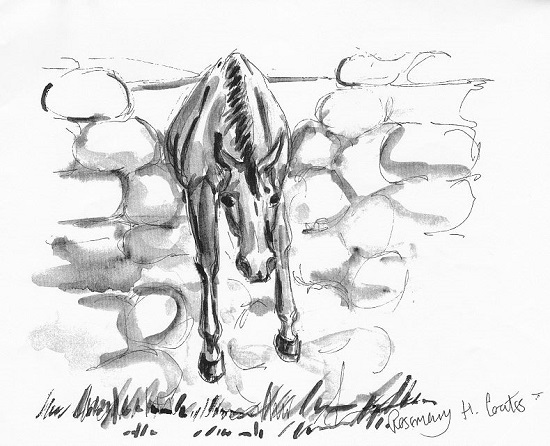 Illustration by Rosemary Coates
Sarah and I clearly remember Billy telling us about Purrfec’ Granary. Billy mucked out for us but he also had a way with words. This is how he described her infuriating ability to demolish stone walls and gallop off toward the rising sun.
“She lie down against a wall of stone—it’s a trick she learned—and she do gently poosh that darned wall clean over. Then off she go wid ’er tail over herself!”
So…several days later when I took ‘purrfec’ Granary out cubbing, I made sure we stayed away from any stone walls. Instead, we had the bad luck to find a groundhog hole. Although Granary was a careful and accurate jumper, even the best jumper cannot avoid groundhog holes. This was a disastrous thing to happen on this of all days as it was Thanksgiving. And tonight was Thanksgiving Dinner. However, still muzzy from the fall and with two blackening eyes, festive dinners were out of the question. Though I still had my teeth, they’d not be chewing turkey that night.
By the time the meet was over, we’d trucked home, and cared for the horses, I needed breakfast for by then it was nearly noon. Billy plastered his bacon and eggs with maple syrup. The plastered syrup mixture was then topped off with apricot jam. This jam habit was endemic in the American south, and Billy had brought it north with him. It was so good that even today most of my cooking usually has a dollop of apricot jam in it somewhere!
The Fun of Feeding Horses
So recently away from starving Britain, it was a totally new American experience for us to witness the amount of feed that came into the barns for the horses on a routine and sometimes daily basis. With seventy-five horses in five different barns dotted round the farm, the logistics for bringing in feed and taking away muck were intricate. In one month alone Sarah remembered logging in five hundred pounds of sweet feed, one hundred and twenty-four pounds of corn, one hundred pounds of bran, three tons of alfafa, and seven tons of straw. Then a mere twenty-five pounds of flax seed, four hundred pounds of whole oats, five hundred pounds of crushed oats, and one hundred pounds of cracked corn. This was closely followed by two hundred pounds of beet pulp and a weekly delivery of one hundred sixty sacks of sawdust shavings. The last and best delivery was molasses. It could be used in different ways and usually ended up looking a bit like a pulverized muck heap, but the horses loved it…and so did Billy. But we spoiled his fun by locking it up.
The Cowboys
Late one afternoon Jamie came into the barn. The sky was darkening and flashes of lightening heralded a super storm. “Quick,” he said, “saddle up Dinkum, Granary and Humphrey, and we’ll go and watch a King Ranch round up.”
“Listen,” said Jamie, as we cantered up the verge. We could hear the sounds of thunderous yelling, then as we drew level with the herd there was the spitting crack of a whip followed by splintering wood as a steer hit the solidness of the boundary fence. It was almost dark now and we could just see black-cloaked horsemen with black hoods. This was their protection against storms.
“In the spring,” Jamie informed us, “they wear yellow oilskins for the rain—again with hoods. What you’re seeing here are the famous Santa Gertrudis cattle from King Ranch in Texas. They are sent up here to be fattened and are extremely valuable. Their cowboys come with them.”
For Sarah and me, this herding was the Wild West come true, and on a very large scale. Imagine the noise of well over a thousand cattle—fugacious, fecund, over-heated, unstable, long-horned, and cornered. All this muscle was set against the intelligence of fifteen mounted cowboys. The light was gone and the atmosphere ghostly. There it was: the whizzing of lassos, the wind, the shouts, the power, the drive, the steam, the speed, and the blasphemy.
Posted June 28, 2016