What follows is one of Master Epp Willson’s frequent email reports to Belle Meade members to recognize and thank individuals for efforts on behalf of the hunt, apprise members of current hunt affairs, or, as in this case, add to their knowledge of hounds and hunting.
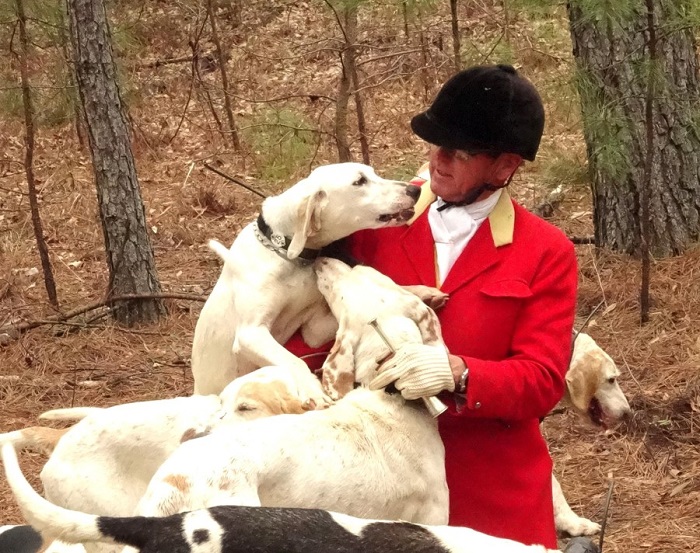
Belle Meade hounds drew well, handled well, and listened all day. They are settling in and becoming the team we expect them to be.
Our hounds provide quality sport nearly every time we go out. They are doing it every time if scenting conditions are decent and a cooperative coyote can be found. Yesterday was an interesting day.
There was a light east wind. (A heavy east wind is often bad for scent, at least around here.) More often than not, it holds true. It was also cool and damp―good signs for scenting.
Usually, the best indication for scent is how hounds behave when they come out of the kennel and on the way to the first draw. If they are disinterested in sniffing the ground and generally lethargic on the way to the draw, these are indications that scent isn’t good.
Scenting conditions often change during the course of the hunt. For an afternoon hunt, scent usually improves when the temperature cools and dew begins to appear. That’s where the term “five o’clock fox” comes from. If we start at three pm and are having a slow afternoon, we often find a fox or coyote around five o’clock. That doesn’t mean the critters weren’t stirring earlier, but rather that scent improved enough to run a coyote around five pm.
Yesterday, hounds were normal coming out of the kennel. On the way to our planned first draw at Tally Ho Lake, hounds were more eager than usual. Sometimes that is just energy and has nothing to do with scent. But most of the time, that means scenting is better than normal. Several hounds were constantly pushing ahead―not trying to break, but pushing ahead of where they were supposed to be. We like them to be behind the line of where the huntsman’s horse’s front feet are. They know where the line is, and normally they are cooperative about staying behind it. Yesterday, not so much.
When we rounded the corner to go through the gate in the back of Sylvia Cooper’s place, they went straight into the woods―not through the gate. I had told the staff that I planned to draw the Tally Ho Lake area unless hounds hit something before we got there. For a moment, it appeared that they had. It turned out to be nothing, but we let them draw on north anyway. Not a bad cast. They drew nicely to Treelo’s coop, crossed the pipeline, and were trailing a little more actively.
Sharp-eyed Terry Cooper radioed that he had just seen what may have been a coyote crossing to the north side of the pipeline. That would be the same place the coyote crossed last Saturday―just beyond the crest of the hill east of Deacon’s Coop. We gave hounds another moment to see if they could turn their trailing into running. No joy on that. So we lifted them lightly and harked to the view. Hounds hit the line, and about two-and-a-half couple of hounds―Rebound, Colleen, Garnet, and a couple of others―took it north, the correct direction. The rest roared south on it―running the heel line (backward).
Terry is north flank, and he went on with the front hounds. Jeb and Alf went south with those running heel to try to get them turned around and heading in the right direction. They caught up to us quickly, having already figured out for themselves they were wrong. They came back to my horn, and we tried to catch up with the front-runners.
When the lead hounds turned toward US-78 from Five-Points, Barbara and I decided to wait and hold the twenty hounds we had. We didn’t need twenty more hounds going toward a busy road.
It would be much easier to stop and catch the five front hounds if they made it to US-78. Terry and Kim were close to the front hounds―coordinating with the road whips―all doing their usual good job. Robbi saw the coyote cross US 78 from her truck. Steve Latham and Judith were nearby in the hunt truck. Together, they got the hounds stopped, caught, and into the truck.
We were with the fields and the rest of the pack at Quaker Cemetery. The priority was getting those front hounds away from danger, whether it meant into a truck or following a whipper-in back to the rest of us.
Once things were under control at US-78 and the pack back together, we drew on west, and hounds struck about three hundred yards northwest of Tyson’s Bridge. We had a blistering run, counter-clockwise, about four miles, with hounds accounting for him about one hundred yards west of where they first struck. Well done, hounds!
More About the Hound
This year’s puppies are still trying to figure it out. Not unusual.
Most of last year’s puppies are doing really well. They are not only becoming team players, but some have become leaders.
Stryker, for example, has gotten so good he is almost too fast. He often outruns the pack and gets way out ahead of the others. This is pretty remarkable for a second-year hound, but his pedigree is exceptional. Stryker goes straight back through his tail-female line (his dam’s line, the bottom-most line in his pedigree) to Midland Saucy ’84, out of Bill Smith’s Maggie. This means that Maggie’s genes from the foundation bi*ch of this long-maintained and highly-prized line in the Midland kennels, traveled directly to Stryker through his bottom (female) line for eight generations―dam, grand-dam, great-grand-dam, great-great-grand-dam, etc.
Pre-potency
While we’re at it, let’s define this breeding term because it’s so important. Most of us have heard the old saying, “Breed the best to the best, and hope for the best.” Sure, that’s bound to work sometime, but there’s another factor you’d be ignoring if you follow that advice. Breed to a well-maintained breeding line, the foundation hound of which, male or female, is generally considered to be pre-potent.
Bill Smith’s Maggie is regarded as a highly pre-potent hound. By this, we mean that Maggie’s genes―and therefore many of the desirable traits she exhibited when she was hunting―somehow express themselves as they are passed on to her get, generation after generation. In other words, she was able to reproduce herself! Not all hounds or animals or people have that ability.
For example, we all remember Triple Crown Champion Secretariat, the superhorse whose speed records still stand at tracks that host the best of Thoroughbred racehorses. Mares with the highest of hopes lined up for Secretariat’s attention after he was retired to stud. But most of those hopes went unfulfilled. As outstanding as he was, he was not especially pre-potent. He could not pass on those genes that made him a legend. He couldn’t reproduce himself. He was a one-of.
Knowledgable foxhound breeders seek hounds with good hunting traits and the proven ability to pass on those traits. In the mid-1980s, Ben Hardaway noted Maggie’s ability to pass on the hunting traits he wanted in his hounds and carefully maintained her line in the MIdland kennel. He was a line-breeder (another term for this practice), as are most of the leading hound breeders. According to the MFHA Foxhound Kennel Studbook, Maggie now has nearly nine thousand descendants since 1984!
Breeding
Hardaway was the most skilled hound breeder I ever met. They say Ikey Bell, MFH, was one of the greatest. Probably so, judging from the results of the hounds he bred. Mason Lampton is another great hound breeder, as are Marty and Daphne Wood. Great hound breeders such as these often say that the most influential genes of a pedigree are carried through the top-most (tail-male) line of the pedigree or the bottom-most (tail-female) line. They would know better than I.
Perhaps I am like a blind hog. Even a blind hog gets an acorn every now and then. It appears that the Stryker litter is definitely an acorn―a very good acorn at that. We will likely breed Stryker. Sapphire and Sassy are the other two in the litter. We will need to breed one of them soon to carry the female line forward.
There are many historic hounds in Stryker’s pedigree: Gallant, Midland Combat 1984, Piedmont Watchman, Solo, Lifeguard, Bling, Fox River Valley Parlay 1999, Belle Meade Secret 1994, Midland Secret 1991, Cadet 1989, Full Cry Sovereign 1997, and on and on. All of this pedigree information is free and available on the web. Go to the MFHA website, and click the ‘hounds’ tab. This is a fabulous resource.
Back to Belle Meade. Our staff is doing a fine job, it is all a team effort, and we are so blessed as a hunt. Thanks for everything all of you do to keep it going so well!
Posted February 4, 2022