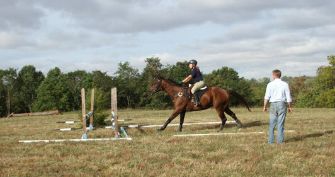
 Chris Ryan sets exercises to benefit horses and riders of all levels. / Alys Emson photo
For the second consecutive year, Chris Ryan, MFH of the Scarteen Black and Tans in Ireland crossed the Atlantic to impart some of his knowledge and experience to participants in the Woodford Hounds Hunt Clinic held over the Labor Day weekend at the kennels in Harrodsburg, Kentucky. Chris has been Master of the Scarteen since 1987, and the hounds have been in the trusted care of the Ryan family for over 350 years.
The clinic was held for three days with divisions for the open horse and rider as well as for green horses and for hilltoppers over the three-day period. Overwhelmingly, the results were positive. Chris’s teaching style leaves one a more positive, confident rider. He pushes and pushes and gets results. He even had some of the participants jumping wire, after explaining that we must be prepared to jump what is encountered in the hunting field.
Several of the clinic riders have since moved up to first field and they credit the work they did in the clinic for giving them the confidence to do so. Chris responded to several questions posed by members:
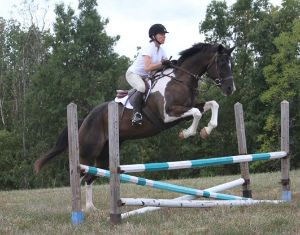 Woodford Hounds member Debbie Long and Sparky concentrate on attacking the gymnastic line. / Alys Emson photoWhat were your teaching objectives going into the clinic?
We can all ask more of our horses and ourselves. There is huge satisfaction to be gained and a fortified bond and trust between horse and rider.
There are some rudimentary points in my equine philosophy.
1. When I put my leg on, my horse goes forward. No ifs or buts. They must go from the leg. This gives the horse the security and confidence he needs to go tackle that fence or whatever. It also engages the horse’s hind end, which he needs for all forward propulsion.
2. I want the horse thinking for himself. I wish I was a David O’Connor but I’m not. I like to define my responsibilities to the horse and my horse’s responsibilities to me, the rider. My sole responsibility to the horse is to bring him on the correct line to a fence with the correct amount of energy, rhythm, balance and pace. His job is to jump. If I’m on his mouth at take off, the horse thinks the rider is doing the jumping . Watching the clinic jumping the wire tape shows this clearly.
3. I want the horse aware that this partnership is a team. I might have a lot to say, nearly all of it rubbish, but I want him receptive to me.
4. Training hunters and eventers, I want the horse to be able to park, that is, stand still at my request and without the support of my leg and hand. I might want to talk to my friends or wait in front of a fence while others are jumping. A horse must learn to switch on and switch off. It is so useful. Parking after a fence also allows him to assimilate information and learn by it.
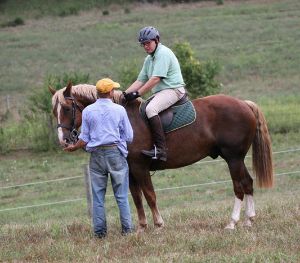 Chris discusses strategies with Woodford Hounds member Justin Sautter. / Alys Emson photoDo you feel that most participants reached another level of proficiency in their riding?
Without a doubt. Firstly, they are starting from a very good base. The Woodford hunt members are real goers. There is fantastic camaraderie generated by their Masters and huntsman. Do you know that when a horse’s ears are pointing forward, they are thinking forward, and the reverse is also true. Well the Woodford hunt members are always thinking forward. To watch the members galloping upsides [side by side] over a steeplechase fence grinning from ear to ear and the horses doing exactly the same is fantastic.
What inspires you to teach?
I love it. I love the bond between horse and rider and the pleasure we get from this amazing alliance. I love the sorting out of issues and mis-communication that we all go through. When you can take all the heat and pressure out of the situation and see the progress it’s a real buzz.
You relate so well to others in your instructions. To whom to you attribute this rare quality?
I don’t know about that. I can sympathize with most situations because I’ve possibly been there and know, perhaps, what it feels like.
In regard to asking more of our horses and ourselves, why do you think you are so successful at getting riders to be more confident and push beyond what they think they can do?
We all need confidence, both horses and riders. If the rider’s leg contact comes off the horse a stride off the fence, it leaves the horse in a bad place. We’ve brought him there and we are suddenly saying we’re not sure what happens next. That’s the very time he needs the security of the contact and a lightening of the hand. If I’m pushing with my leg and pulling with my hand I’m telling the horse to stop go, stop go….impossible. When we feel what positive thinking from the rider does for the horse all boundaries recede.
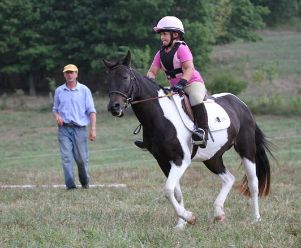 Since her work with Chris in the clinic, Vivian J has joined the third field. / Alys Emson photoWhat would you advise most of us do at home on our own to build on what we learned and to keep moving forward?
Those stop-start* exercises are great and reinforce the half-halt and therefore the engagement of the hindquarters. I wouldn’t advise the galloping around with your eyes closed** without supervision, tho’ it is great to feel the horse operating on auto pilot!
Foxhunting in Ireland or in the UK starts at an early age as opposed to North America where riders usually start hunting as an adult. How does this affect teaching technique?
We had sixty kids at our mock hunt (just off lead reins). They have no fear and have a dangerous need for adrenaline. As adults we are more inclined to tense up and therefore restrict the horse. It just takes a little more conscious effort to push with the leg and ease the hand. The level of horsemanship, style and seat of riders with Woodford Hounds was fantastic. You have a great club. The schooling facility you have built at the kennels with huntsman Glen Westmoreland and his wife Sharon Holmes is fantastic.
*******
*Chris really likes the stop-start exercise. As he explains, the ability to park means you can wait your place in line at a coop and go forward with enough energy to get the job done when the coast is clear, or stop immediately if a hound darts in front of you on your approach. He has a horse head toward a fence at a walk, trot, or canter and then halt and wait. Chris has been known to walk up and feed a nervous horse a handful of grass to keep him relaxed while parking at a fence. When the horse is settled, Chris has the rider send him forward with energy to the fence, again at the walk, trot, or canter (depending on the exercise). The spot for parking moves farther away from the fence as the gait changes (walk closer, canter further back).
**In the galloping exercise, Chris had ten of us in my group gallop on a large circle with eyes closed, asking for a change of stride by feel. If we felt we needed to peek now and then to be sure we weren’t in line for a fence or about to run into the horse in front of us, we could quickly open our eyes to check and then close them again. Great fun!
Posted October 31, 2012