
If the predictions of Nostradamus should prove to be correct, by riding to hounds you may well be preparing to save your life. If Armageddon happens, you will know how to survive—just so long as it happens between August and December. In other words, during the hunting season.
Sounds a little ridiculous? Well, maybe, but ride along with me and learn how foxhunting might have already prepared you.
When riding through your own hunting country, and especially if you should be acting as a whipper-in, you have plenty of time to appreciate and learn the local countryside. Occasionally you have to ride like a bat out of hell but much of the time you are there to observe and to take in nature’s wonders all about you. On a beautiful fall day, a feast of epicurean plentitude is there for the taking. A regular cornucopia of fruits and vegetables is available to sample as you wish. Some of it is even conveniently delivered to you at saddle height. You can just reach out and enjoy.
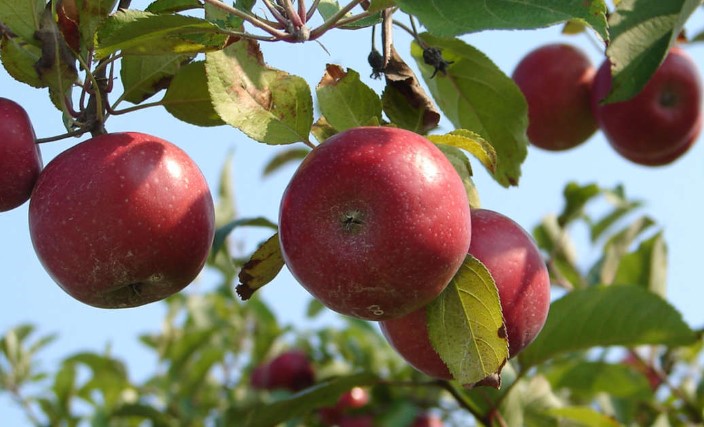
Who has not plucked a juicy apple from a hedgerow, albeit a variety of unknown pedigree? Just one bite, and if it is not sweet enough or is home to some small creatures, a few more strides and you may have an array of alternatives varied enough to challenge the display in your local supermarket.
Apples are only the first course. Other delicacies are there for your sustenance, albeit perhaps not so conveniently presented to you. If you are careful to avoid the thorns, I can guide you to a secret place in my hunting country close by the Mimosa meet where, with a little bending and reaching out from the saddle, you can have your dessert course of blackberries from a thicket of brambles.
In Blithe Hill country and at other locations, there are fast food pit stops where you can enjoy red and black raspberries. With a touch more testing of your flexibility and Velcro-like attachment to your saddle, these delicacies can be gathered to sweeten your tooth at minimal cost when compared to the local farmer’s market.
Just like the gone-wild apple trees, there are places where the wild ‘Deer Pears’ can be found. It seems those deer know a thing or two about succulent treats. These small pears are sweet to the tooth but can be a hazard to anyone with dentures or a loose tooth. Wild pears can be ‘as hard as a witch’s heart.’ Risky but worth it for the sweet taste.
Still available from the saddle is the fruit of the nut trees. Hazel nut trees, or perhaps we should call them bushes, are in many hedgerows but not easily identified as you pass them by at the trot. Timing is important with hazel nuts. Too early and the kernel is too soft. If the shell is empty, Nutkin the squirrel got there first.
There are Black Walnut trees in many areas. The green fruit, while on the tree, is reachable from the saddle but not worth the effort. The green casing has to turn yellow before the nut is ripe and, by then, the nut is unreachable on the ground. In any case, the dark walnut stain, once on your riding gloves, is there forever. If you do gather ripe-looking walnuts from the ground, float them in water before you waste your time cracking them open. Many will be empty and will float. The one’s with nuts in them will sink.
‘Gleaning’ is a word you don’t hear spoken much lately; it refers to the gathering of farmers’ crops from the fields after the harvest is over. This was an accepted rite of practice among peasants in years gone by. Even today, more than one of us has taken advantage of this practice. In late fall, our hunt meets in what we term ‘potato country.’ Once modern machinery has harvested the tubers, there are always a few spuds that have eluded man’s mechanisms. Lying there naked and gleaming white on the well-tilled black earth, they are crying out to be rescued. A couple of good sized ‘bakers’ have sometimes found a good home. But be sure not to pick up those taters that have been tanned by the sun and turned green; they have increased alkaloid levels and may not be good for the tummy.
Then there is corn, also known as maize or mealies in some parts of the world. Nutrition provider for man, beast and automobile. Whose horse has not stolen a bright yellow cob as he is passing by? Since the snatch-and-run has usually occurred on a headland next to the bush, your horse has simply denied a meal for the local raccoon family. As the field has emerged at the end of the row, many a rider has been seen desperately reaching forward to extract a three foot length of filched corn stalk as her horse shakes his head to detach the cob. It becomes a contest between rider and horse, with the horse usually winning.
There is a farm lane in Mono Township where I could lead you to some wild asparagus. Its flavour questions the right of the store-bought variety to bear the same name. If your palate is partial to spicier foods, horseradish can be found growing along many a fenceline.
Although most of the bounty of the land is available only in the fall months, in the months of May and June there is a particularly aromatic plant to be found in the shadow of the woods. After a posse of horses has passed through a bed of wild garlic, the woods reek of this highly-valued culinary ingredient. The crushing effect of iron-shod hooves on this delicate little plant is enough to transport one’s senses to a bustling cuisine in Montmartre or a cucina in old Napoli. The pungent aroma can linger for days, marking the passage of the hunt cavalry.
If you should stop to gather some of this flavour-enhancing little plant, be sure to refrain from using it at least two or three days before the hunt ball. Failure to do so will see you sidelined on the dance floor resembling another plant, the wallflower.
Dare we mention it; there is a plant that is in high demand in some circles—a plant that is likely to hide out in obscure places and will move on to different sites each year. When you roam the countryside on horseback, you are able to reach remote corners where official vehicles and prying eyes are unlikely to be around. On several occasions, some of us have been surprised to come across that valuable plant known in legal circles as cannabis sativa or marijuana. Hidden in seldom-visited backwoods and with plants scattered hither and thither, it is clear that the hand of man has been at work. Yes, we should inform the local authorities, but when hounds are running there are more pressing things to do. At the end of the day, however, unless you are a true woodsman, you may have difficulty recalling exactly where this chance encounter occurred.
It is unlikely that you will ever have to literally ‘live off the land,’ but if you really had to do so you will have been well prepared by the gastronomic education acquired while riding to hounds.
Bon appétit!
May 20, 2020
Derek French is the author of “Spirit: The Lighter Side of Life In Wartime Britain.” Foxhunting Life has published several of Derek’s delightful essays. Readers are invited to use our Comments space to contribute any local gastronomic delights found in their own hunting countries.