Sedgefield Hunt—Members and Hounds—Go Visiting
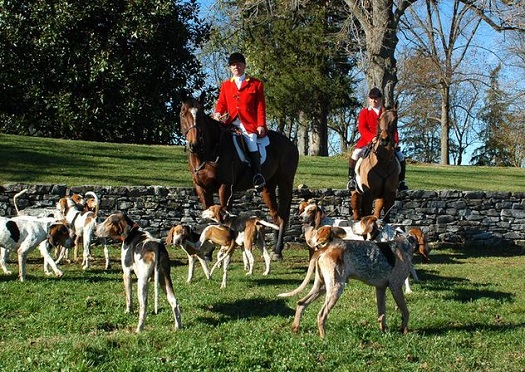
Sedgefield Master and huntsman Fred Berry (left) visits with his pack of Penn-Marydels. Blue Ridge huntsman Graham Buston (right) was his guide for the day. / Nancy Kleck photo
The Sedgefield Hunt, founded in 1927, hunt a pack of Penn-Marydel foxhounds in the Piedmont region of North Carolina and Southern Virginia. We are a small hunt, but we have big fun, and we love our hounds. Last November we took a road trip to Northern Virginia to hunt with Blue Ridge and Thornton Hill. Six members, ten couple of hounds, eight horses and Ellie Mae, my mule, hit the road.
Fred Berry, MFH and huntsman, and his wife Elaine went up first and had a great day with Blue Ridge and their magnificent pack of Modern English and Crossbred hounds. On our day with Thornton Hill, which also hunts Penn-Marydels, the packs were put together. In our final outing with Blue Ridge, Fred was invited to hunt our Penn-Marydels. I’m told that for 275 years—from the time George Washington hunted with Lord Fairfax over that same country—the local foxes had never before heard a pack of Penn-Marydels in full cry!
Carol Easter Tribute Draws Hundreds to Farmington

Honorary whipper-in Tom Bishop, huntsman Matthew Cook, and honorary whipper-in Kimberlee Morton move off from Springhaven Farm for a memorial meet in honor of the late Carol Easter, MFH. / Cathy Summers photo
On a clear, sunny Saturday morning, December 19, 2015, two days after what would have been Master Carol O. Easter’s seventy-seventh birthday, the Farmington Hunt gathered on a grassy knoll at her beloved Springhaven Farm in Charlottesville, Virginia to celebrate her life and legacy.
MFH W. Patrick “Pat” Butterfield addressed a large gathering of fifty-five riders, family members, and guests as a chilly breeze prompted me to adjust the buttons on my coat. Blue Ridge mountains in the distance framed the classic scene of hounds rolling in the grass, horses milling about, and riders exchanging greetings in anticipation of moving off for the morning’s sport.
Multiple generations of friends and family, young and old, were there to be part of this special day. The entire Easter family was on hand to welcome a steady stream of visitors–a serious yet jovial field of riders and onlookers that included life-long close friends Carter McNeely and veteran octogenarian foxhunter and neighbor Bobbie Wells; on foot, Phyllis Jones and daughter Robin Mellen, and Ellie Wood Baxter. Bobbie shrugged against the chilly wind and quipped, “I might have not picked this day to come out, except for the day it is.”
Billy Vance at Eighty, and The Fermanagh Harriers
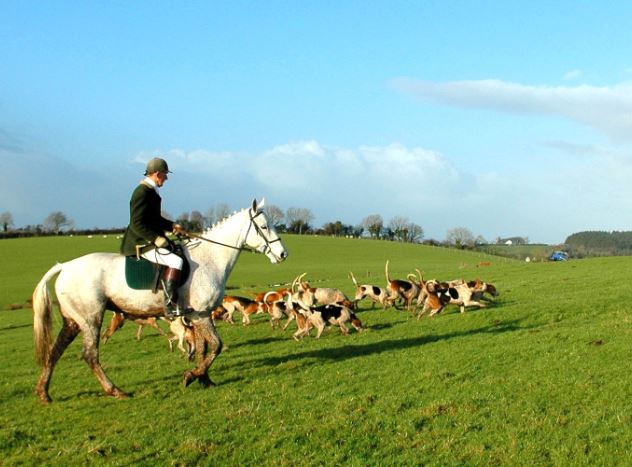
Master and Huntsman Billy Vance (80) watches his Fermanagh Harriers at work. / Noel Mullins photo
How many huntsmen are hunting hounds at eighty years of age? Or to add a twist to that question, how many huntsmen having achieved that age have already hunted hounds for the previous fifty seasons?
Billy Vance, Master and huntsman of the Fermanagh Harriers, has achieved this remarkable milestone. To see him hunting hounds is inspiring, humbling, and brings home just how lucky we all are to be able to follow great horsemen like him across the countryside.
Vance is special—a consummate and stylish horseman across what can only be termed as challenging hunting country with drains, banks, walls, and wire to contend with. And he is usually riding horses he bred himself. He is a genius with a pack of hounds, but don’t get in his way when they are running! If Ireland is in need of role models in these difficult economic circumstances, then Billy Vance fits the bill. He never seeks attention, yet is respected not just in his own hunt but by the hunting fraternity at large. And it is sometimes difficult to get a photograph of him.
“I am not into photos!” he says.
A Fast Day and Foxes Aplenty at Blue Ridge
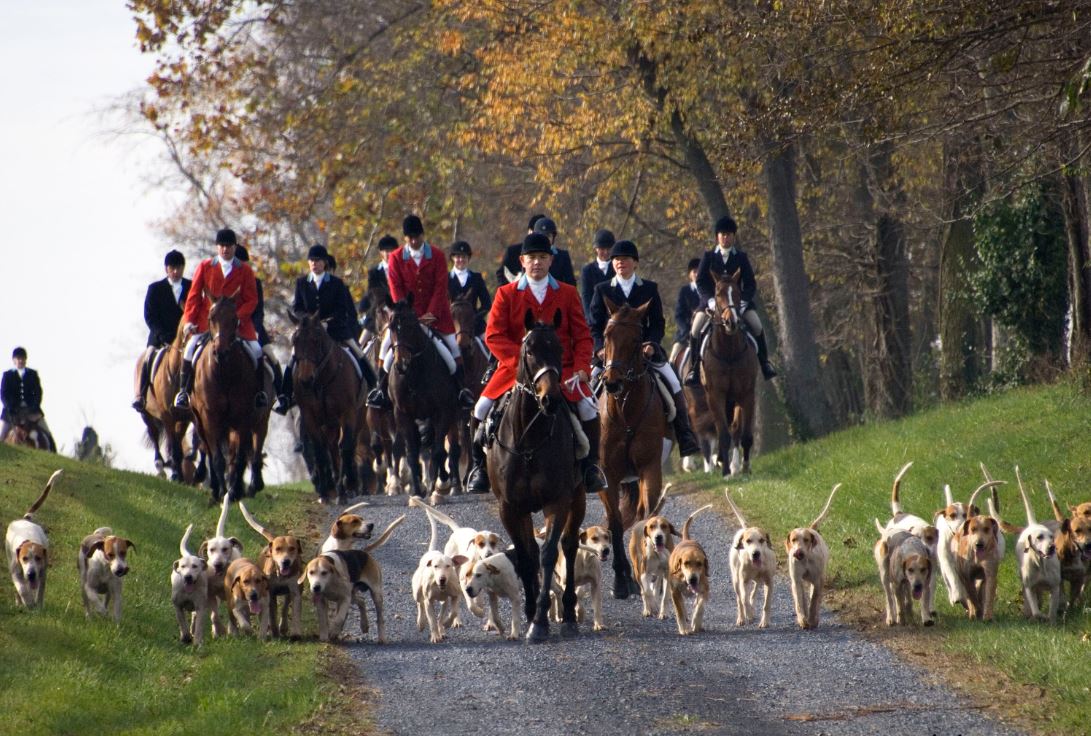
Huntsman Graham Buston, hounds, staff, and field of the Blue Ridge Hunt / Joanne Maisano photo
The November morning was unseasonably warm as I tacked up my beautiful Cleveland Bay/TB cross, Fearnought. It was a surprise that I had come home from school, but with my mother keeping him fit for me, I knew that he would be all ready for a day’s hunting. Conveniently, the Blue Ridge Hunt (VA) meet was only a fifteen-minute hack from my grandmother’s stable where I keep my horse. By the time we arrived I was already very warm in my formal coat and wondering, ‘Did I drive all the way home for nothing?’
Boot Camp at Belle Meade
Belle Meade First whipper-in Barbara Lee organizes the hunt’s annual Foxhunting Seminar for all new members. / Bella Vita Fotographie photo
Individuals interested in joining the Belle Meade Hunt (GA) quickly learn what they need to know in the hunting field, and they also learn what is expected of them as members. The hunt holds an annual Foxhunting Seminar that all new members are required to attend, whether or not they have hunted elsewhere.
New members learn that they are expected to have fun and to be contributors. “Mandatory Volunteerism” is the principle, and every member must subscribe to it. From that institutional expectation, the unique Belle Meade culture has developed.
It all began with the hunt’s founder, the late Master James Wilson, an inspirational leader who believed in teamwork. According to the seminar handout explaining the principle of mandatory volunteerism, “Master James knew that it took every member chipping in to make Belle Meade the place we have all come to love. As a member you were expected to respond with a willing, ‘Yes, sir,’ to anything you were asked to do. Most of us would have jumped through hoops of fire if the man asked us to! One of the unique things about our hunt that drew all of you here was the tradition of working as a family for the good of the hunt.”
Opening Meet at Woodbrook Is a Weekend Affair
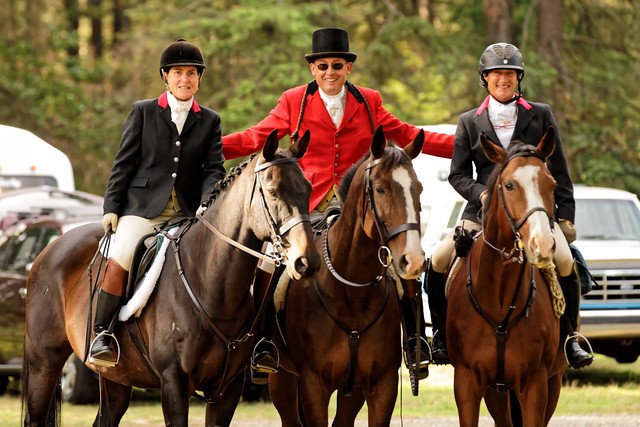
by Tami Masters
(l-r) Field Master Patty Steimert, Eric Stiemert, and author Tami Masters / Andrew Towell photo
The Woodbrook Hunt Club in Washington State was established in 1925 and is the oldest hunt west of the Mississipi. The drag hunt was recognized by the MFHA in 1962 and has recently undergone a changing of the guard. Huntsman Jennifer Hansen has brought about much newfound energy and enthusiasm to the clubhouse and to the hunting field. We have a rather diverse pack of hounds that Andrew Barclay helped us to acquire from all around the country.
Opening Weekend was a spectacular affair, starting with our annual Hunter Trials and Hunter Pace on Saturday and ending on Sunday with a lively eight-mile drag hunt through the beautiful woods and prairie on military land just southeast of the kennels.
A Cowboy in County Clare
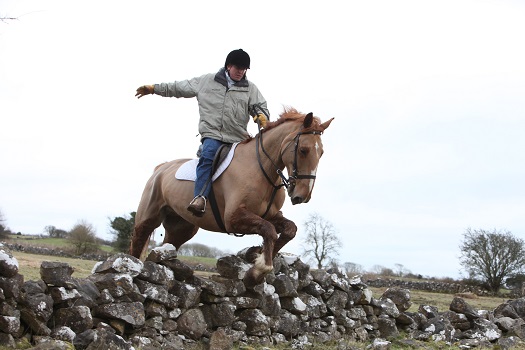
Kail Mantle from Montana: just like riding a bronc / Val Westover photo
Last year, while hunting with the Red Rock Hounds (NV), I met Renee and Kail Mantle from Big Sky Hounds in Three Forks, Montana. Kail gave us a bucking horse lesson one day before hunting. This Montana cowboy, who hunts in chaps and cowboy hat, had sat calmly to his horse bucking crazily above the sagebrush and had seriously impressed me.
When a group of these Western foxhunters invited me to accompany them to Ireland this year, I jumped at the chance. These were fun people—more than a little crazy, and I wondered if anyone had warned the Irish!
I also wondered if my companions knew what they were getting into. I had hunted the big Irish walls and hedges in 2000, and I came home with newfound respect for anyone who hunts regularly in Ireland. It is challenging country, and their version of foxhunting is an excuse to run and jump really big fences.
The East Galway Foxhounds at McDonagh’s Pub
What follows is a report on a fine day’s hunting, a description of a brilliantly executed new kennel complex that any hunt contemplating new kennel construction will appreciate, and an opportunity to become Joint-Master of an Irish pack for any foxhunter yearning for more adventure!
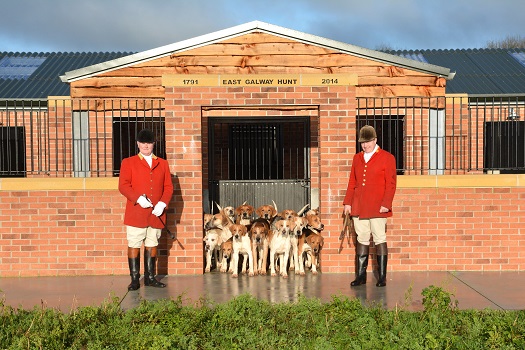
(l-r) East Galway Foxhounds Joint-Master Joe Cavanagh and huntsman Liam McAlinden with hounds at the New Kennels / Noel Mullins photo
The history of the East Galway Foxhounds goes back to Giles Eyre of Eyrecourt who kept a pack of hounds from about 1790. The East Galway Foxhounds was founded in 1880.
In addition to those milestones, the year 2014 will go down as a proud year for the East Galway followers. A brand new state of the art kennel complex was developed and financed by Joint-Master Joe Cavanagh and handed over to the hunt recently. Cavanagh, a successful businessman and a former owner of Cavanagh Foundry in Birr, is passionate about hunting. A former Master of the Ormond Hunt for twenty seasons, he joined the mastership of the East Galways eight seasons ago. Joe bred the international eventer Comanchee who with his rider James Robinson was third at Burghley and fourth at Badminton, the latter which he competed in ten times, and the last time at nineteen years of age!
The project of building the new kennels has taken Cavanagh three years from purchasing the site, visiting kennels in the UK and Ireland for ideas of what mistakes to avoid, securing planning permission, and then building. Meticulous about detail, his top priorities were the welfare of hounds and horses and comfortable surroundings for the huntsman to do his work.
The Grallagh Harriers at Moyvilla
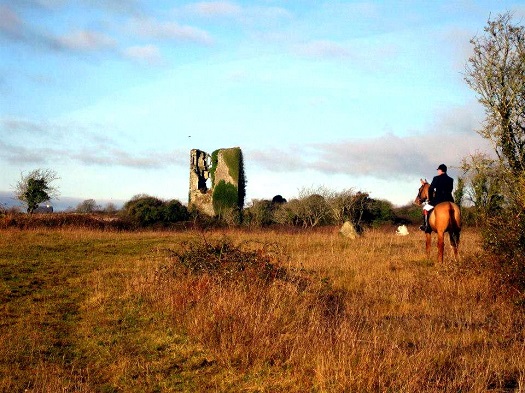
The morning’s heavy showers abated, affording my visitors a promising start at the Moyvilla meet, County Galway. I am still forming opinions on which hunt on our card is best, but Moyvilla would be among my favourites. It regularly brings out the best in Master and huntsman David Burke!
Skies were clearing nicely as we drove to the meet, air temperature considerably cooler than previous days. Martin McNamara, who just started riding in September and is a recent convert to the stone walls, was on Darcy, a fifteen-two-hand Irish Cob gelding. Andrea Ypma, visiting from Canada, was excited to be part of the foot followers. She had arrived in Ireland two days earlier for a three-week immersion into the Irish Hunting culture with us at Coopers Hill Livery. The wall builder was tasked with the important job of escorting Andrea to all the finest places to watch the fox bolt and view some of the horses jumping the walls.
Ballymacad Foxhounds at The Hurler’s Rest
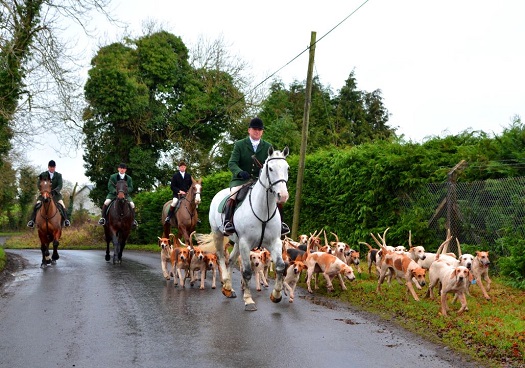
Ballymacad huntsman Kevin Donohoe with hounds at Archerstown. Following (l-r) are whippers-in Bobby Kellett, Maurice Quinn, and Irish MFHA trainee Keith Broderick. / Noel Mullins photo
There is a rich history of hunting in County Meath, Ireland. The Sherbourne family kept a pack at Loughcrew, and the Ballymacad Foxhounds were founded there in 1797.
The Ice Age of 30,000 years ago made a massive contribution to foxhunting in the Ballymacad hunt country. The countryside is made up of drumlins, small tear drop-shaped hills such as found in the Carolinas in the U.S. Many are covered in gorse, and despite the weather if one looks underneath the cover there is always a snug dry base, which makes them natural homes for foxes. Add to that the small bogs and hazel woods and you have variety. Foxes don’t have far to travel, and prying eyes are easily avoided.
To hunt foxes successfully in this country, hounds need to be true to the line to reduce their opportunities of going to ground too quickly. The country is challenging; one needs a horse that can jump walls, wire, drains, double and single banks, and a rider that can stay on!