Interactive Puppy Show: A Superb Idea
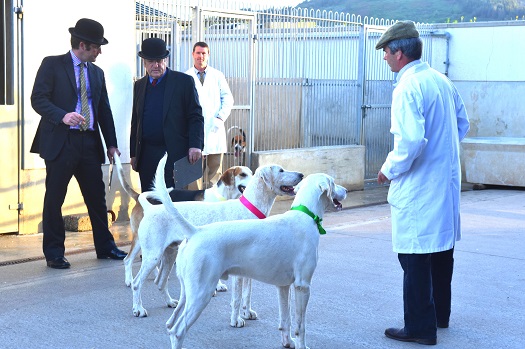
Rank these three hounds—green, pink, and yellow—to match the judges’ card, and you’re a winner! In the ring during the Spectators’ Class at the Wicklow Foxhounds (IRE) Puppy Show are (l-r) Judges Mark Ollard and Noel Mullins, whipper in Peter Kavanagh and Master and huntsman Philip Lazenby.
Here’s a superb idea for puppy shows guaranteed to increase spectator interest in and knowledge of foxhounds, and have fun at the same time…and it’s so easy to do!
Noel Mullins, a regular contributor to Foxhunting Life, recently judged the Wicklow Foxhounds (IRE) puppy show along with Scarteen huntsman Mark Ollard. After the pair had finished judging the puppy classes and chosen their Champion and Reserve foxhounds, a final class was held as a judging competition for the spectators.
Joan Batterton (1917–2015)
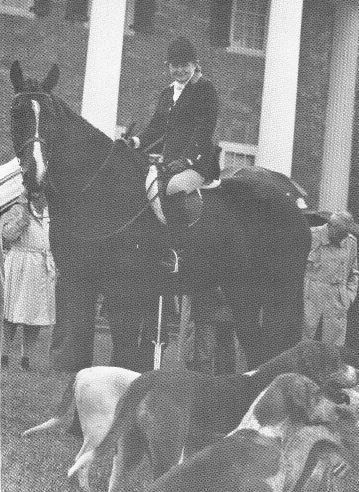
Field Master Joan Batterton, Opening Meet, 1986, on her homebred North American Field Champion Beacon RockJoan Batterton, one of the finest Field Masters I have ever followed across a hunting country, died on Monday, August 31, 2015 at the age of ninety-eight. She was born in Auckland, New Zealand in 1917 and died at her home in Berryville, Virginia.
A diminutive but magnificent horsewoman, she led the field for the Blue Ridge Hunt (VA) for fifteen years, while in her sixties and seventies, on a succession of bold, grand jumping horses, some off the timber racecourses. She knew her country, knew how the foxes ran, and what I remember best is how she led her field at a steady hand-gallop, at an even pace, whether over fences or in the open, keeping us in touch with hounds in a lovely and seductive rhythm.
She never raised her voice, but spoke in her soft New Zealand accent, always with a touch of a smile, an inquiring arch of her eyebrows, maintaining an eye contact as expressive as her words. She didn’t suffer fools, however, and could flay them with a quiet single-sentence opinion.
One More Race for American Pharoah
One more chance is in the offing to watch American Pharoah race. Reuters reports that American Pharoah will run his last race in the Breeders’ Cup Classic at Keeneland in Lexington, Kentucky on October 31, 2015, after which he will be retired to stud. Owner Ahmed Zayat was reported to be on the fence, but […]
Red Fox “Terrorizes” Australian Neighborhood
 Cathy Summers photo
The Daily Telegraph, Sydney, Australia, August 24, 2015: “DON’T be fooled by its furry face—this daring fox has been blamed for killing seven pets in Kellyville and terrorising children in the neighbourhood.”
Whew! How low has “journalism” sunk these days? (Not news, just our opinion.)
Journalist Angela Ranke continues with a subhead: “Fox on the prowl in Kellyville, residents warned to lock up their pets.”
Yikes! Would Australia declare a national emergency if a coyote or bear were seen crossing the driveway? C’mon Aussies, we know you guys are tougher than that. (Not news, just our long-held impression.)
You Ask; We Answer
As the new season begins, I want to remind readers about one of Foxhunting Life’s features—our Panel of Experts. Every foxhunter has the occasional question, whether it be what the huntsman, the whipper-in, or the hounds are doing; the meaning of an arcane hunting term; breeding or judging hounds; correct attire; a point of etiquette; training the field hunter; even sporting art or literature.
I have found over the years that while there are no bad questions, sometimes there are bad answers! In the belief that our readers deserve only authoritative answers, we assembled a Panel of Experts whose breadth of knowledge and proven experience was unassailable.
Questions tackled by our Experts have included: why does a fox bark, what triggers the spring dance of huntsmen from one hunt to the next, are there different types of foxes in England, how to handle a hound that is shy of men, can foxhounds make good house pets, how to retrain a horse that exits the trailer like a cannonball, why is an afternoon after-hunt meal called a hunt breakfast, what is a July hound, what is the origin of ratcatcher, and many, many more. To see the answers to those questions and others, go to the Ask the Experts dropdown menu and click on Questions and Answers.
Peek-A-Boo!

Jody Ciliberto photo Mounted staff were exercising the Red Oak Foxhounds, as photographer Jody Ciliberto followed in her car. She saw a sudden commotion—fingers pointing, hounds jumping, sterns waving. Jody jumped out of the car with her Canon 60D fitted with a 35mm to 200mm lens, managed to get within ten feet, and took her […]
James Barclay’s Hunting England
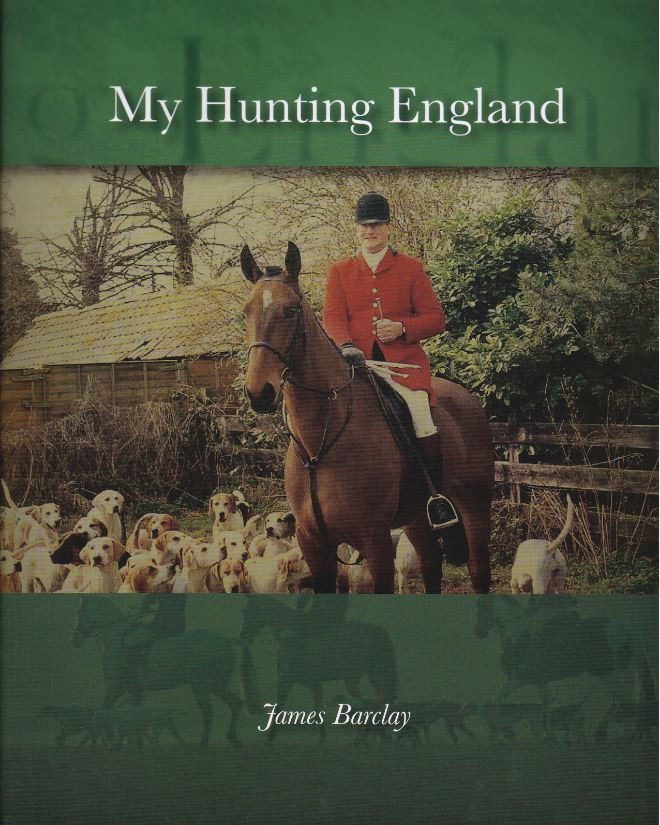
My Hunting England, James Barclay, Ruddocks, Lincoln, UK, 2015, cloth, illustrated, large format, 143 pages, £45Foxhunters are often regarded by the uninitiated as a pack of wealthy horsemen in fancy clothes galloping gaily over the countryside. Truth be told, some foxhunters riding in their private and select world above the fray see it the same way.
James Barclay learned differently. In his just-published My Hunting England, he tells of his life in hunting, his love for England, and—for a man born high above the fray—tells his story with humanity, sympathy, and respect for all manner of hunting man and his quarry.
A frequent contributor to the pages of Foxhunting Life, James Barclay was born to a banking family well-represented in the world of hunting. He, his sister, two brothers, mother, father, grandfather, and great-grandfather all served as Masters of Foxhounds—a family way-of-life that began in 1896 when his great-grandfather became Master of the Puckeridge. James served as Master of five hunts from 1983 to 2012: the Essex and Suffolk, Fitzwilliam, Cottesmore, South Wold, and Grove and Rufford.
James’s new book is part memoir, part snapshot of hunting in the twenty-first century, and part tribute to those who left their mark on the sport of his life. He entered hunt service at the bottom and toiled alongside the other lads in the kennels. Nor, as he was to find, were all kennels equal.
Ewbank Clothiers Gutted by Fire
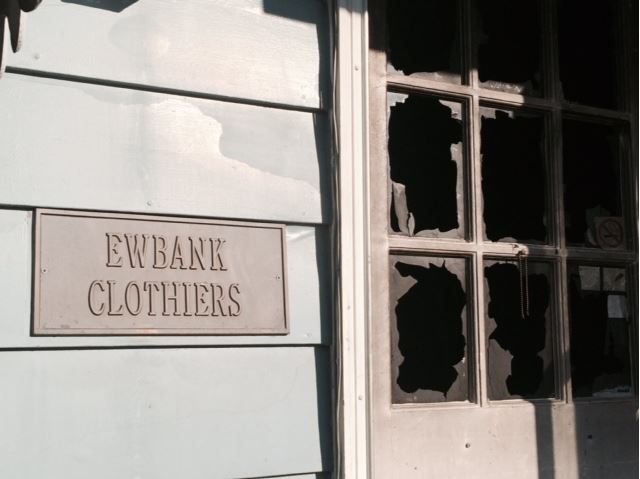
The fire that consumed Ewbank Clothiers in Berryville, Virginia on Thursday, August 13, 2015 couldn’t have come at a worse time for proprietor Karen Ewbank. Her custom tailoring shop was full of hunt coats and other foxhunting attire either being repaired or built in preparation for the upcoming hunting season.
“I woke up at three in the morning that night, counting red coats,” she recalls.
In addition to the loss of clothing and fabrics, perhaps even more serious is the loss of her meticulously cut pattern drafts—now ashes—used to trace shapes onto fabrics. The patterns will have to be re-plotted on brown Kraft paper from client measurements and re-cut—a process that takes about five hours for each client’s hunt coat. As of the date of this article, Karen doesn’t yet know whether her client measurement charts survived. They’re in steel filing cabinets in the front of the shop, and she has hopes that they were spared.
“I’m kicking on,” Karen told me today, the first workday of a new week. “I’m moving everything to my house and will work from here until the shop is rebuilt. That could take months, even though the structure is still sound.”
Karen Stives Succumbs After Long Illness
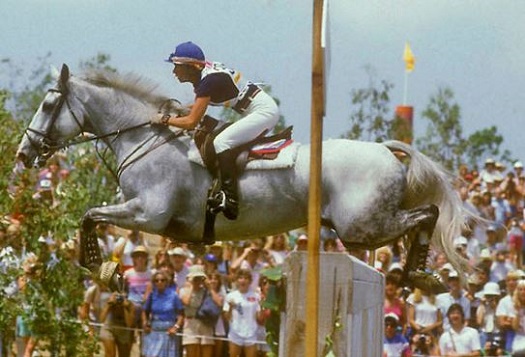
Karen Stives and Ben Arthur, 1984 Olympics
Olympic medal-winner Karen Stives died peacefully at her home in Dover, Massachusetts on August 14, 2015 after a five-year battle with cancer. She was sixty-four. Karen was a member of the Norfolk Hunt Club but her great passion was competition, and there she made history.
Karen showed hunters and jumpers successfully through the 1970s and then became smitten with eventing and dressage. She was the first woman to win an Individual Medal in an Olympic Three-Day Event, winning the individual Silver Medal in the 1984 summer Olympics in Los Angeles on her gray Irish-bred Ben Arthur. In doing so, she anchored the U.S. team in capturing the Team Gold Medal in the Three-Day Event that year. In 1982 she had represented the U.S. in the World Championship Three-Day Event at Luhmuhlen aboard her Thoroughbred horse, The Saint. She was the USEA Rider of the Year in 1981, 1987, and 1988.
In her induction into the USEA Hall of Fame, Karen is described as a “New England rider who rose to the top of international competition through sheer diligence, hard work, and plenty of natural ability, and is called a ‘small package with a thousand-pound brain,’ by longtime friend and colleague, Jim Wolf. At one time she contemplated trying out for both the U.S. eventing and dressage teams in the same year—an idea she discarded after riding in two separate selection trials in the same weekend!”
Blue Birdseye Stock Ties: They’re Back!
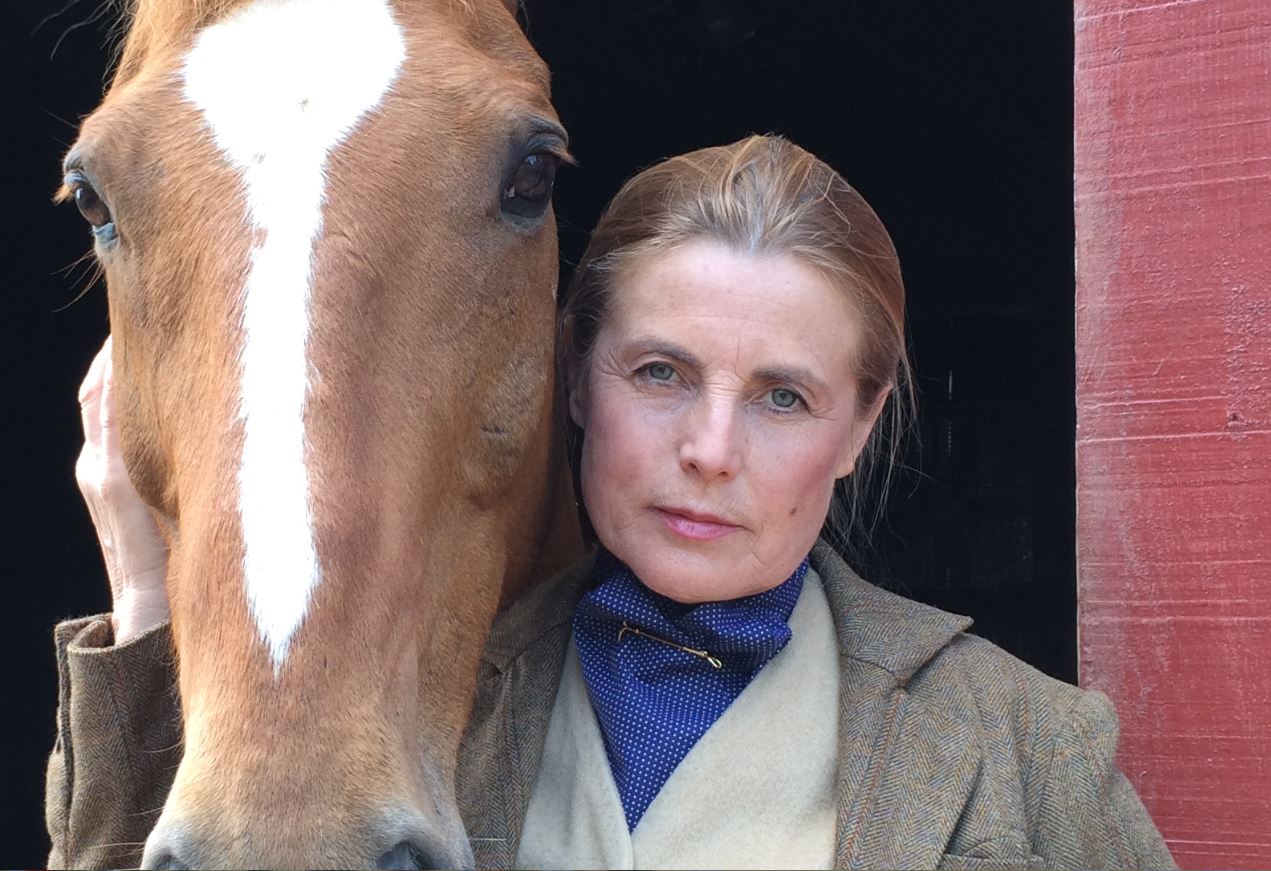
Karen Ewbank is ready for cubhunting in her blue birdseye stock tie.
Back in early May we ran a story titled “The Blue Birdseye Stock Tie: A Smashing Style from the Past.” The story, about a little-known, mostly forgotten, yet very attractive and traditional item of foxhunting attire, turned out to be our best-read story of the entire spring season!
We thought it would be fun to bring the blue birdseye stock tie back into the hunting fields of the twenty-first century, and many of you agreed. So we researched the fabric, purchased a few yards, and launched its rebirth at the Virginia Foxhound Show at the end of May. It was a hit!
Here then, is a reminder: our informal season is only weeks away. If you’d like to start the season sporting one of your own, click here!