
The Recognizable Foxhounds of John Emms
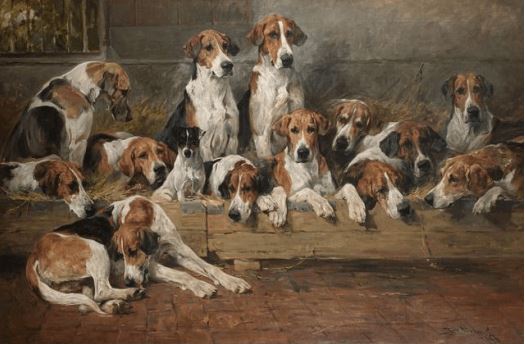
The New Forest Foxhounds by John Emms
John Emms (1843–1912) is one of the most admired animal painters of the nineteenth century. He was an avid foxhunter himself, and his paintings of foxhounds are easily recognizable as clearly and uniquely his work. The postures, characteristic attitudes, and expressions of Emms foxhounds, in kennels especially, confirm his hand before even seeing his signature. I can stare from one hound to the other and the essence of his foxhounds will awaken even my olfactory senses and suggest my presence in a well-kept foxhound kennel.
Louis “Paddy” Neilson, MFH
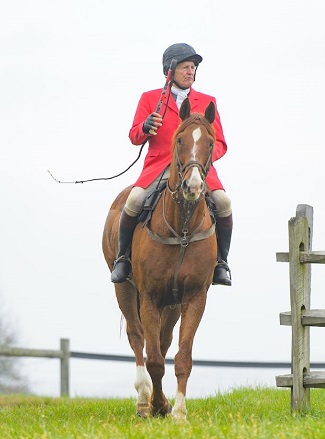
Paddy Neilson, MFH, whipping-in at Cheshire / Jim Graham photoLegendary horseman Louis “Paddy” Neilson III, MFH, died Thursday, September 5, 2019 at the age of seventy-seven. He was the husband of Toinette Phillips Neilson, with whom he shared thirty-one years of marriage.
Paddy served as Master, alongside his daughter, Sanna, of Mr. Stewart’s Cheshire Foxhounds (PA) and was a winning race rider and trainer. He hunted with Cheshire since childhood and served as full-time honorary whipper-in for the last thirteen years of his life, jumping his last fence in the line of duty just a couple of weeks before his death.
Squire Osbaldeston: A Sporting Prodigy
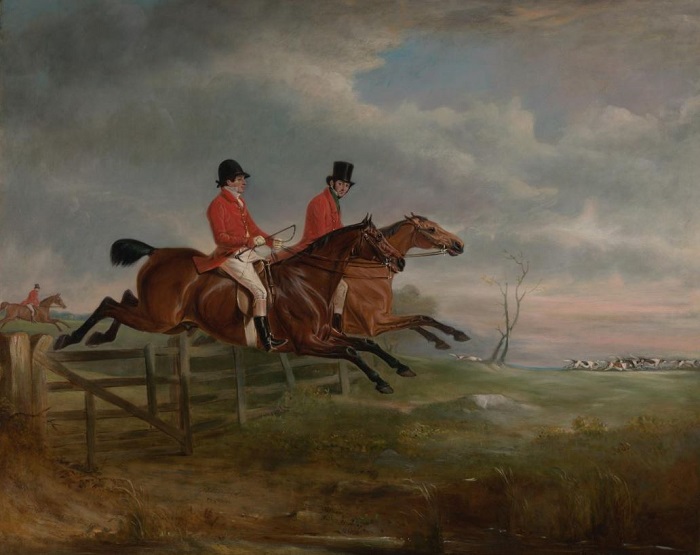
Squire Osbaldeston, MFH (foreground) on Ashton, with Sir Frances Holyoake-Goodricke on Crossbow, 1830, hunting the Pytchley in Melton Mobray, Leicestershire, England. Oil painting by John Ferneley
London-born in 1786, George Osbaldeston was a natural athlete. He rowed for various schools that he attended, including Eton and Oxford, neither of which he matriculated. He assiduously avoided academic work, but set high standards for rowdy behavior and was expelled from most of these fine institutions.
He was an outstanding cricketeer, bowling and batting as an amateur in numerous important matches. In 1818, however, he was barred for life from membership in a club as the result of an intemperate outburst, effectively finishing his career in important cricket matches.
Andre Pater: An American Journey
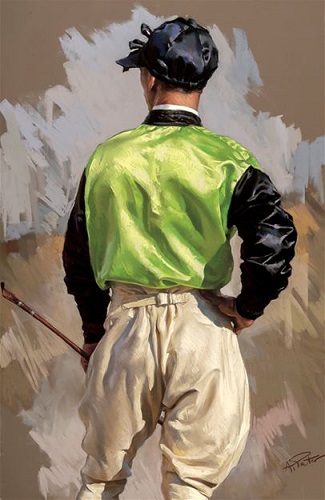
Oil painting by Andre PaterThe Headley-Whitney Museum in Lexington, Kentucky will mount a retrospective exhibit of the impressive work of Andre Pater. Sixty-six equine, sporting, and recent Native American works borrowed from private collections will hang from Friday, September 13 to Sunday, November 17, 2019. The closing day will coincide with the Keeneland Sporting Art Auction in that city.
Mr. Pater will give a talk on Saturday, September 14, the first full day of the exhibition. He has been described by many as the heir to the late Sir Alfred Munning’s throne, and a glance at his racing and hunting works are convincing evidence that the comparison is valid.
The Recognizable Foxhounds of John Emms
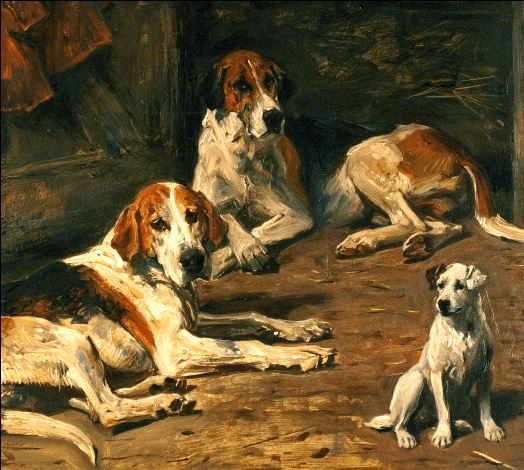
Foxhounds and Terrier, oil painting by John Emms
John Emms (1843–1912) is certainly one of the most admired animal painters of the nineteenth century. He was an avid foxhunter himself, and his paintings of foxhounds are easily recognizable—clearly and uniquely his work. The postures, characteristic attitudes, and expressions of Emms foxhounds, in kennels especially, confirm his hand before ever seeing a signature. I can stare from one hound to the other and the essence of his foxhounds will awaken even my olfactory senses and suggest my presence in a well-kept foxhound kennel.
Born on April 21, 1843, the son of an amateur artist in Norfolk, England, the young Emms moved to London where he apprenticed with the great academic painter, Lord Frederick Leighton. Emms very quickly developed his own distinctive style, however, and soon struck out on his own.
Andrews Bridge Litigation Resolved
The Masters of the Andrews Bridge Foxhounds—George Strawbridge Jr., Steve Harris, Betsy Harris, Cathy Huston, and Bill Kimmel—made public the following statement:
We are pleased to report that all litigation between the Cromptons, the Harrises, and the Andrews Bridge Foxhounds Inc. has been resolved. It was decided that in the best interest of our sport, the two Andrews Bridge hound packs should be reunited and again hunt as one unified pack in our territory.
Like everything else in life, the hunt has taken many detours in the past 102 years and we have not been the exception. A journey is not a single straight line, but rather a long up and down winding road.
American Rider, 70, Wins Mongol Derby
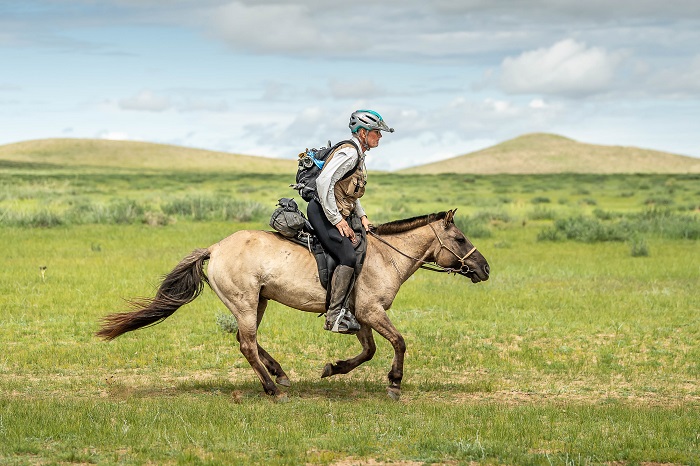
American western horseman Bob Long wins eleventh running of the Mongol Derby. / Sarah Farnsworth photo
There are crazy things to do. And then there’s the Mongol Derby.
Foxhunters have been known to compete in the Mongol Derby, as if the post-and-rail line fences in Mr. Stewart’s Cheshire country, the wire in New Zealand, the banks and ditches of Ireland, or the hedges of the English Shires aren’t enough of a challenge. The Mongol Derby, according to the Guinness Book of Records, is the world’s longest and toughest horse race. This year forty-five men and women from eleven countries gathered to race one thousand kilometers (621 miles) across Mongolia on semi-wild horses.
Finishing strongly, seventy-year-old Robert Long, originally from Cheyenne, Wyoming but now living in Boise, Idaho, was the undisputed winner of this year’s race. Long reached the finish at 11:03 am Mongolian time on August 14, 2019, seven days after the starting gun. Competitors will continue to cross the finish line for another three days.
Dr. H. L. Todd “Doc” Addis, VMD
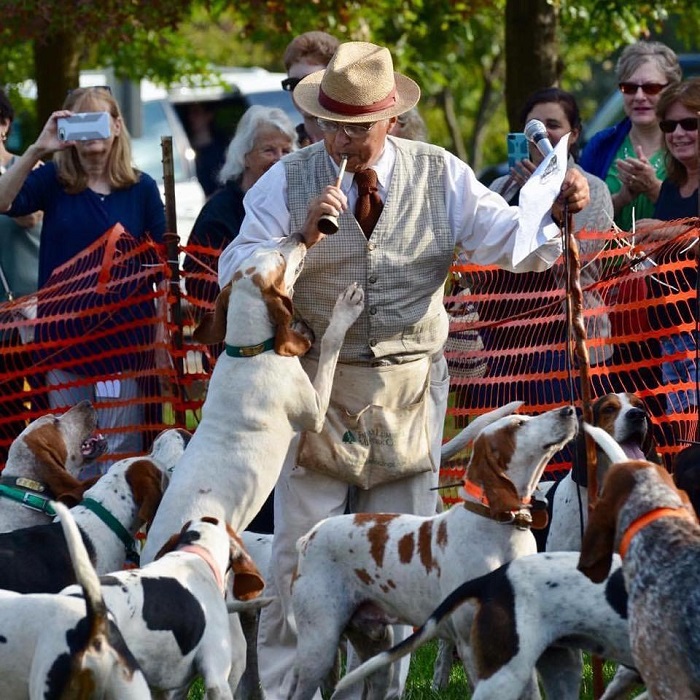
Todd “Doc” Addis, MFH, courtesy of Thornton Hill huntsman Beth Opitz. “This photo sums up the love he had for his hounds and the hounds’ love for him,” says his daughter.
Dr. Todd “Doc” Addis, one of the great champions of the American Penn-Marydel foxhound, died suddenly on July 24, 2019 at his home, Fox Hill, in Elverson Pennsylvania. He was eighty-five and with his family.
Doc was Master and huntsman of Warwick Village Hounds and a zealous advocate for the Penn-Marydel foxhound. He made it his crusade to convince foxhunters across North America of the advantageous traits, and superior abilities of his beloved Penn-Marydel compared to any other breed. He not only converted many successful Masters and huntsmen to his convictions, but was also personally responsible for helping, advising, and drafting good working bloodlines to those packs. In so doing, Doc was instrumental in extending Penn-Marydel bloodlines from their Pennsylvania/Maryland/Delaware roots to so many other hunts across North America.
A. Henry Higginson: More than just a Familiar Name
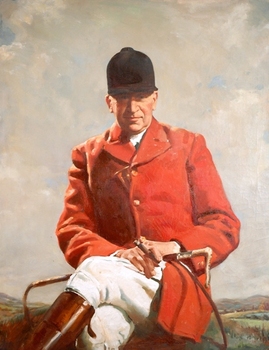
Alexander Henry Higginson, MFHAn Old Sportsman’s Memories, the autobiography written by A. Henry Higginson and J. Stanley Reeve tells the story of a proper Bostonian, Harvard class of 1898, who turned his back on a life of commerce, finance, and philanthropy—the route traditionally followed by New England men such as he. Smitten by the sport of foxhunting to the exclusion of all else, and with the support of his indulgent father, A. Henry Higginson followed his dream: a life of foxhunting.
His father, Major Henry Lee Higginson, more than fulfilled the family’s responsibilities to his community by his own philanthropy. The elder Higginson had dreamt of being a musician in his younger years, but Puritan Boston expected other things from her sons, and so he became a businessman as was expected. In time, he founded the Boston Symphony Orchestra, however, and was its earliest administrator.
He organized the corporation that built Symphony Hall, the first auditorium designed in accordance with scientifically derived acoustical principles. It is, as a result, widely regarded as one of the top concert halls in the world. Interestingly, with all the architectural flourishes of the period that architects McKim, Mead & White could bring to their creation in the year 1900, the structure displays only one composer’s name upon a large shield mounted on a frieze centered above the stage—Beethoven. There are other smaller shields upon the frieze framing the stage, but they are still blank! Boston is a careful and thoughtful old city.
Blind Bombing
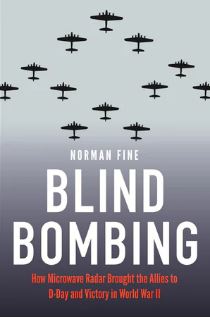
Caution: Readers are advised that this article contains neither a horse, a hound, or a fox. Fair warning.
Blind Bombing: How Microwave Radar Brought the Allies to D-Day and Victory in World War II, Norman Fine, Potomac Books, an imprint of the University of Nebraska Press, 2019, hardcover, illustrations, 264 pages, $29.95 (less 40% direct from the publisher with discount code).As with most readers of Foxhunting Life, I admit to having lived another life separate from the sporting subject which brings most of you to these pages. In that other life I was an electronics engineer; before that I had an uncle who, unbeknownst to the family, did something extraordinary during World War II; and in the course of my engineering work those many years ago, I discovered a little-known but critically important story about the war, the invention that proved most influential in getting the Allies to D-Day, and my uncle.
That story is about to be published. I want to share a 40%-discount code for any one inclined to purchase, and I hope I will see many of you on my book tour next winter.
During my engineering years I researched the story with this book project in mind, finally wrote the manuscript two winters ago, found a respected publisher of war history, and, lo! In this year in which the world marked the seventy-fifth anniversary of D-Day, Blind Bombing: How Microwave Radar Brought the Allies to D-Day and Victory in World War II is scheduled for release on December 1, 2019. (Click for a fuller description of the book and how to order from the publisher using the discount code.)