AKC English Foxhound Standard Needs Updating
It’s a shame that there exists a disconnect between AKC foxhound standards and those of the foxhunting community. Not that foxhunters need be concerned with AKC foxhound standards. The Masters of Foxhounds Associations in this country and in England maintain their own breed registries, and both registries are orders of magnitude larger than the AKC foxhound registry.
One would think, though, that the AKC should be more than a little interested in what foxhunters are breeding. After all, foxhunters are the ones using foxhounds for the purpose for which they were originally bred.
To look at the AKC standard for the English foxhound is to be stuck in a time warp of more than fifty years. According to a recent article by Ann Roth in DogChannel.com, the AKC breed standard for the English Foxhound was composed more than fifty years ago by foxhunters.
I’m not certain just which foxhunters the AKC was talking to fifty years ago, but I don’t believe the English foxhound photo accompanying Roth’s article or the English foxhound painting found on the AKC website would have been models for any pack of that time, here or in England. They are more reminiscent of the so-called Shorthorn era in England, a period between the mid-nineteenth and the early twentieth centuries, when fashionable foxhounds of the time were criticized for resembling Shorthorn cattle.
Chasing a Fox: In a Little Black Dress

Foxhunting Life editor Norm Fine was interviewed on the Horse Radio Network last Friday, July 26, 2012 by Helena Bee and Sissi Finn for their program “Chasing a Fox in a Little Black Dress.” The interview was aired on “Stable Scoop,” the network’s flagship program, and may be heard at the network’s website and through Stable Scoop’s other outlets such as The Chronicle of the Horse, iTunes Radio, Horse.com, Equestrian Life, and Chasing a Fox.
Helena and Sissi hunt with the venerable Myopia Hunt in Hamilton, Massachusetts. In addition to their radio programming productions, the pair has teamed up in a new venture which provides style consulting services for the hunting field as well as other equestrian pursuits and all related social activities such as hunt balls, hunt teas, race meets, fund raisers, polo matches, and cocktail parties.
“I have a long history in equestrian retail and a former career in corporate marketing,” says Helena. “With Sissi’s style expertise and my business acumen, we figured we could eek out a small living from Chasing a Fox!”
Townies Should Pass an Exam Before Voting on Rural Affairs
Retired star cricket player and professional team captain David Gower suggests that “townies” should be required to pass an exam on rural affairs before being allowed to vote on issues that affect the countryside. He also accuses politicians who are “allergic to grass” of making unpopular decisions about countryside matters. Gowers’ comments were made to […]
Fox and Terrier Are Best Friends
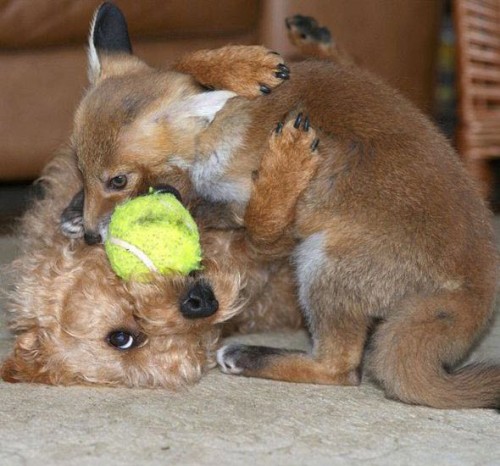
As in Disney’s movie, The Fox And The Hound, a Patterdale-Lakeland terrier cross and a fox cub have become the best of friends. The fox, called Rosie, was the lone survivor of her litter after the father killed the other cubs. She was rescued—eyes not yet open—hand reared, then taken in by Richard Bowler in […]
Puppy Walkers Gone Wild
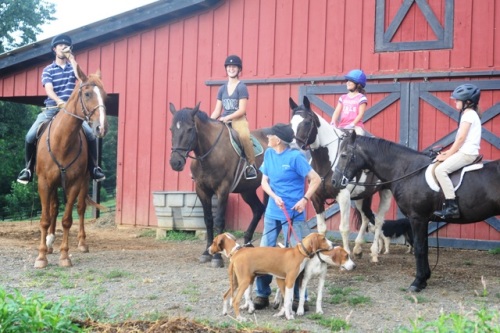
l-r: huntsman Chris Cerrone (hunting horn by Bounty), first whipper-in Annabelle Whitticar,
honorary whippers-in Ainsley Colgan (7) and Sam Homeyer (9), kennelman Jean Simpson with
Old Dominion hound puppies Feagan (front), Febe (behind left), Fever (behind right) on walk
Betsy Parker photo
What better way to introduce summer campers to foxhunting than by bringing a foxhound puppy or two on the trail ride with the other dogs and then writing it up in the form of a formal hunt report? Good for the puppies to be exposed to all the sights and sounds in the woods and good for the campers who have a fun ride and learn about hunting. All it takes is a multi-talented camp director like Betsy Parker. -Ed.
July 24, 2013, 7:30 am meet at Hunter’s Rest (site of the old Old Dominion Hounds kennels), Flint Hill, Virginia.
Air temp 71 degrees at first cast. BP 29.73 and rising. Breeze variable 3-6 mph from the east/northeast. Fine overcast, cool and cloudy.
Staff: Huntsman Chris Cerrone, first whipper-in Annabelle Whitticar, amateur whippers-in Ainsley Colgan and Sam Homeyer, kennelman Jean Simpson
Hunted hounds: two couple. Old Dominion Feagan, Hunters Rest Mel, Nap and Sneak. (Old Dominion Febe and Fever were left in kennels.)
The pack moved off promptly at 7:29 am from kennels, drawing east toward the Jordan River. Whips rode wide to keep young entry on track as the field jogged along the “Aiken Line” and followed Linden Lane and Redbud Lane to first covert.
D. Harcourt Lees, Jr., ex-MFH
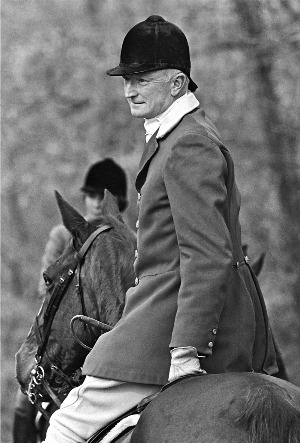
In nearly a half century of foxhunting, I have never seen a more handsome, elegant, and classically turned-out man astride a horse in the hunting field than Harcourt Lees. Nor did I ever meet a kinder or more pleasant gentleman in the hunting field. For me, he epitomized the grace and courtliness of a bygone age. It was an honor to know him, and I shall never forget him. What follows is the obituary of this sportsman/businessman/civic leader as released. -Ed.
With the passing of Douglas Harcourt Lees Jr. on July 21, Warrenton and Fauquier County, Virginia lost not only a respected businessman and sportsman but also a living link to a simpler time of grace and civility. Mr. Lees, 91, suffered a stroke on July 9 and was hospitalized briefly before returning to “Blackrock,” the Lees’ family home on Springs Road.
RSPCA Makes Overture to English Countryside
Stung by criticism of the staggering amount of money—£326,000—spent to prosecute the Heythrop hunt for violations of the Hunting Act, the Royal Society for the Prevention of Cruelty to Animals (RSPCA) is attempting to repair relations with the British countryside. (See earlier, related FHL article.) The Society has proposed the establishment of a new self-regulating […]
Collecting the Lost Hound
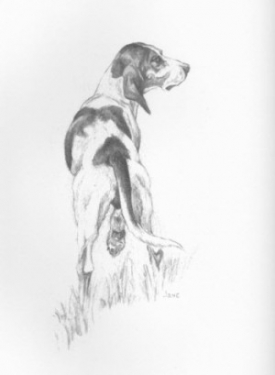
“Lost Hound” by Jane Gaston: illustration from the
book of the same name by Robert AshcomAll foxhunters know that a lost foxhound on the road is a situation that cannot be ignored. There are many possible outcomes, most of them bad. In fact, Jerry Miller, MFH of the Iroquois Hunt (KY) announces to all his members that if they see a lost hound and get it safely back to kennels in their car, he will personally pay for a complete car cleaning! It’s often not an easy job to coax a lost hound into your vehicle, as anyone knows who has tried it. Here’s a story of how one clever woman did it.
Sir Alfred Munnings In Open Air
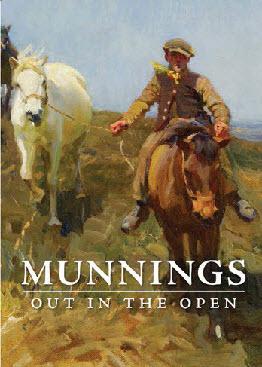
We have all admired the paintings of Sir Alfred Munnings and his portrayal of the horse in motion—flowing, graceful, muscles rippling, indescribably beautiful. Not to mention his figures of elegant ladies riding sidesaddle and his scarlet-coated huntsmen. Lovely paintings, but being unfamiliar with the artist as a man, I saw them in only two dimensions.
Then the National Sporting Library and Museum (NSLM) in Middleburg, Virginia mounted this once-in-a-lifetime exhibit of almost seventy Munnings paintings with revealing descriptions of each work, and the man came to life for me. And learning about the man brought the paintings to life.
One of the elegant ladies riding sidesaddle is Munnings’ first wife, a troubled soul who attempted suicide on her wedding night. This part of Munnings’ story is told in Jonathan Smith’s fascinating book, Summer in February, just released as a motion picture. Other paintings of lady and horse are of his second wife. Looking at the paintings of these two women with my new-found knowledge, the differences in mood and tension were there to see.
How Long Can a Red Fox Live?
Mary Marks photo
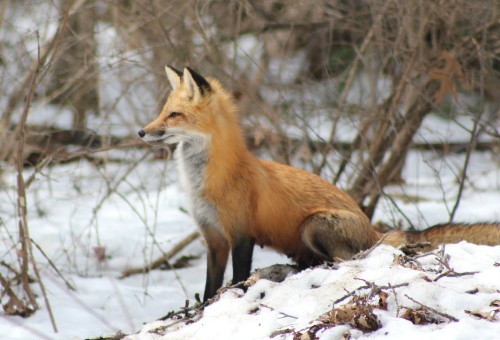
I believe that the ripest old age a tame fox might achieve is twelve. A wild, country fox could reach about eight. The governing factor, of course, apart from predators, is the fox’s teeth. No teeth, no food, no energy, and the end will be near, perhaps by scavenging dog or internal parasite—a death neither quick nor noble, and without Nature’s own equivalent of the National Health Service.
When I was hunting the Tiverton in Devon, the oldest fox caught by my hounds was aged six, according to that great naturalist Sir Newton Rycroft. It was the Tiverton’s first hunt in the New Forest, in 1975, and the fox’s incisors were long, very curved, and extremely dark—which prompted the discussion. The longer and more curved the teeth, the older the fox. Bob Street, who had disappeared into a bog during the excitement of the run, said that in forty years’ hunting it was one of the oldest he had seen hounds catch.