
Aintree Grand National, Maryland Hunt Cup, and…Velka Pardubice?
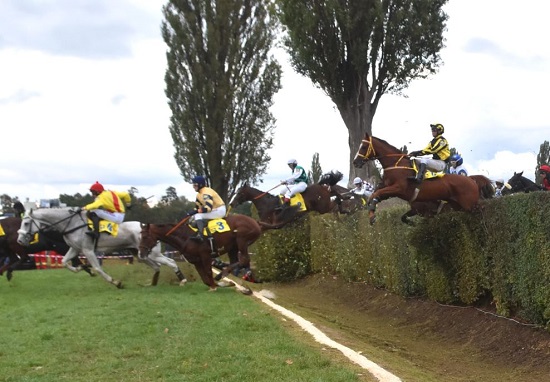
For race enthusiasts our Irish correspondent Noel Mullins introduces us to a venerable steeplechase race in the Czech Republic, where a few Irish and English bloodstock agents, trainers, and jockeys have found good markets.
The famous Taxis Ditch on the Velka Pardubice racecourse in the Czech Republic / Noel Mullins photo
A steeplechase race in the Czech Republic, with its roots in foxhunting, is recognised as one of the three most challenging steeplechases in the world, the others being the Aintree Grand National in Liverpool and the Maryland Hunt Cup in the U.S. The 126th running of the Velka Pardubice Steeplechase took place on October 9, 2016.
Ex-Huntsman and First Whipper-In Wed
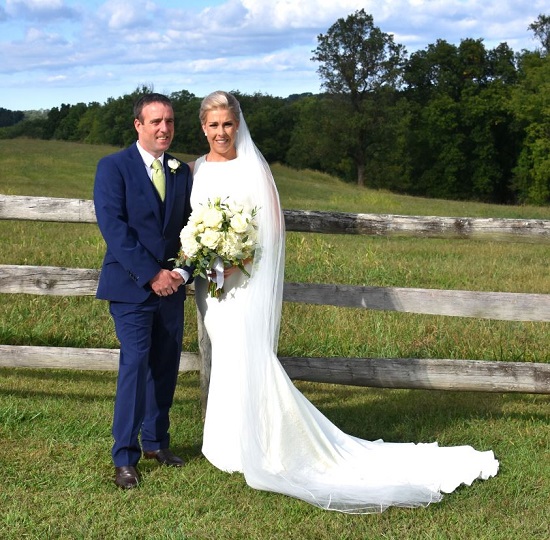
Noel Mullins photo
Considered the social event of the year in the Unionville, Pennsylvania equestrian world, family and friends gathered from both sides of the Atlantic to celebrate the marriage of Irishman Ivan Dowling and Californian Stephanie Boyer. Dowling, a native of Loughrea in County Galway, grew up hunting with the Galway Blazers before emigrating to America as huntsman of Mr. Stewart’s Cheshire Foxhounds for the last twelve seasons. Dowling successfully carried through the daring foxhound breeding experiment at Cheshire initiated by previous huntsman John Tulloch.
Boyer, having changed careers from eventing, served the Cheshire as professional whipper-in to Dowling. Boyer had worked with international event riders, Philip Dutton, Olympic dual gold and bronze medallist, and Buck Davidson, Pan American Games and Olympic rider. She has competed at the highest level in eventing, including riding her own Irish-bred eventer Macloud at the Rolex 4* event in Kentucky in 2009. She also breezed horses for top race trainers Michael Matz and Jonathan Sheppard.
What Is a Penn-Marydel?
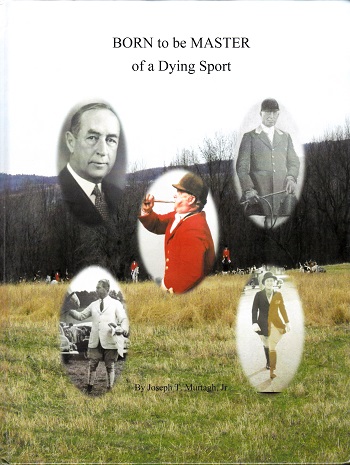
Born to Be Master of a Dying Sport by Joseph T. Murtagh, Jr., ex-MFH, 2016, 287 pages, illustrated, $45.00 plus $5.00 shipping. Purchase direct from author by clicking on this email address: [email protected]. Inscribed, signed copies may be requested.What follows is an excerpt from Jody Murtagh’s new memoir, Born to Be Master of a Dying Sport. The book tells the unvarnished story of the ups and downs of a man trying gallantly to keep his hunt and his heritage going in a changing world and his love for the Penn-Marydel foxhound, a breed formally established by his maternal grandparents.
A Penn-Marydel is a true American hound that was a derivative of hounds that came to America from England and France in the early 1600s with the settlers of the time. These settlers came to what we now call the Eastern Shore regions. One such family with which I am very familiar—the Jackson Family—settled around 1682 in the Maryland family seat, Jackson’s Choice, a three hundred-acre tract on the Eastern Bay shore opposite Lower Kent Island, patented to Richard Jackson by Lord Baltimore in 1664.
The Best Day…On the Planet…Ever
Jackets excused, we started out on this warm early autumn day by hacking left out of the drive and down Lees Mill Road. Passing behind one of the houses a man was bent over a small back door garden while an elderly man watched from the adjacent deck. Although he looked our way the elderly man did not respond to our waves, standing with his arms slack at his sides. The younger man pointed at us and, barely audible, I heard him say we were “looking for the fox.” Closing in on the one year anniversary of the death of my father-in-law, it was a bittersweet scene. Much more sweet than bitter to witness this quiet exchange between what I imagined to be an adult son and his father.
Approaching the creek crossing we heard a whipper-in’s view halloa ahead of us. Shortly after that we heard third field’s view; they had crossed the creek the usual way by the machine shed. The run lasted roughly an hour-and-a-half. At one point there were simultaneous views on opposite sides of the strip of corn running alongside Doss Garland Drive. There were views being called all over the place. Hearing them ahead of me I rushed up only to miss them. Second Field was viewing behind me, and I missed those, too.
Bagpipe Is Hound of the Year at Tennessee Valley
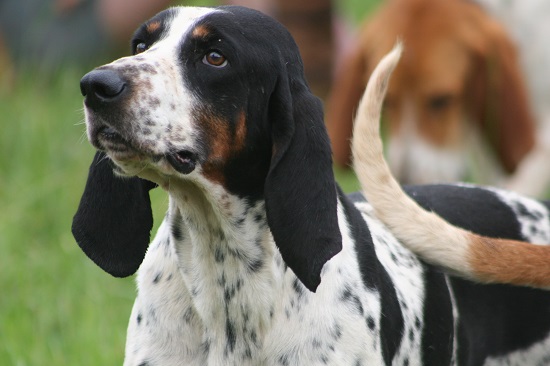
Johnsey’s tribute to Bagpipe was first published in the 2016 Yearbook of the Tennessee Valley Hunt. The hunt, founded in 1989, is unique in that most of the founding members had never foxhunted prior to forming the hunt. Fortunately, they found their way to Dr. Todd “Doc” Addis who, along with his wife Happy, brought his hounds to Tennessee and taught the fledgling foxhunters all about hunting. Before leaving, Doc made a gift of twenty couple of Penn-Marydels to the Tennessee Valley Hunt.
Kimberton’s Bagpipe 2010 / Gretchen Pelham photo
I’ve chosen Kimberton’s Bagpipe 2010 as this year’s Hound of the Year. Prior to last hunt season, Bagpipe was nothing more than your everyday, stubborn, old filler hound. Terrified of his own shadow and extremely anti-social when it came to humans, Bagpipe did everything on his own terms. By the end of the 2014/2015 season he would pack in, walk out, and was only decent in the hunt field.
New Pro-Hunting Organization Kicks Off in UK
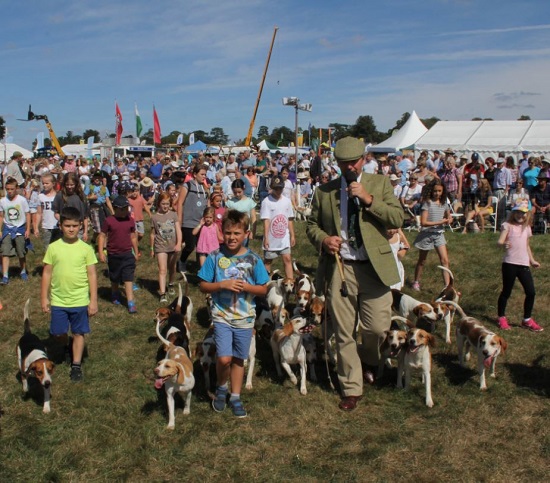
A new pro-hunting organization focuses on communicating at the grass roots level.
In the belief that a grass roots organization could do much good for foxhunting in the UK, a group of us hunting enthusiasts have formed a new organization—This Is Hunting UK. We are not in competition with the Countryside Alliance or any of the hunting associations. Quite the opposite, we seek to find ways of working together for the common good of all forms of hunting.
The essence of our mission is to communicate fully and openly, directly with the public, by providing the information they require to understand more about the conservation, cultural, social, and financial benefits that hunting provides. However, there was one key question: how to give our effort a kick start? Believe it or not, it turned out to be the anti-hunting activists who gave us just the incentive we needed.
Toronto and North York Hunt: From Fort York to Creemore
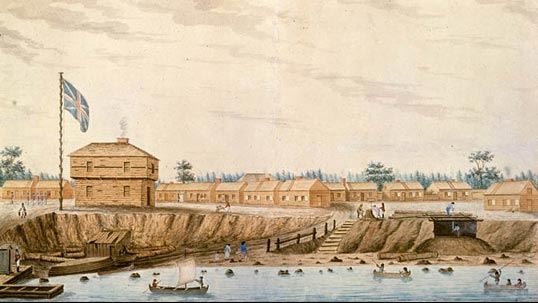
Fort York on Toronto Harbor, early nineteenth century
The Toronto and North York Hunt is proud of the long history of its pack of English foxhounds. Early in the nineteenth century, British military men, fond of sport, shipped hounds across the Atlantic to Fort York, which guarded Toronto Harbour on Lake Ontario. Not long after the City of Toronto was incorporated in 1834, we find mention of the Toronto Hunt. Between 1843 and 1869, eight of the hunt’s nine Masters were army officers.
Foggy Cubhunting Morning

Denya Dee Leake shot this dramatic photo and recorded the cry of hounds with her smartphone. Hounds found a fox near the kennels, sang all the hound music that one could wish for, and pushed their quarry hard through the course of the morning in a huge circuit and finally to ground back near the […]
Esmé
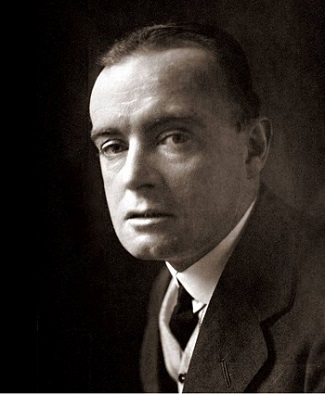
Writing under the pen name, Saki, British writer Hector Hugh Munro (1870–1916) was considered a master of the short story. Influenced by Oscar Wilde, Lewis Carroll, and Rudyard Kipling, Munro himself influenced A. A. Milne, Noël Coward and P. G. Wodehouse.
His witty and sometimes macabre stories satirize Edwardian society and culture. Here’s one that falls into the macabre, the Baroness lacking that measure of sensitivity with which many of the Edwardian British upper class were comfortably unencumbered.
“All hunting stories are the same,” said Clovis; “just as all turf stories are the same, and all…”
“My hunting story isn’t a bit like any you’ve ever heard,” said the Baroness. “It happened quite a while ago, when I was about twenty-three. I wasn’t living apart from my husband then; you see, neither of us could afford to make the other a separate allowance. In spite of everything that proverbs may say, poverty keeps together more homes than it breaks up. But we always hunted with different packs. All this has nothing to do with the story.”
Sex Spot: The White, Furry Menace
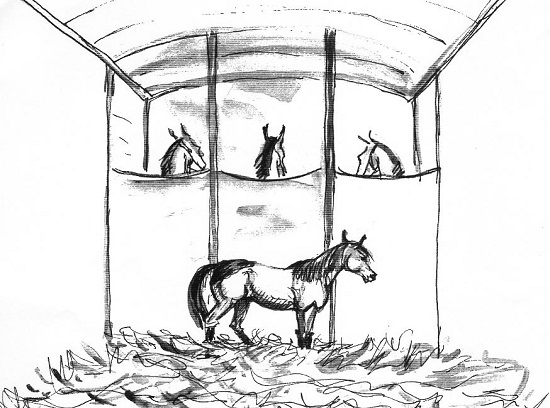
Back in the late 1950s, Deirdre and her friend Sarah, both just nineteen, came to America. The pair had left Britain, where post-war ration books were still in use. Sarah was to train horses and riders for Jamie Kreuz at Bryn Mawr Farms outside Philadelphia. Deirdre was to work for the Insurance Company of North America in Philadelphia and help Sarah on weekends. What follows is Part V of their adventures, which have included Part I: “How to Bridle a Green Field Hunter,” Part II: “The Witch With Warts,” Part III: “Pink Gin: The Beer Swilling Timber Horse,” and Part IV: “Purrfec’ Granary.”
Illustration by Rosemary H. Coates
Two weeks after Sarah and I arrived in the States we were on the road northwards with twenty-five hunters. They were entered at the Piping Rock Horse Show on Long Island. The horses were loaded into nine-horse trailers for their journey. In the first compartment six horses faced each other across an aisle. Although three horses could be loaded into a separate compartment at the back, there was only one 11.2-hand pony in there—so small, he was up to his belly in straw. This was Sex Spot who would not travel with another horse; he had the three back stalls to himself. He got his name because he had a football-sized black spot on his rump, in an otherwise white coat.