Badgering: A Fund Raiser for the Hunt
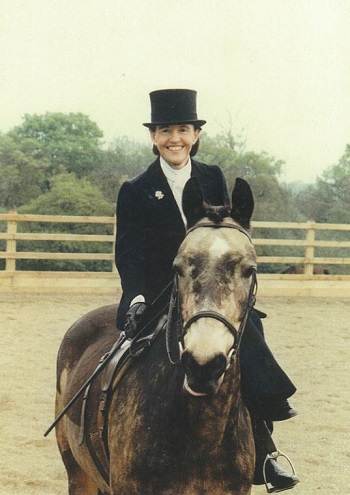
*Many hunts are continually on the prowl for a new fund raising scheme. Here’s a game from Britain that may raise funds, but if the members get to brawling don’t blame me.* The idea of using badges to raise hunt funds was the brain-child of our Hunt Chairman and this is the way he made […]
A Red Letter Day at Live Oak
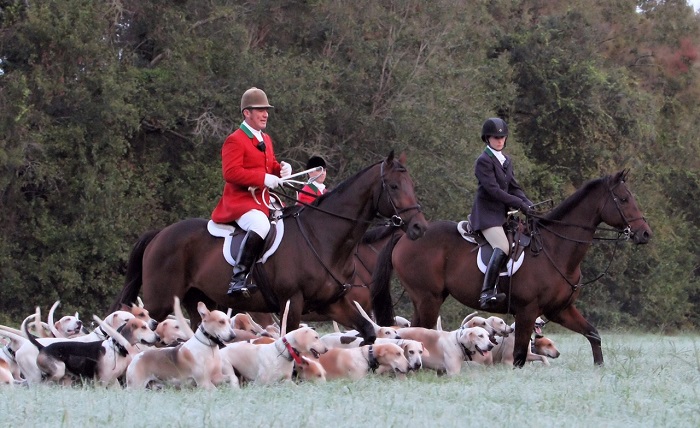
Huntsman Spencer Allen with the LIve Oak foxhounds, accompanied by whipper-in Alexandra Taber and kennel huntsman Sam Andrews. / Leslie Ballenger photo
Marty’s Weather Channel said no way but my Weather Bug gave me hope, and hope springs eternal! It looked highly likely that we might have to cancel due to heavy rain and possible thunderstorms, but, never wanting to cancel unless totally necessary, the call was made at 5:30 a.m. to go for it.
We were in the saddle at 8:30 and headed for the Dip Vat. What a shame, as it turned out, that so many were put off by the weather prediction of three inches of rain, to have only two in the field—Cameron and David Reid. “Small field, good hunt” could not have been more true!
Farmington Accepts the Inevitable, Adds New Quarry
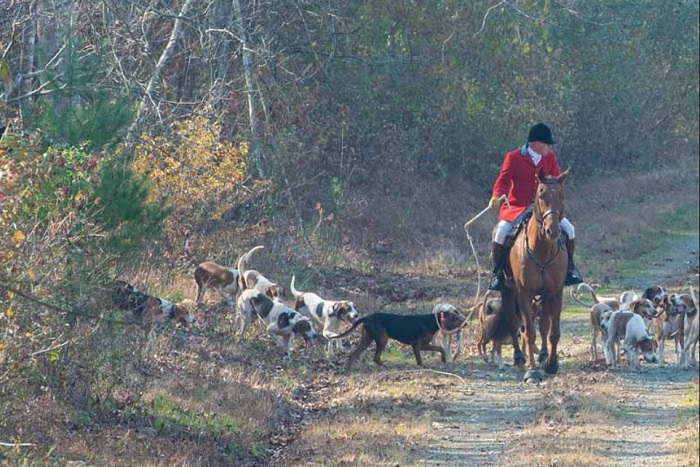
Professional huntsman Matthew Cook and hounds of the Farmington Hunt (VA). / Cathy Summers photo
On a hot midsummer afternoon, huntsman Matthew Cook rode up to meet me on a green John Deere lawn mower. Cutting grass is just part of the work it takes to maintain the grounds and kennels at the Farmington Hunt Club (VA), home to sixty noisy, rambunctious foxhounds.
Coming to Farmington in the summer of 2013 from the Los Altos Hunt in northern California, Cook faced a new set of challenges, both in topography and local culture. He was learning his new job in the shadow of the forty-year reign of the revered Jill Summers, MFH, whose practice and policy of hunting only foxes laid the foundation for Farmington’s hounds. The pack was bred and trained to ignore anything non-vulpine.
Duhallow Foxhounds at Kilbrin: The Oldest Foxhound Pack in Ireland
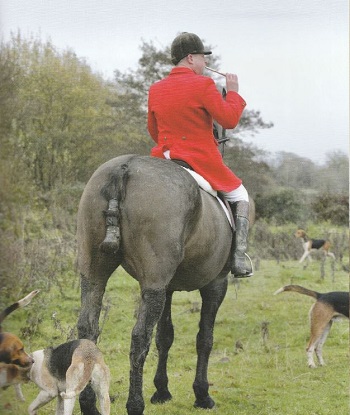
Duahallow huntsman Ger Withers / Catherine Power photoFounded by the Wrixon-Becher family, the Duhallow foxhounds have been hunting North Cork from the Kerry border to Doneraile continuously since 1745 making it the oldest foxhound pack in Ireland. (For those who question how to reconcile that with the Scarteen, the recorded history of which goes back to the early 1700s, the keyword is “foxhounds.” The Scarteen Black and Tans are technically known as Kerry Beagles, though they dwarf any beagles we know today.)
The Duhallow pack existed before 1745, but there is no recorded history. That year, Henry Wrixon of Ballygiblin rented a fox covert, Regan’s Break, for thirteen guineas. Henry passed the pack on to his son, Colonel William Wrixon, who in turn passed it on to his own son. In 1800, Sir William Wrixon Becher, MFH met with several other gentlemen to form a club to be called the Duhallow Hunt Club. Sir William had taken on his wife’s maiden name, Becher, she from the same family for which the infamous obstacle on the Grand National Steeplechase course at Aintree, England, Becher’s Brook, is named.
From the Foreign Office to the Hunting Field
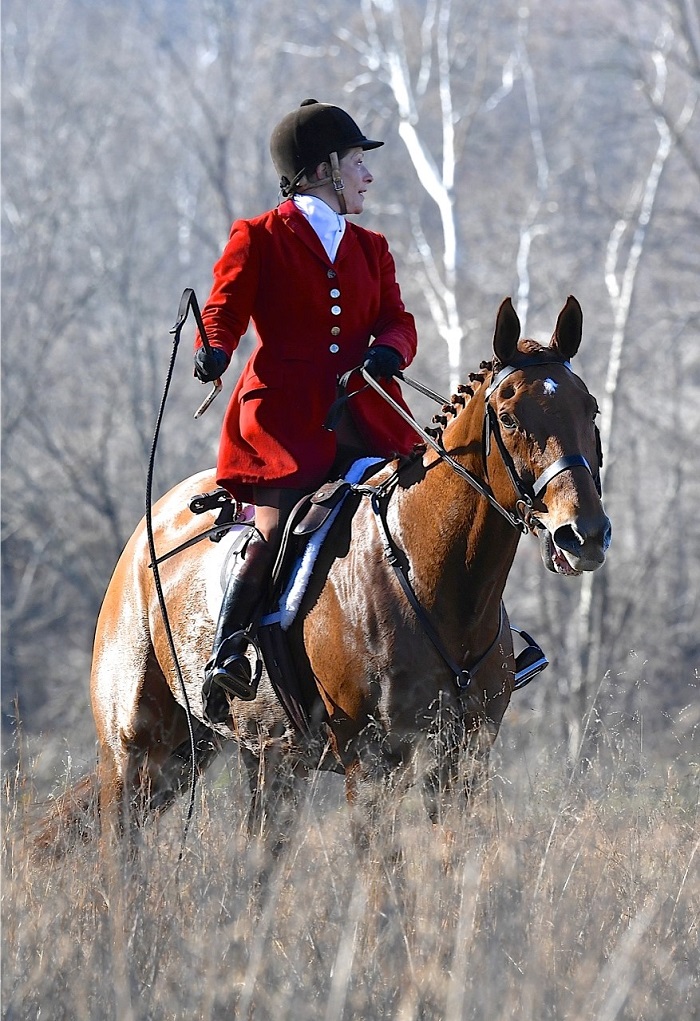
Shannon MacKenzie’s professional life progressed from the confines of the office to the open spaces. / Douglas Lees photoThe horse industry is historic, even old-fashioned; the foxhunting world is more so. But follow Shannon MacKenzie’s journey from her native Canada to Virginia’s storied hunting country, and find a surprisingly modern twist to the tale. Facebook played a part.
MacKenzie first found out via a Facebook chat last year about an open slot for a professional first whipper-in at the Old Dominion Hounds (VA). It was a job she felt her skill set would serve, but it was a position she’d never held.
Two to One On the Petticoat: Foxhunter Is First Female Jockey
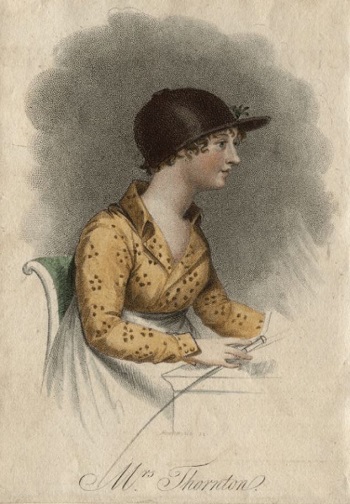
Alicia Thornton by Mackenzie, after unknown artist stipple engraving, published 1805. NPG D8248 © National Portrait Gallery, LondonThousands of spectators thronged the race meet at Knavesmire in York on August 25, 1804. The crowd was much larger than usual and curious onlookers strained for a view of the upcoming race. The reason for all the commotion was simple: a woman was challenging a man in a horse race. It was a staggering event, derided as pure novelty by some and lauded as step toward equality by others. For many of the day’s spectators, it meant drama and entertainment, and they turned out in droves to see it.
How the Huntsman Draws for Coyote
The Genesee Valley hunting country is blessed with both red fox and coyote which have coexisted for thirty-five years. So to say that I would draw specifically for coyote on any given day would be impossible. However, there are areas in which coyote are more likely to be in my country. If am drawing one of those areas, I am very mindful of the wind.
With a coyote it is much more important to draw upwind. He will get up and go much sooner than a fox will. To have the best chance of being close behind him, it is better to draw upwind so he does not wind us and bolt. I would enter the covert quietly, encouraging hounds to concentrate and draw fairly widely.
The South Tyrone Foxhounds at Minterburn
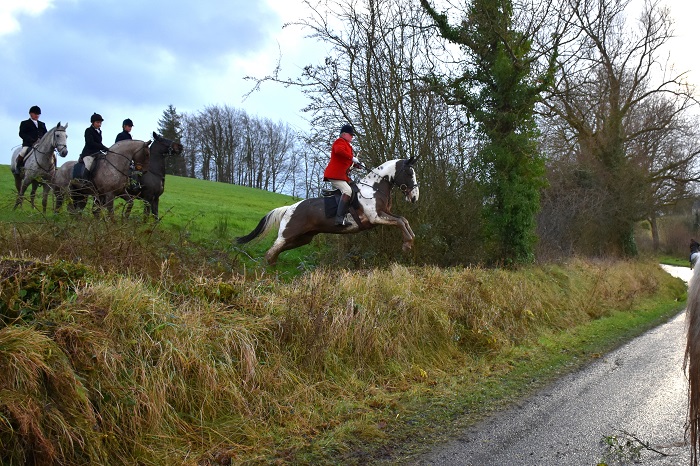
Some get it right. Stephen Hutchinson, MFH in a brave jump onto the road with the South Tyrone Foxhounds / Noel Mullins photo
I never cease to be amazed at the challenges of foxhunting in County Tyrone, Northern Ireland. On a good hunting day, for many, it would be easier to ride in the Aintree Grand National. Such is the challenge of crossing this well-fenced countryside with its network of wire, drains, and hedges, that visitors seldom return a second time!
If there is any weakness in the hunt membership, it is that they have too many veterinary surgeons following and not enough physicians. In the course of this day’s hunting, every one of the vets was in trouble. Since Dr. Cathal Cassidy emigrated to New Zealand it has not been the same, particularly as he was a psychiatrist, which, given the cavalier attitude of the followers across the hunting country, is the branch of medicine most suited to the needs of the South Tyrone followers. In fact the horses look sounder than the riders.
Major Charles Kindersley and the Modern English Foxhound
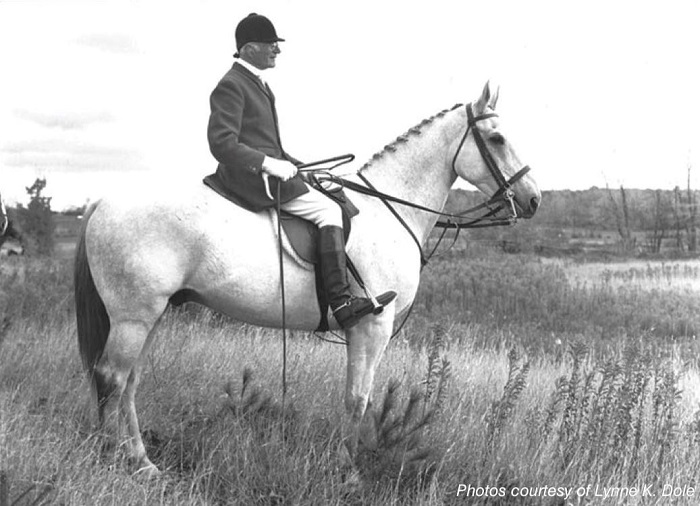
Virtually every coop, bridge, landmark, or covert in the Belle Meade Hunt foxhunting country (GA) has a name, so that huntsman, mounted whippers-in, and road whips can accurately and concisely communicate where the action is by radio. What does this have to do with the late Major Kindersley, MFH of Ontario’s Eglinton Caledon Hunt? Only that one of the coops very often in the middle of the hunting action is named “Major Kindersley’s Coop,” and virtually everyone who has hunted at Belle Meade is familiar with the name. Here’s the Major’s story.
In 1919, George Beardmore, MFH of the Toronto and North York Hunt (ON), bought the old World War I aerodrome land on Avenue Road and Eglinton Avenue for the purpose of setting up a riding establishment, including a drag pack. Most of the Toronto and North York members lived in Toronto and travelled the twenty-five miles to the kennels in Aurora only on weekends. These new facilities gave members the opportunity to ride during the week, hunt with the drag pack, and still keep up with their day’s work at the office. Over the years that pack became known as the Eglinton Hunt. Between the wars, the Eglinton Hunt also acquired land on Leslie Street north of Toronto.
The Lady Who Rides to Hounds
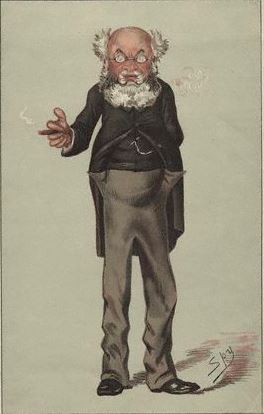
Anthony Trollope illustration by Spy in Vanity FairHunting Sketches by Anthony Trollope was published in 1865 and contained eight chapters, including “The Man Who Hunts and Doesn’t Like It,” “The Man Who Hunts and Does Like It,” and the six chapters that follow. Here is “The Lady Who Rides to Hounds” from this classic by Trollope.
Among those who hunt there are two classes of hunting people who always like it—hunting parsons and hunting ladies. That it should be so is natural enough. In the life and habits of parsons and ladies there is much that is antagonistic to hunting, and they who suppress this antagonism do so because they are Nimrods at heart. But the riding of these horsemen under difficulties, horsemen and horsewomen, leaves a strong impression on the casual observer of hunting; for to such an one it seems that the hardest riding is forthcoming exactly where no hard riding should be expected. On the present occasion I will, if you please, confine myself to the lady who rides to hounds, and will begin with an assertion, which will not be contradicted, that the number of such ladies is very much on the increase.