Keyboard Bullying Harms Your Hunt and Your Sport
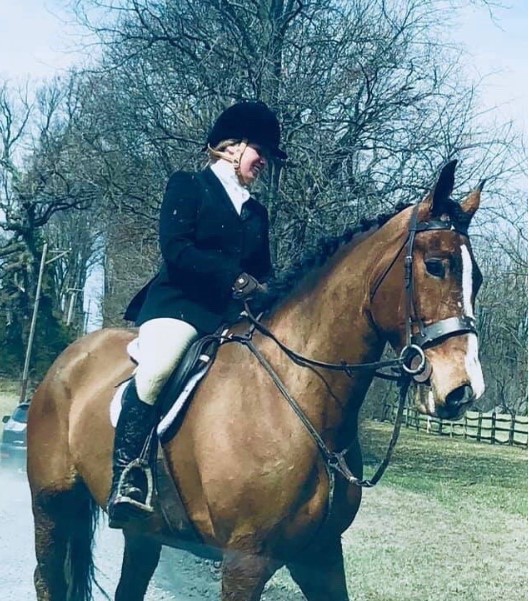
Happy time for our author is sitting on a good horse and following a topnotch pack of hounds. She worries that incivility, personal attacks, and coarseness on the part of foxhunters on social media is harming our sport and our clubs.
As a twenty-two-year-old, I have grown up in the age of extreme technological and social media growth. Everyone has it; everyone uses it. I’ve also grown up in the hunting field and follow hounds three days a week. I travel to hunt and do my best to experience all types of hunting, all over.
My happy place is on a good horse, behind a great pack of hounds. The hunt field is the place where you can leave all other thoughts behind for a few hours and turn your focus to staying topside and keeping up with hounds. The hunt field is a place to be at peace, away from our own and the world’s struggles, whether big or small. But recently…
The Great Hound Match: Day 4
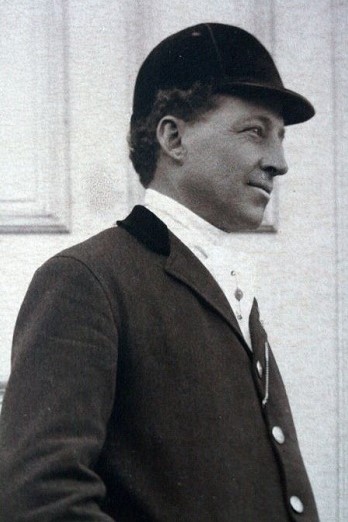
Harry Worcester Smith in hunting attire, circa 1910, from the Harry Worcester Smith Archive (MC0041), National Sporting Library & MuseumThis week’s Bonus article, free to all (no subscription necessary), is an excerpt from Chapter 10 of “The Great Hound Match” by Martha Wolfe―a historical account (with liberties taken) of that famous quarrel between Masters A. Henry Higginson and Harry Worcester Smith over the merits and hunting ability of the English foxhound compared to the American foxhound. The author views the match as “a metaphorical battle in America’s coming of age―her psychic independence from Britain’s lingering shroud at the turn of the twentieth century.”
Saturday, November 4, 1905, Grafton Hunt’s Second Day
“Hounds never ran so fast since the world began.”
−Allen Potts quoting Dr. Charles McEachran, judge for The Match, Richmond Times-Dispatch. Saturday, November 5, 1905
You and Ham trot on ahead with the hounds,” Smith told Mal Richardson. “We’ll not be far behind.”
The Fox’s Prophecy

Painting by Anthony BarhamThe Fox’s Prophecy was written in 1871 by D. W. Nash and presented to the then Master of the Ledbury Hounds. Foxes have forever been suspected of harboring deep thoughts, and this poem certainly reflects those ancient superstitions. Through Nash’s fox we read predictions of a future that might well be recognizable to many readers in these times.
However, Foxhunting Life remains apolitical, as always, and, if you read carefully, you will find that for every stone cast by this poem at anyone who might take offense, be assured that there is a stanza here casting a stone as well at the opposite end of the spectrum. The fox, also apolitical, seems to believe that all humans have something to answer for.
For swiftly o’er the level shore
The waves of progress ride;
The ancient landmarks one by one
Shall sink beneath the tide.
Phillipa’s Fox-Hunt (Part 2)
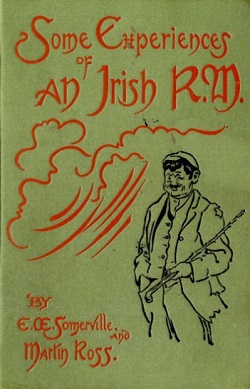
In this week’s Bonus article, free to all (no subscription necessary), we rejoin Philippa as she is escorted into the dining room at Aussolas Castle after her first foxhunting experience. She is fully out of breath, having followed hounds by bicycle and across the country on foot led by two local country lads showing her the way. Major Sinclair Yeates, R.M., who has been following hounds on a supremely confidential hunter borrowed from Lady Knox, finds his new bride in a state of unsuppressed excitement scarcely recognizable from the proper young English lady he supposed he had married.
Mrs. Knox was already at breakfast when Philippa was led, quaking, into her formidable presence. My wife’s acquaintance with Mrs. Knox was, so far, limited to a state visit on either side, and she found but little comfort in Flurry’s assurances that his grandmother wouldn’t mind if he brought all the hounds in to breakfast, coupled with the statement that she would put her eyes on sticks for the Major.
Foxhunting and the Cavalry Spirit
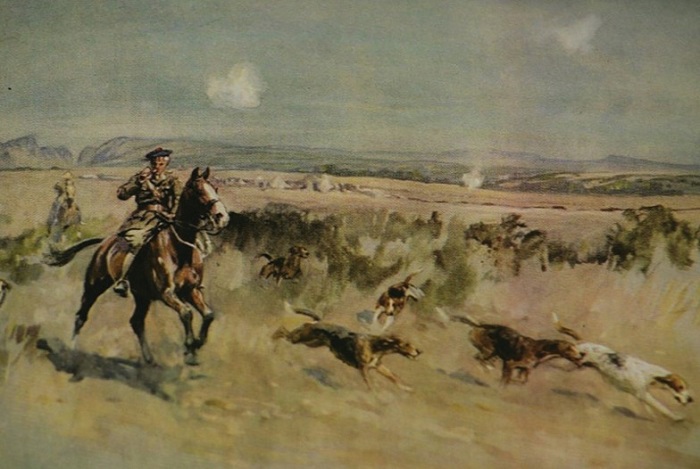
This scholarly examination of how English foxhunting and European manège schooling influenced warfare as it was waged and as it evolved over the last three centuries of European conflict is extracted from the author’s forthcoming book, Horsemen, Horsesoldiers, and Grand Illusions by Professor Caramello, for the readers of Foxhunting Life.
Hunting on the Salonica Front by Lionel Edwards
An earlier article titled, “Siegfried Sassoon, Foxhunting, and the Great War” (Foxhunting Life, March 27, 2019), focused on Sassoon’s Memoirs of a Fox-Hunting Man (1928) and its companion volume Memoirs of an Infantry Officer (1932), semi-autobiographical works of Great War fiction. It proposed that Sassoon, in those works, developed a complex and nuanced comparison and contrast between fox hunting in untroubled English “countries” and trench fighting in the “waste land” of the Western Front. It also pointed out that Sassoon did not invent this parallel between fox hunting and warfare, but, on the contrary, was visiting, intentionally and pointedly, a recurring theme in British equestrian and military writing in the 18th and 19th centuries and the first decades of the 20th century: fox-hunting as ideal preparation for cavalry service and leadership. The following article briefly sketches some aspects of that theme.
Chris Ryan, MFH, and the Scarteen
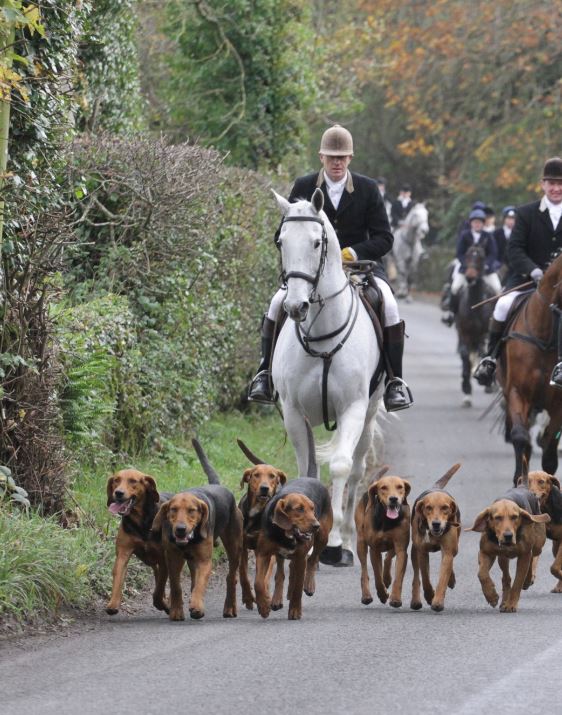
The Ryans and Scarteen are fabled names to every foxhunter in the world. In addition to the many visitors to Ireland who have experienced the magic of following their pack of Kerry beagles—bred for more than 300 years by succeeding generations of the Ryan Family—both Chris Ryan and his late father, Thady, are well known in North America where they have visited over the years to judge hound shows, hunter trials, participate in panel discussions, lead clinics, and promote Irish tourism.
Chris Ryan, MFH and huntsman, Scarteen, takes his hard-hunting pack of Kerry Beagles to the draw. / Catherine Power photo
The name of Chris Ryan is synonymous with all that is good about foxhunting and the famed Scarteen Black and Tan hounds. He is the eighth generation of the family to carry the horn, a tradition that goes back all the way to the late sixteen hundreds.
Morning Stables
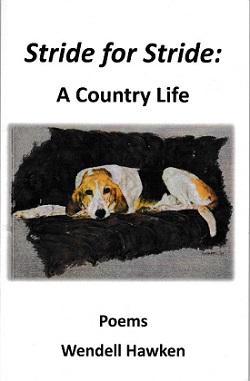
Stride for Stride: A Country Life, Bartley Books, an imprint of Three Pounds Press, Millwood, Virginia, 2020, paper, cover art by Anita Baarns, 70 pp, 43 poems. Available from the author.This slim, award-winning volume of forty-three poems by Wendell Hawken speaks of horses, foxhounds, and country life. Writing with authority on hunting, scent, whelping, riding, animal husbandry, and woodlore, Wendy conjures vivid mental images easily recognized and pleasurably savored by foxhunters who have ‘been there.’ Several of the poems have been previously published in Foxhunting Life, eliciting high praise from readers and establishing this author, in my view, as the most prolific, talented, and serious writer of sporting poetry of the present time.
Wendy’s poem, “Morning Stables,” from this collection will resonate with horsemen and horsewomen who have tended their own, and will jiggle old memories especially of those who were favored with the horse gene as children, and no one else really understood!
Philippa’s Fox-Hunt
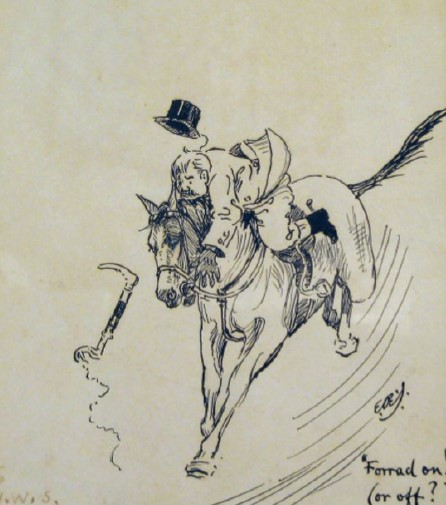
“…made me feel as if I were being skillfully kicked downstairs.” / Illustration by Edith Somerville
This week’s Bonus article, free to all (no subscription necessary), finds Major Sinclair Yeates, R.M. (Resident Magistrate) posted to Ireland by the British Crown with the authority to adjudicate local disputes. He rents a house, Shreelane, for himself and his wife-to-be, Philippa, from Mr. Flurry Knox, Master of the local pack of foxhounds.
No one can accuse Philippa and me of having married in haste. As a matter of fact, it was but little under five years from that autumn evening on the river when I had said what is called in Ireland “the hard word,” to the day in August when I was led to the altar by my best man, and was subsequently led away from it by Mrs. Sinclair Yeates. About two years out of the five had been spent by me at Shreelane in ceaseless warfare with drains, eaveshoots, chimneys, pumps; all those fundamentals, in short, that the ingenuous and improving tenant expects to find established as a basis from which to rise to higher things. As far as rising to higher things went, frequent ascents to the roof to search for leaks summed up my achievements; in fact, I suffered so general a shrinkage of my ideals that the triumph of making the hall-door bell ring blinded me to the fact that the rat-holes in the hall floor were nailed up with pieces of tin biscuit boxes, and that the casual visitor could, instead of leaving a card, have easily written his name in the damp on the walls.
Reap The Wild Harvest
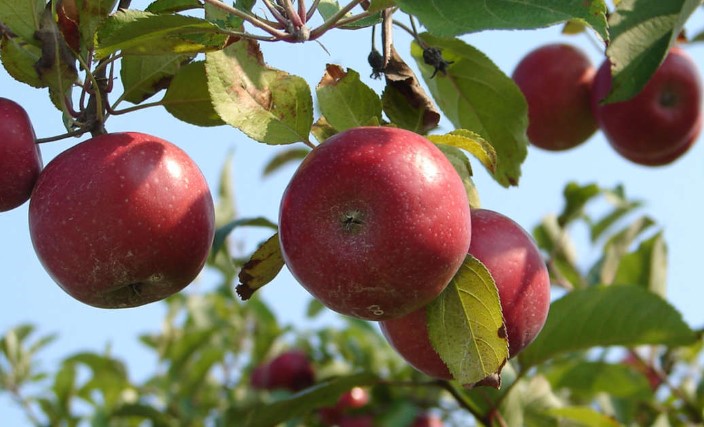
If the predictions of Nostradamus should prove to be correct, by riding to hounds you may well be preparing to save your life. If Armageddon happens, you will know how to survive—just so long as it happens between August and December. In other words, during the hunting season.
Sounds a little ridiculous? Well, maybe, but ride along with me and learn how foxhunting might have already prepared you.
The Dunraven Arms
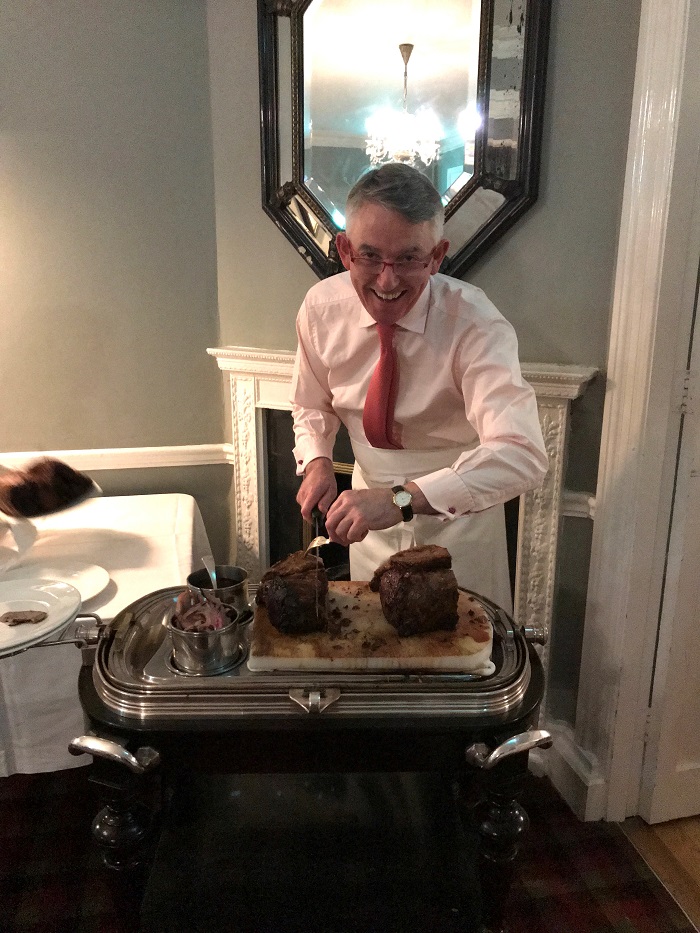
Louis Murphy carves Dunraven’s famous roast beef at tableside. / Catherine Power photo
There can be few hotels that are so intrinsically linked to their owners or the world of the horse as the Dunraven Arms in Adare, Ireland. An institution, it has been a welcoming home to generations of North American foxhunters, and indeed, families across the sporting world. Once you enter that famed revolving door you are struck by the quiet elegance, and you won’t have taken too many steps before you will meet one of the Murphys, Louis or Brian and more latterly Brian’s son Hugh. Brian and Louis were born and brought up in Athenry, County Galway where their father PF (Paddy) was a veterinary surgeon and a keen hunting and racing man. He bred and produced many useful horses such as Orient War and Fred Octerri who went on to win the Sweeps Hurdle.