
Book Review by Matthew Biscotti
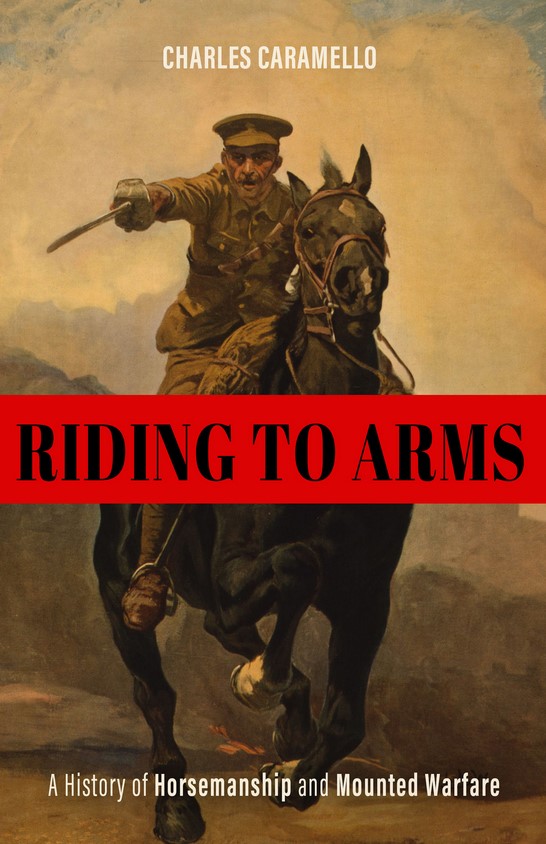 Riding to Arms: A History of Horsemanship and Mounted Warfare, Charles Caramello, University Press of Kentucky, 2022, Horses in History Series, illustrated, hardcover and digital, 279 pages, $34.95 (list)
Charles Caramello’s Riding to Arms: A History of Horsemanship and Mounted Warfare is a thorough and erudite treatise on the evolution of the subject. Though the horse is no longer critical in warfare, much of this literary history describes principles of riding and instruction that laid the foundation for the theory and practice of riding today.
The author treats the subject with a Preface, five chapters, a postscript, a section of copious footnotes, a sixteen-page bibliography, and an Index.
The first chapter, “Ryding and Breakinge,” (the author used the old English spelling for emphasis) is a review of equestrian literature published beginning with Xenophon of Athens’ (431 – 354 BC) Art of Horsemanship and carrying through all of the important works to the end of the eighteenth century.
Chapter two, “Manége to Field,” discusses the literature on classical methods of riding and training horsemen and their influence on horsemen of the day. Works by Grisone, Cavendish, von Eisenberg, Caprilli, Santini, and many of the other French, German, and Italian masters of the seventeenth, eighteenth, and nineteenth centuries are included.
Chapter three, “Light Horse, Dragoons and Others,” begins with definitions of various terms, such as “heavy cavalry,” “light cavalry,” “dragoons,” “cavalry charge,” and is a discussion of how horses were ultimately used in warfare and how the horseman’s training influenced their use. Emphasis is placed on how the horse was used in World War I and how effective its use was, both on the eastern and western fronts.
Dr. Caramello continues to provide references to various authors such as Hinde, Nolan, Baker, Denison, and others in this chapter. Chapter three also introduces references to the subject from the American point of view with discussions of books by McClellan, Carter, and Boniface. It also discusses the views of various authors of the day in regard to the future of the horse in warfare, since the early twentieth century had introduced motorized transport to the world.
Chapter four, “Remounts and Wastage,” discusses how the vast number of horses needed for the American Cavalry, the British in the Crimean War, and World War I were procured. The author provides statistics for the horses used and, most horrifically, estimates of how many were killed, abandoned, or died of other causes (8,000,000 died for all combatants).
This chapter also provides an interesting section on posters and other graphic art produced for recruitment purposes with full-page examples of some of the illustrators.
Chapter five, “Hunting in the Trenches,” discusses the role that foxhunting experiences influenced the mounted soldier. This is done primarily by a review of the memoirs written by Blunden, Graves, Fussell, and others, but special emphasis is placed on Sigfried Sassoon’s Sherston Trilogy, Memoirs of a Foxhunting Man, Memoirs of an Infantry Officer, and Sherston’s Progress. A considerable effort is also made concerning how many of these memoirs turned into anti-war sentiment by their authors.
Dr. Caramello ends the book with a Postscript containing a concise summary of what this book is all about:
For six millennia, the horse played a signal role in human history and, for the past half-millennium, a decisive role in military history. In the modern era in Europe, from the renaissance to the twentieth century, mounted warfare depended upon the formal training of military horses and riders, and, for at least two centuries, refined systems of manége dressage and equitation provided the theoretical and practical bases for that training.
The reader can look forward to gaining insight into the evolution (both theoretical and practical) of how horses were used in warfare. Dr. Caramello pulls together the dozens of books written on the subject with a concise commentary. Riding To Arms was impeccably researched over a number of years and will make a valuable addition to your equestrian library.
Dr. Charles Caramello is the former Dean of the Graduate School and current professor emeritus of English at the University of Maryland. He is also a John H. Daniels Fellow at the National Sporting Library and Museum in Middleburg, Virginia. He has been an accomplished horseman for many years.
Posted June 9, 2022
Matthew Biscotti is the author of Six Centuries of Foxhunting: An Annotated Bibliography, Rowman and Littlefield, 2017