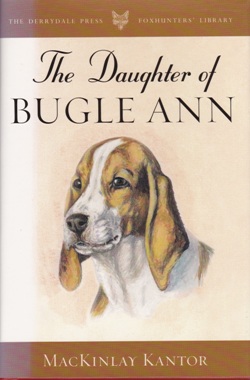
 This foxhound classic by a Pulitzer Prize-winning author, reprinted in 2003 by The Derrydale Press, is cloth bound, 153 pages, $18.95, in the Foxhunting Life Shop.Our dogs rustled out a fox, south and east beyond all hearing, running like they were tied to him. It was eleven o’clock at night, middling damp and black-dark, for the young moon had already gone to hide.
We squatted on the west slope of the Divide above Heaven Creek—the usual four of us, armed with boiled eggs and onion sandwiches, and we carried along a water jug, and my father had a half-a-pint of whiskey. Our trucks were under the oaks, just far enough back for firelight to pretend that radiator caps were precious gems. The spooky places among big trees were full of betty-millers and numerous other moths, and beetles were a-buzzing.
But it seemed as if the timberland considered itself incomplete, without voices of hounds splitting themselves upon the shagbarks; and so all life was waiting and summoning—acorn and peeking coon and noxious flytrap weeds beside the creek—urging that the pack return and make dutiful music in the background.
Benjy Davis pulled his thin brown face away from the fire: the blaze was good to watch but hard to sit by. He said to all and sundry, “She’s just about coming in.”
We knew without his saying that he made mention of Little Lady.
“Yes,” said Benjy, agreeing with himself. “From all signs, this should be the last time I run her till she’s clean out of season.”
Springfield Davis moved his jaws around the usual rich wad of chewing tobacco. “Now, I was over to the Maitland place, week before last. Young Lee Maitland took me there in his car to see Flying Bobby Ford.”
“If Little Lady belonged to me,” spoke up my father, Cal Royster, “I would of had me a couple of litters out of her before this.”
Benjy spoke short. “Little Lady doesn’t belong to you.”
Pa took out his flask, and squinted against the flame to see how many swallows were there and how long they’d do him. “The greatest fox-hound in captivity, the daughter of Bugle Ann, and you’ve never let her drop a pup!”
“No,” spoke Spring Davis’s calm old voice. “She belongs to Camden. And Benjy.”
“She belongs to you, Pa. Camden presented her, right in these woods.”
“Oh,” said Spring, “just call her a Davis dog.”
….
Then came a clarion echo, like the love-song of some savage ghost who paced across the wooded miles all dressed in deerskins and his eagle feathers. It was a baying which commanded over all the insects, and Benjy and I heard it first because our ears were younger.
“She’s in front again.” He spoke without exasperating pride, but just as if he’d said the world was round.
“That’s a good chop, right up there with her,” and I was taking note of our own Vinegar Blink, who was keenly close on the fox, even if he couldn’t sing like Kate Smith or someone else.
My father took a next-to-the-last sample of his whiskey. “I’ll testify to God,” he said. “They do pack well, Spring. Our’n and your’n.”
Spring Davis smiled under his mustache and touched his fingers on the bugle-lip. “They
always have, Cal.”
Owk, owk, owk. We Roysters bred for push and drive and speed; we didn’t care for bench, nor how the judges graded up some sorry potlicker who looked like hell on wheels because of his back or stifles or the firmness of his toes, but who couldn’t stay with a fox if the fox only had three feet and corns on one of those.
I stood and snapped my fingers in pleasure, and counted out the names of those we owned, and Benjy named the Davises. Old Spring just leaned against a black oak trunk, and crushed a sandwich in his long claw hand. His ears were hearing only one good trumpet over all the clacking.
He said, “There never lived a voice like that in any time or nation. Excepting one.”
My father took a final swallow from his flask, and screwed the top back on; he tossed it in the flames.
And pretty soon the flask would burst like any bomb, and then we all would dodge, and laugh; and Spring would shake his head, and ask my Pa how soon he’d grow up, anyway.
Pa said, “You’d have some other mouths as good. With luck you’d get a one or two, in any litter that you bred.”
“Take this stud dog at the Maitland place,” Spring told us. “He’s sired champions.”
“And bubble-babbler-bumblebees as well,” his son reproved. “Did you glimpse those two-year-olds the Lanceys tried to run of late? I swear they didn’t know if they was crying fox or polecat or the morning news. And they’re by Flying Bobby Henry Ford, or what the hell they call him.”
Springfield sighed, and ate the last remainders of his sandwich. “That’s the rub,” his foggy voice declared. “We can’t agree. I guess we’ll breed her, but—”
“Well, she ain’t ready to be introduced to anyone tonight,” my father said. “Now, Bake , just set and listen to the tune.” And there I was, not saying anything.
Just marveling at it all. For we were happy; and strange it was to reason that such pleasantness could ever have emerged from all the cruelties which lay on us before—especially upon the Davises. Old Spring had slain a neighbor for Bugle Ann’s own sake, and faced his penalty without a murmur; but still the daughter of that murdered man had been the key to open up his jail-house door.
So we were joyful, though never speaking much about it. We had no inkling of the fury to come.
*****
Daughter of Bugle Ann (1953) is MacKinlay Kantor’s sequel to his 1935 book, The Voice of Bugle Ann. Kantor (1904-1977) had a distinguished writing career. Primarily known for his book, Andersonville, which won him the Pulitzer Prize in 1956, he was also the best-selling author of Long Remember, Turkey in the Straw, and Gettysburg. Reprinted in 2003 and 2001 respectively by The Derrydale Press, both Bugle Ann books are available in the Foxhunting Life Shop at $18.95 each (less 10% automatic discount for FHL Subscribers).