Thoughts on Field Hunter Competitions
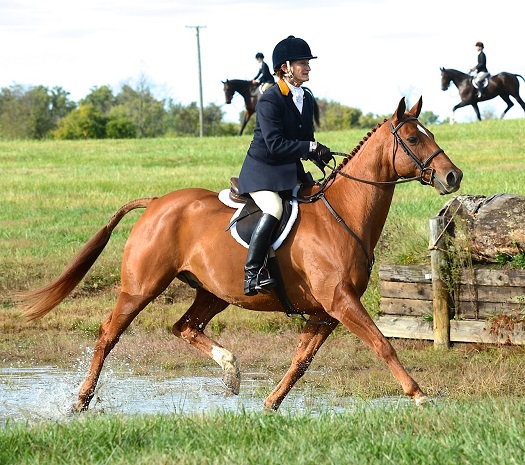
A competent horse and rider, confidently and comfortably crossing the country: what we all aspire to! Laurie Ambrose and Stretch, winning the Theodora A. Randolph Field Hunter Championship in Virginia. / Douglas Lees photo
The recently held Theodora A. Randolph Field Hunter Championship in Virginia is a unique competition. It differs from the more usual one-day hunter trial in which foxhunters ride individually over a course of obstacles, often including lead-overs, trot fences, fast gallops, and hold-hards.
In the Theodora A. Randolph Championship format (see Susan Monticelli’s report in separate article), field hunters are observed by mounted judges for several days during a series of actual foxhunts behind different packs of foxhounds. The judges’ task during these hunts is to select those horse/rider combinations they wish to see in a final day of competition. The finals, held each year at Glenwood Park in Middleburg on the morning of the Virginia Fall Races, consist of a mock hunt following a Field Master over a course of obstacles, and then individual tests similar to those in a hunter trial for the final ten or so selected.
While some avid and capable foxhunters believe that foxhunting is not a competitive sport and decline to participate, and while I can appreciate and respect their view, I also see benefits from these competitions. From one aspect, it’s a great value. If you want a hunting holiday in Virginia, you get to hunt with four different packs for an entry fee of not much more than the cost of a single cap at some of these hunts. And parties all week to boot!
Piedmont Pair Are 2014 Field Hunter Champions in Virginia
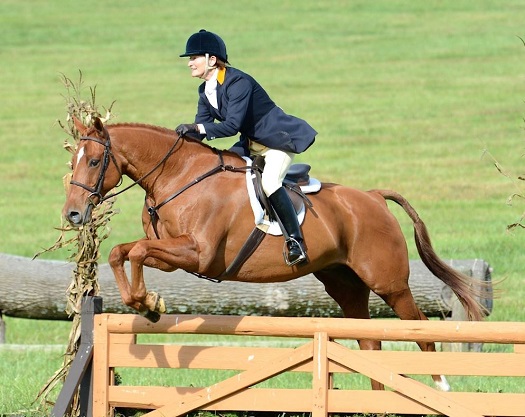
Laurie Ambrose and Stretch from the Piedmont Fox Hounds won the 2014 Mrs. Theodora A. Randolph Field Hunter Championship. / Douglas lees photo
In a hark back to bygone days, the Theodora A. Randolph Field Hunter Championships combine a whirlwind week of foxhunting and socializing against a backdrop of sporting estates, well-bred foxhounds, and passionate foxhunters. Always held the last week of September and ending the first weekend of October, this year’s event attracted seventy-four entries with a brilliant card of hosting hunts: Orange County Hounds, Blue Ridge Hunt, Loudoun Fairfax Hunt and the Piedmont Foxhounds. Judges ride alongside the field to observe the competitors in action before selecting several riders each day, based on how well their horses performed, for the finals on Saturday. Every hunt hosted a tailgate, and there were social functions every evening.
Foxhunters from twenty-two hunts and eight states rode in the event: Andrews Bridge, Belle Meade, Blue Ridge, Bull Run, Casanova, Deep Run, Elkridge-Harford , Farmington, Glenmore, Hillsboro, Keswick, Loudoun Fairfax, Lowcountry, Middleburg, Newmarket-Middletown Valley, Old Dominion, Orange County, Palm Beach, Piedmont, Snickersville, Warrenton, and Whiskey Road. Riders came from Florida, Georgia, Maryland, Pennsylvania, South Carolina, Tennessee, and Virginia. The six judges were Helen Brettell, Middleburg; Snowden Clark; Liz McKnight, ex-MFH, Elkridge-Harford; Ginny Perrin, MFH, Deep Run, and the husband-and-wife team of Lincoln Sadler and Cameron Sadler, MFH, Moore County.
British-Inspired Rabbit Hunt Took an Odd Turn
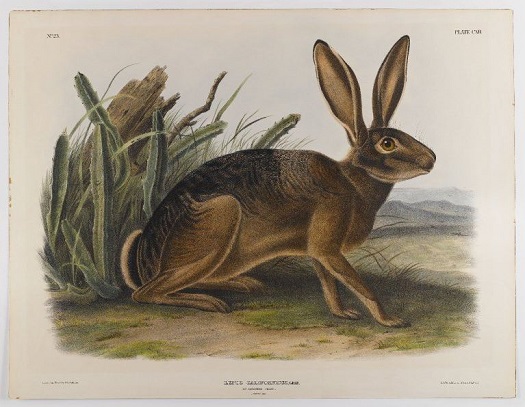
California hare by John J. Audubon
The early part of the last century saw the people of Riverside, California looking towards Great Britain for inspiration for their leisure activities.
This was chiefly because of the many British immigrants who had begun arriving here about 1889, primarily to invest in, among other things, the fast-growing orange industry. English customs were held in the highest esteem, especially among socially ambitious Americans, Tom Patterson wrote in his book, A Colony for California.
Riversiders engaged in such British activities as polo, high tea, and foxhunting. The latter did not usually include a fox, because foxes were not common in the area. Instead they substituted a more common animal, the jackrabbit. These hunts were conducted wherever a large area of open land could accommodate horses, hunters, hounds, and the prey.
First WNV Case in Virginia in 2014
A horse in Virginia has tested positive for West Nile Virus. This is the first case of WNV in Virginia in 2014. The horse, an eight-year-old Paint Gelding stabled in Augusta County, had not been vaccinated. WNV is a mosquito-borne disease, and the first cases are generally seen in August and September, according to Dr. […]
Is Riding Good Exercise?
The New York Times affirms that riding can be moderate to even strenuous exercise, depending on how you ride. The report cites a study comparing the energy expended in various form of exercise. The energy expended is expressed in METs. A MET is the ratio of the work metabolic rate to the resting metabolic rate, […]
Remembering the Irish War Horse
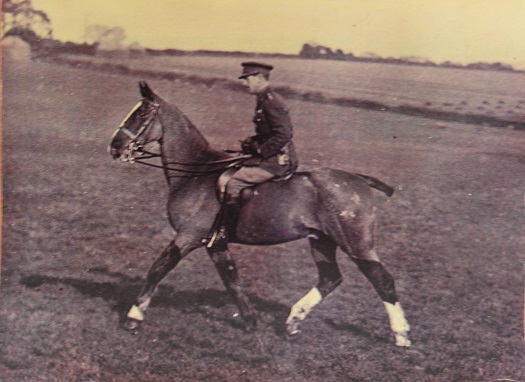
Fascinated by our summer series of articles about the WWI war horses on the occasion of the centennial of that horrific conflict, Noel Mullins, a regular contributor to Foxhunting Life, sent us this story that he wrote for this year’s Souvenir Programme of the Dublin Horse Show. Noel is a Member of the Royal Dublin Society Library & Archives Committee. His story is about Gladeye, a field hunter that went to war, survived, and returned to jump at the Dublin Horse Show in 1926.
War Horse Gladeye and Brigadier Walter Brooke
This year marks the centenary of World War I, and ceremonies around the world remember the nine million human casualties lost in the conflict. But it is often forgotten that eight million War Horses also lost their lives, going through the most terrifying experiences known to any living creature. War was declared on the July 28, 1914 and was expected to end by Christmas 1914, but sadly it lasted another four years until November 11, 1918.
Probably the two most well known Irish War Horses in history were Emperor Napoleon’s white horse Marengo and the Duke of Wellington’s Copenhagen who met at the Battle of Waterloo. Both are said to have been purchased at an Irish horse fair. War Horses in the mounted cavalry units were deployed in many battles in the first years of WWI, amongst them, the battles of Mons, First and Second Battles of Ypres, Festubert, Aubers Ridge, Marne, Vimy Ridge, the Somme Hill, and Cambrai.
The Lathom Remount Depot of World War I

The horror of the First World War is much on the minds of our English sporting friends this summer as the world marks the hundredth anniversary of that conflict. Foxhunters there are especially moved in remembering the terrible toll taken on the world’s equine population in numbers unequaled before or since. Ron Black in Cumbria, […]
Lecture, Book Signing on Grisone’s Sixteenth Century Riding Manual
Elizabeth M. Tobey will present a lecture and book signing at the Middleburg Public Library on September 18 at 7:30 p.m. Tobey will discuss her (and Dr. Federica Deigan’s) translation of Federico Grisone’s The Rules of Riding (Gli ordini di cavalcare). Tobey began the translation project seven years ago while a John H. Daniels Fellow […]
Edward Troye, Harry Worcester Smith, and Alexander Mackay-Smith: Archival Research Connects the Dots
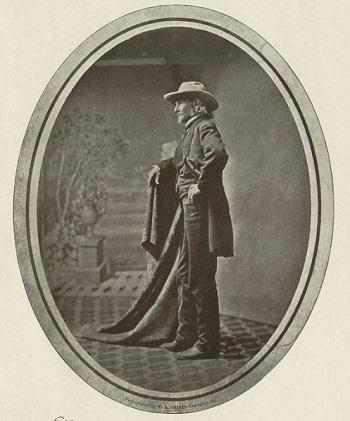
Edward Troye gained artisitic renown painting America’s greatest bloodstock of the mid-twentieth century. / 1872 photographic print, National Sporting Library and Museum Archives, Harry Worcester Smith papersFoxhunting Life is proud to publish this preview of the stories behind one of the most important exhibition of the works of Edward Troye ever mounted.
It is said that “traces of the soul can be found in boxes in the archives.” Where letters, scrapbooks, newspaper clippings, jotted notes-to-self and snippets of individuals’ lives are kept, distractions lurk and surprises are inevitable. And patience is rewarded with a story.
The archives of the National Sporting Library and Museum in Middleburg, Virginia contain the story of three men whose lives spanned two centuries, whose interests overlapped, and whose souls were kindred: Artist Edward Troye (1808-1874), the indomitable sportsman Harry Worcester Smith (1864-1945), and the scholar, chronicler, and author Alexander Mackay-Smith (1903-1998).
The Stable Yard Is Silent
The anniversary of the start of the First World War will be upon us July 28th. Four years ago, in England, on the hundredth anniversary of that terrible conflict, James Barcaly, ex-MFH, tossed and turned through the early morning hours. Thoughts of the war, the carnage that took its toll on James’s family members, eighteen million people, eight million horses, and what those years meant to a way of life that was so much a part of the Barclay family ran through his head. He got out of bed, sat down, and wrote this poem. At 6:30 am he finished writing. Twenty minutes later the South Wold Foxhounds came up his drive on summer exercise, making his world right once again.
The stable yard is silent, no equine friends, no ears twitching over the doors.
Where have they gone? They have gone to Europe to fight a war.
Will they be back to graze the summer pastures green?
Will they be back to see the autumn mist and hear hounds running?
Will they be back to enjoy the fifty minutes across the grass?
They and their Masters have gone to defend our freedoms.
In mud and wire they toil, no end in sight,
But the thought of hounds running and their cry deep in their veins,
Make our horse and human friends dream, dream of
A cold winter’s night, hacking homewards with the moon up high.