
University of Arizona Offers Race Track Industry Curriculum
The University of Arizona in Tuscon offers a course of study for aspiring race track industry executives and officials. The university’s Race Track Industry Program (RTIP) is the only Bachelor of Arts and Masters Degree program of its kind, specific to the pari-mutuel racing industry. RTIP students have two options to follow toward their degree—the […]
A 3-Day Eventer Goes Foxhunting
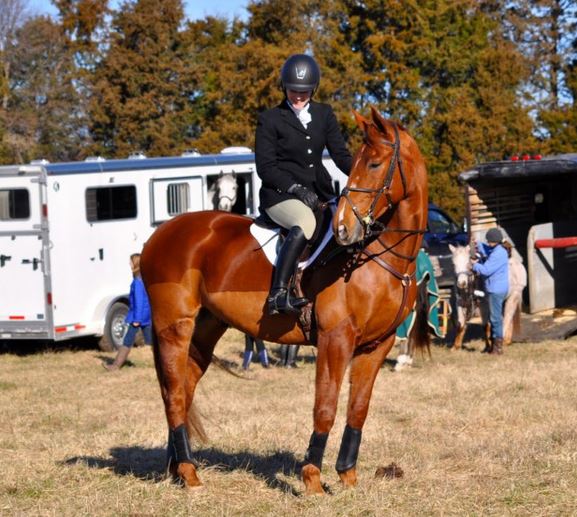
Handsome Leo and the author go hunting. / Joe Samuels photo
In England and Ireland, it’s de rigueur for eventing horses of all levels to spend their winter season in the foxhunting field, but in the U.S., not so much. In this country, the hunt field is not necessarily where young eventing enthusiasts start their passion for galloping at hedges and coops, or where young horses find their balance and footing across varied terrain.
We reap the benefits when we import sensible Irish horses that have already been out for two seasons at the age of five, but it is certainly less common than it used to be to find crossover between the two disciplines.
Leo, I decided, was going to take the old-fashioned route to finding his cross country talents; we were going to foxhunt. He had come an incredibly long way in the eighteen months that I owned him, in both cross country acumen and fitness for the activities required in eventing, but there was still something missing.
David Hopkins Semmes, ex-MFH
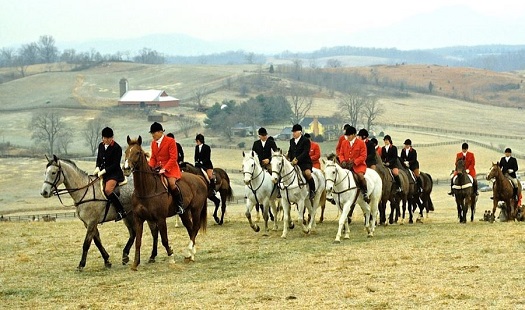
Joint-Masters David Semmes and Mildred Riddell move off at the head of the Old Dominion field from a meet at the Honorable and Mrs. Joseph W. Barr’s Houyhnhnm Farm near Hume, Virginia / Douglas Lees photo
David Hopkins Semmes—longtime Master of the Old Dominion Hounds (VA), amateur steeplechase rider, and deep-water sailor—died peacefully at his home, Indian Run Farm, near Flint Hill, Virginia, on New Years Day, just four days shy of his eighty-seventh birthday.
Born in Washington, D.C., Semmes graduated from Episcopal High School then served a tour of duty in World War II as an aviation radio crewman. He graduated from Princeton in 1949, and in 1950 served in Army intelligence on the Pusan perimeter during the Korean conflict. He worked as a government service officer in Japan, Taiwan, and Hong Kong before returning to Washington to practice law.
Semmes managed intellectual property for forty-one years, notably patenting the so-called “black box” used on airplanes, and the technology used for protective vests for jockeys.
Politics and Sport: The Berlin Wall and Drag Hunting

The state of Brandenburg in Germany (formerly a part of Soviet-controlled East Germany from 1945 to 1990) is known for its well-preserved natural environment. Ambitious preservation policies began there in the 1990s, following reunification of East Germany and West Germany. Berlin, which was also divided into East and West Zones until the fall of the Berlin wall, lies as a separate city-state within the borders of Brandenburg. Just a short twenty-five years ago the scenes in this video could not have taken place.
This video of the Brandenburger Hunting Club was recorded by a rear-facing camera attached to my wife’s helmet. The Club was founded in 1991—shortly after the fall of the Berlin wall and German reunification—in Seeburg, close to the capital of Brandenburg in Potsdam. The fall of the wall actually enabled drag-hunting in the area, as the required space was simply not available in the isolated city of Berlin. Needless to say, in socialist East Germany, drag hunting and foxhunting were certainly not sports encouraged by the state.
A Sporting Tour Through Merry Old….Part 2
Join James Barclay—an ex-Master of five English foxhunts—for Part 2 of his personal and revealing tour of elite hunting establishments through Middle and Eastern England. Barclay went out with twenty-one packs in just two months during the informal season, the last of which on the morning before the first of six Opening Meets. Click for Part 1.
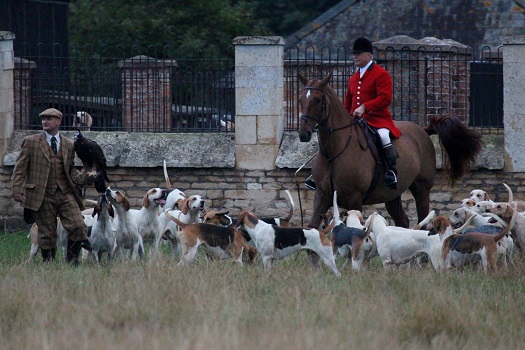
Fitzwilliam huntsman George Adams and hounds with birdman John Mees at the kennel meet, Milton Park / James Barclay photo
Fitzwilliam
Hunting with the Fitzwilliam is always a treat, especially as my family and I spent twelve very happy seasons there. Although Peterborough is on the doorstep, the Park is beautifully laid out for hunting and many good days are enjoyed there. The kennels are situated on the eastern side of the Park and have a history going well back into the 1700s.
The combination of these hounds hunting with an eagle—[The Hunting Act allows a pack of hounds to flush a fox to a bird of prey]—in close proximity to the action is something we are seeing in all but a few places now and is very much a sign of the times. George Adams has hunted these hounds for over thirty years and is certainly one of the most popular men in his profession. This particular morning was when one realises just how lucky we are. On our side of the Park wall was a great gathering of like-minded people enjoying something that has taken place here for generations. On the other side is four miles plus of new houses, factories, roads and the roar of urban noise. Is it therefore, not up to us—those who love our countryside and its activities—to encourage and involve those who may never have come across us before? Our worlds may be far apart in one sense, but they are not in another. There may be just a wall between us in this case, but it should never be looked upon us as a barrier.
‘Dimple,’ A Memory of ’94
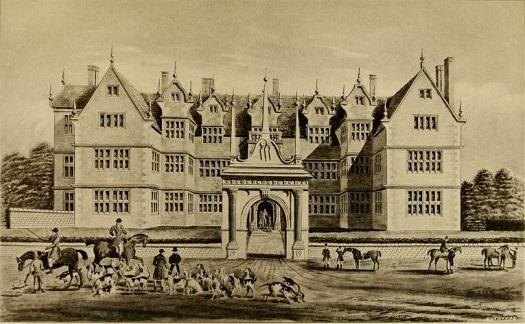
The Old Pytchley Hall
This poem, published in Baily’s in 1896, is not just timely (with Christmas and the New Year), but it links directly to contemporary subjects in two of our articles below: James Barclay’s “Sporting Tour“ and “Remembering the Curre on Boxing Day.” It’s a wistful poem, beginning with the mystery of whence this wonderful hound named Dimple. The mystery is resolved at the end, but no hope of ever seeing her like again is imagined. Why? Because she comes from Wales, and the type of hound anointed as stylish and desirable by the elite English foxhunting establishment of the time would never even consider a different way.
However, the very fact that this poem was written demonstrates that some foxhunters of the time, indeed even the superlative Pytchley huntsman, Young Will Goodall,* yearned for something better. But change in the form of a direct challenge to the establishment wasn’t to come until the twentieth century, and even then the process was painful for all concerned. So, here’s what can be considered a poetic prelude to both the Modern English foxhound and the American-English Crossbred foxhound of today.
The Pytchley Hounds are running hard across the Badby Vale;
They fly like swallows on the wing, altho’ it blows a gale.
’Twould make an old man young, I swear, to see so brave a sight,
As scarlet flashes past, and gleams the Pytchley collar white.**
A New Hunting Experience in the Lowcountry
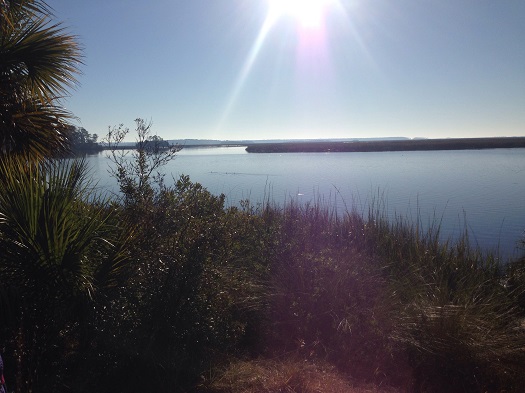
South Carolina’s Lowcountry / Caroline Leake photo
I have been hunting for fourteen years now—since age six—and recently experienced a completely different way of hunting! I visited the Lowcountry Hunt in South Carolina to visit old friends—Lowcountry huntsman Martyn Blackmore and his lovely wife Sue. My mom Caroline and I drove down on Friday, December 12, to be ready to go hunting on Saturday. My first observation was everything is flat! Absolutely no hills. And the footing is sand—much different than what I am used to here in the Blue Ridge of Virginia.
Martyn was up by 4:30 in the morning and getting hounds ready since we had a two-hour drive ahead of us. The pack is mostly Crossbred, but when Martyn came to the Lowcountry he brought with him some puppies bred from his favorite Old English lines.
Sue was up getting the horses ready to go. The meet was at a place called Palmetto Bluff. I thought we had arrived because we pulled off the road into a smaller driveway. Wow, was I wrong! The driveway started as pavement and then went to gravel and then to sand and then we were not particularly on a road at all, just more of a path in the woods. We kept driving and driving, and fourteen miles later we ended up at the meet.
A Sporting Tour Through Merry Old…Part 1
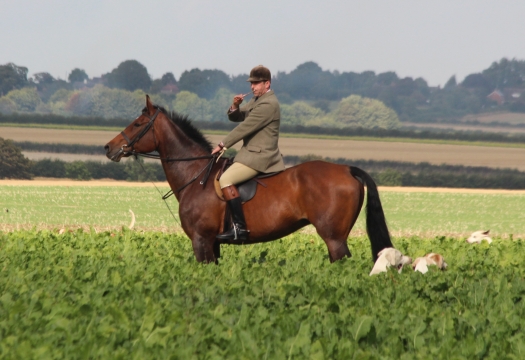
Master and huntsman Adam Esom and the South Wold Foxhounds midst the sugar beets in Lincolnshire. / James Barclay photo
Join James Barclay—an ex-Master of five English foxhunts—for a personal and revealing tour of elite hunting establishments through Middle and Eastern England. Part 2 to follow.
This last summer has been one of the busiest for a while with a fair share of weekends spent judging various Puppy Shows, which is always a pleasurable thing to do, but sadly does nothing beneficial for the waistline! It is always nice to look at hounds during their restful period, and we can soon start to gauge what there is coming on from behind the scenes and start to assess the breed’s general standard.
On that note, it is a great relief to see a lot of nice hounds about, as there was a time after that dreaded day in February 2005 when the Hunting Act became law that many packs cut right back to a minimum. However, to see that confidence returning is most reassuring to all of us who take the breeding of the Foxhound seriously.
Now the time had come to dust off the camera and get out there and firstly to take some early morning pictures of hounds on exercise. This is a wonderful time of year as, given the blessing of some good weather, harvest starts to move, and with those dewy late summer mornings and a hint of mist in the air, our countryside comes to life in a way any true hunting man knows. So visits to Badminton, Belvoir and the Bicester were a particular pleasure this year, as last summer, I had decided to cover most packs in the Eastern Counties as well as the Midlands.
Remembering the Curre on Boxing Day
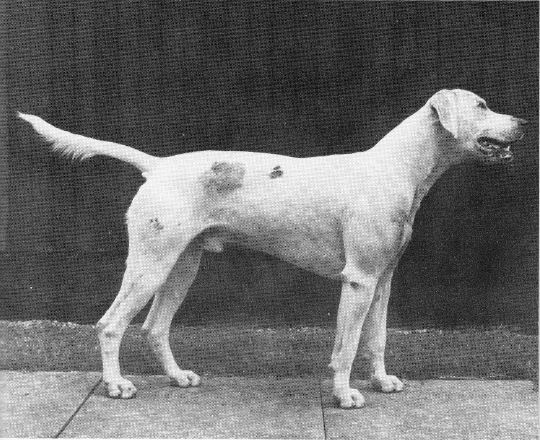
Modern English Foxhound: Duke of Beaufort’s Monmouth 1977 by New Forest Medyg 1969 Peterborough winner of the early 1900s — thick and ponderous — an example of the style of foxhound favored at the time.
Thousands of foxhunters and hunt supporters are expected to turn out in England and Wales on Boxing Day. Young and old, riders and spectators alike, entire families together for the holidays tumble out-of-doors the morning after Christmas for these traditionally celebrated meets.
“It’s the highlight of the season which starts in November,” said Peter Swann, MFH of the Curre and Llangibby Foxhounds in Wales. “This year we are expecting forty riders to take part and around five hundred spectators and supporters to join us on the green.
In Wales, the Curre and Llangibby and the Monmouthshire Foxhounds trace back to the 1600s and 1700s. The Curre remains of particular significance to foxhunters because we still see and enjoy the results of Sir Edward Curre’s bloodlines in our own Crossbreds and modern English foxhounds to this day.
It was Sir Edward Curre who provided Isaac “Ikey” Bell, father of the modern English foxhound, with the Welsh blood and the pale coloration of his breeding that has been preserved and carried on by forward-looking breeders in England ever since. Bell’s vision of the foxhound finally prevailed over the thick and ponderous, black-and-tan colored foxhounds that were fashionable early in the twentieth century. Bell’s efforts to breed lighter and more athletic foxhounds fell so afoul of the foxhunting establishment of the time that leading Masters would cross the street to avoid having to greet him.
Extend Your Weekend Sport with a Foot Pack
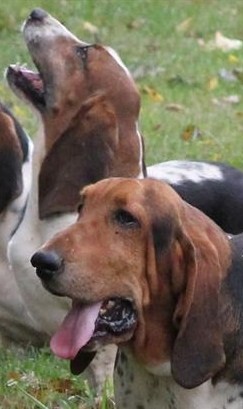
The Ashland Bassets / Susan Monticelli photoWhen not following foxhounds on horseback, many foxhunters and their like-minded friends can be found following their local basset or beagle pack on foot—a perfect way to continue enjoying sport and a country lifestyle. Any foxhunter who thrills to the cry of foxhounds and hasn’t yet heard a pack of bassets in full cry must try a day’s hunting behind these wonderful hounds!
Even after dismounting from the saddle on a Saturday, many still yearn to hunt on before returning to an office on Monday. There are others who have hung up their tack for various reasons, and some who have never hunted astride yet love being outdoors on fall and winter afternoons. For all these sportsmen and women, the Ashland Bassets—hunting the territories of the Casanova, Old Dominion, Orange County, and Warrenton foxhound packs in Virginia—have provided a welcome window through which to extend one’s weekend enjoyment of the countryside and venery.