A Sporting Tour Through Merry Old….Part 2
Join James Barclay—an ex-Master of five English foxhunts—for Part 2 of his personal and revealing tour of elite hunting establishments through Middle and Eastern England. Barclay went out with twenty-one packs in just two months during the informal season, the last of which on the morning before the first of six Opening Meets. Click for Part 1.
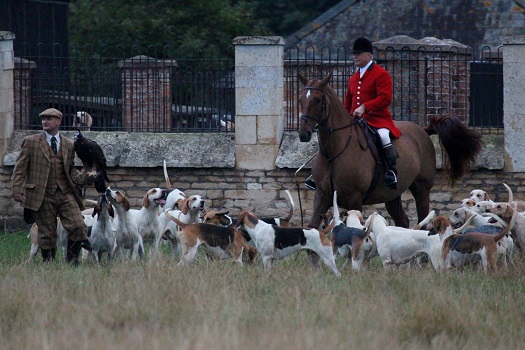
Fitzwilliam huntsman George Adams and hounds with birdman John Mees at the kennel meet, Milton Park / James Barclay photo
Fitzwilliam
Hunting with the Fitzwilliam is always a treat, especially as my family and I spent twelve very happy seasons there. Although Peterborough is on the doorstep, the Park is beautifully laid out for hunting and many good days are enjoyed there. The kennels are situated on the eastern side of the Park and have a history going well back into the 1700s.
The combination of these hounds hunting with an eagle—[The Hunting Act allows a pack of hounds to flush a fox to a bird of prey]—in close proximity to the action is something we are seeing in all but a few places now and is very much a sign of the times. George Adams has hunted these hounds for over thirty years and is certainly one of the most popular men in his profession. This particular morning was when one realises just how lucky we are. On our side of the Park wall was a great gathering of like-minded people enjoying something that has taken place here for generations. On the other side is four miles plus of new houses, factories, roads and the roar of urban noise. Is it therefore, not up to us—those who love our countryside and its activities—to encourage and involve those who may never have come across us before? Our worlds may be far apart in one sense, but they are not in another. There may be just a wall between us in this case, but it should never be looked upon us as a barrier.
‘Dimple,’ A Memory of ’94
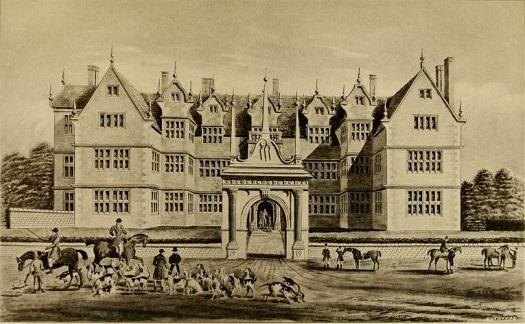
The Old Pytchley Hall
This poem, published in Baily’s in 1896, is not just timely (with Christmas and the New Year), but it links directly to contemporary subjects in two of our articles below: James Barclay’s “Sporting Tour“ and “Remembering the Curre on Boxing Day.” It’s a wistful poem, beginning with the mystery of whence this wonderful hound named Dimple. The mystery is resolved at the end, but no hope of ever seeing her like again is imagined. Why? Because she comes from Wales, and the type of hound anointed as stylish and desirable by the elite English foxhunting establishment of the time would never even consider a different way.
However, the very fact that this poem was written demonstrates that some foxhunters of the time, indeed even the superlative Pytchley huntsman, Young Will Goodall,* yearned for something better. But change in the form of a direct challenge to the establishment wasn’t to come until the twentieth century, and even then the process was painful for all concerned. So, here’s what can be considered a poetic prelude to both the Modern English foxhound and the American-English Crossbred foxhound of today.
The Pytchley Hounds are running hard across the Badby Vale;
They fly like swallows on the wing, altho’ it blows a gale.
’Twould make an old man young, I swear, to see so brave a sight,
As scarlet flashes past, and gleams the Pytchley collar white.**
Remembering the Curre on Boxing Day
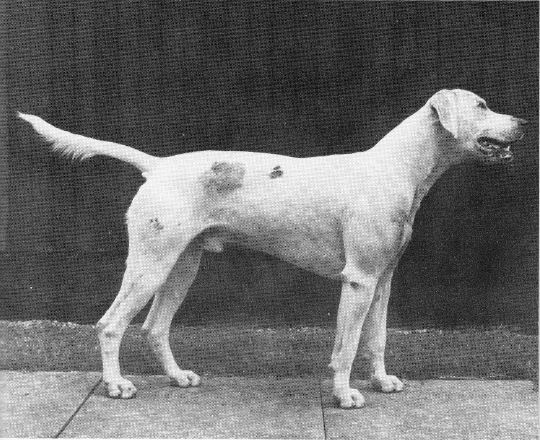
Modern English Foxhound: Duke of Beaufort’s Monmouth 1977 by New Forest Medyg 1969 Peterborough winner of the early 1900s — thick and ponderous — an example of the style of foxhound favored at the time.
Thousands of foxhunters and hunt supporters are expected to turn out in England and Wales on Boxing Day. Young and old, riders and spectators alike, entire families together for the holidays tumble out-of-doors the morning after Christmas for these traditionally celebrated meets.
“It’s the highlight of the season which starts in November,” said Peter Swann, MFH of the Curre and Llangibby Foxhounds in Wales. “This year we are expecting forty riders to take part and around five hundred spectators and supporters to join us on the green.
In Wales, the Curre and Llangibby and the Monmouthshire Foxhounds trace back to the 1600s and 1700s. The Curre remains of particular significance to foxhunters because we still see and enjoy the results of Sir Edward Curre’s bloodlines in our own Crossbreds and modern English foxhounds to this day.
It was Sir Edward Curre who provided Isaac “Ikey” Bell, father of the modern English foxhound, with the Welsh blood and the pale coloration of his breeding that has been preserved and carried on by forward-looking breeders in England ever since. Bell’s vision of the foxhound finally prevailed over the thick and ponderous, black-and-tan colored foxhounds that were fashionable early in the twentieth century. Bell’s efforts to breed lighter and more athletic foxhounds fell so afoul of the foxhunting establishment of the time that leading Masters would cross the street to avoid having to greet him.
Extend Your Weekend Sport with a Foot Pack
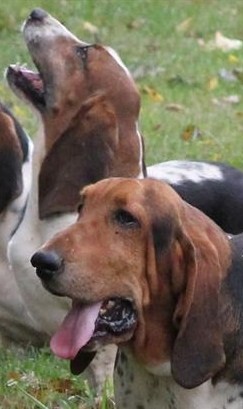
The Ashland Bassets / Susan Monticelli photoWhen not following foxhounds on horseback, many foxhunters and their like-minded friends can be found following their local basset or beagle pack on foot—a perfect way to continue enjoying sport and a country lifestyle. Any foxhunter who thrills to the cry of foxhounds and hasn’t yet heard a pack of bassets in full cry must try a day’s hunting behind these wonderful hounds!
Even after dismounting from the saddle on a Saturday, many still yearn to hunt on before returning to an office on Monday. There are others who have hung up their tack for various reasons, and some who have never hunted astride yet love being outdoors on fall and winter afternoons. For all these sportsmen and women, the Ashland Bassets—hunting the territories of the Casanova, Old Dominion, Orange County, and Warrenton foxhound packs in Virginia—have provided a welcome window through which to extend one’s weekend enjoyment of the countryside and venery.
A Son Remembers Essex Fox Hounds’ Tribute to His Father

Columnist Russ Hannah, writing for NorthJersey.com, recalls the day the Essex Fox Hounds (NJ) paid tribute to Bert Hannah, his late father. Bert wasn’t a foxhunter, a landowner, or a captain of industry. He was, writes Russ, an “ordinary man who had once been a Minnesota lumberjack with a third-grade education, if that.”
Bert was a caretaker on a large estate near the Brady estate and Hamilton Farms. The latter represented five thousand acres, constituting the primary Essex hunting country. The former, Martha Brookes Hutcheson’s estate of 104 acres, where Bert Hannah served as caretaker, was closed to the hunt by the owner as the result of a fallen rider being seriously injured there years earlier.
Nevertheless, Bert Hannah was an animal person. He bred field trial beagles—one a 1963 National Champion, Longview Susie at left in news photo with two of her offspring. And he loved horses.
Bert was always friendly to the Essex riders, stopping to talk as they went by. Any injured or lost foxhound that passed Bert’s way was taken in by him, fed, and cared for before being returned to kennels.
Old Chatham Rising
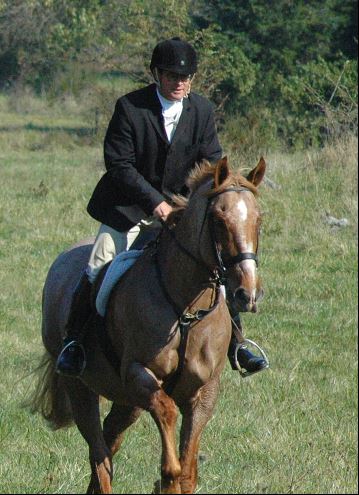
Newly appointed Old Chatham MFH Jef Murdock tells how it feels to hunt hounds for the very first time. / Nancy Kleck photoOn a recent Saturday the Old Chatham Hunt (NY) had a rare hunting day. Hounds ran their first coyote hard for an hour before huntsman and staff had to stop them from going into country where it was difficult to follow. Hounds then found another coyote and ran it through their wooded country in fine voice for another forty-five minutes to finish an excellent day of hunting. What’s remarkable about that? one might ask. Nothing, except that the huntsman had never hunted a pack of hounds before in his life until that day.
At the end of last season, Old Chatham members made some difficult and controversial organizational changes in an effort to improve their sport. A new huntsman—Tommy Hopkins—was named, and a new Master—Jef Murdock—was appointed. Hopkins had been whipping-in for years and was familiar with the hounds, but Murdock, though he’d been following hounds as a field member for years, was better known for his skiing acumen—he owns the popular Butternut ski area in the Berkshire Mountains of Massachusetts—than for his prowess with foxhounds.
Three Convicted of Foxhunting in England
Persuaded by evidence furnished to the court by investigators from the League Against Cruel Sports (LACS), an English judge found three men from one of that country’s foremost hunts guilty of illegally hunting the fox. Joint-Master Timothy Windham Basil Smalley, MFH; huntsman Ian McKie; and kennel huntsman Andrew Proe of the College Valley North Northumberland […]
Huntsman Walter Perry Dead in UK
Retired huntsman Walter Perry died in his nineties on September 17, 2014 in Crowcombe, Somerset, UK. Walter hunted the Devon and Somerset Staghounds from 1963 to 1971, the Dulverton East Foxhounds from 1971 to 1978, and accepted his final post in 1978 as kennel-huntsman and huntsman for the Quantock Staghounds. He retired from the Quantock […]
Your Human Faces Are Showing
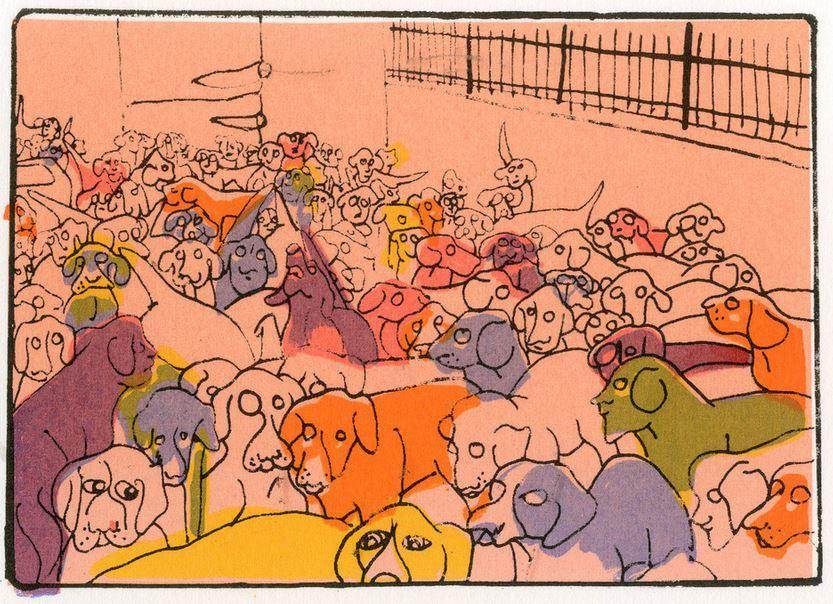
Perhaps because I’ve seen so many serious photographs of hounds in kennels, I was arrested and amused by this whimsical print by Emily Robards, daughter of a well-known huntsman and author. Emily’s dad has hunted hounds in Ireland and in North America, and Emily has whipped-in to him and spent most of her younger years in or near the kennels. I asked her to tell us about her art.
“Your Human Faces Are Showing” by Emily Robards
I am a visual artist who works in a variety of media such as photography, printmaking, collage, embroidery and paint. My work draws from dreams and memories, linking the spiritual, human, and animal worlds together with an underlining narrative of innocence and the uncanny. The work arises from the self, drawing from my past, while trying to take control of the present. I also work a lot with vintage photographs and text combining them to create new narratives.
The piece, “Your Human faces are Showing,” is a seven-colour limited edition screen print, approximately 11.4 x 8 cm. The print is slightly off register so they are not all exactly the same, which is called a print variable.
The print is based on an old photo my grandmother took of the County Limerick Foxhounds. The piece started out as a doodle in my sketchbook a few years ago, and stayed that way until my last year of college when I made it into a print. The drawing is relaxed, almost comical. I wasn’t worried about it being exact or anatomically correct. This relaxed idea towards the drawing I feel is what makes it a success.
Mountain and Muse: A Bicentennial
 The Port of Baltimore earned a place in American history two hundred years ago this month during the War of 1812. The British, after burning and sacking Washington, D.C. in August of 1814, turned their attention to Baltimore with an assault by naval and ground troops in September. Francis Scott Key, a witness to the naval bombardment of Fort McHenry, jotted down the words to what became our national anthem, “The Star Spangled Banner.”
The Port of Baltimore earned its place in American foxhunting history that very same month—September, 1814. After the British fleet withdrew to make its final assault of the War of 1812 on New Orleans, a merchant ship entered the Port of Baltimore and disembarked two foxhounds from Ireland, Mountain and Muse.
Unusual for their appearance, speed, aggression, hunting style, and pre-potency, Mountain and Muse turned out to be progenitors of our principal American foxhound strains: July, Birdsong, Trigg, Bywaters, and Walker. The Midland Crossbred, developed by Ben Hardaway, MFH, found today in kennels all over North America as well as England, and having its roots in the July strain, also goes back to Mountain and Muse.