The Foxhounds of John Emms
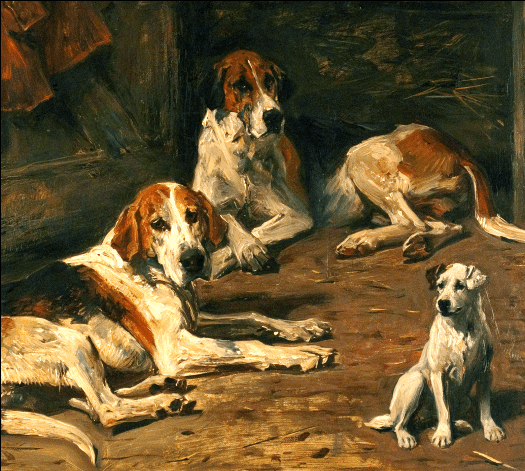
Foxhounds and Terrier / painting by John Emms
A major exhibit and sale of paintings by John Emms (1843–1912) will be mounted by the William Secord Gallery in New York City from February 8 to March 15, 2014. This will be the largest and most comprehensive exhibition of Emms’ work and is timed to coincide with this year’s Westminster Dog Show. More than fifty paintings of foxhounds, terriers, spaniels, and other sporting breeds are included. Foxhunters visiting New York during the MFHA Annual Meeting week are invited to visit the Gallery for a preview of the entire exhibit.
Born the son of an amateur artist in Norfolk, England, the young Emms moved to London where he apprenticed with the great academic painter, Lord Frederick Leighton. Emms soon went on his own, painting images that capture the beauty of English country life. An avid foxhunter, Emms maintained studios in London and in the New Forest area of England.
The Legitimate Sport of Drag Hunting
Karen L. Myers photoThe sport of drag hunting started as a competitive race in early seventeenth century England, developed into a fast dash over intimidating fences in early twentieth century North America, and evolved in more recent years into an artistic attempt to simulate live hunting.
Since foxhound packs that run a drag scent—either exclusively or periodically—account for about seventeen percent of all MFHA-Registered hunts in North America, we’re devoting much of this issue to a comprehensive view of the sport and its history, with observations, comments, and recommendations from some of today’s best practitioners.
Drag Hunting Today
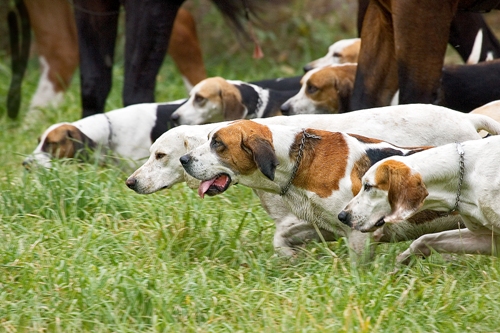
Wayne-DuPage drag hounds head to covert. / Chris Carney photo
Drag hunting, according to conventional wisdom, is what a hunt does when its country is constricted by suburban development. Sometimes that’s true, but, more often, hunts follow a dragged line of man-laid scent because the Masters want to. And a few hunts have been doing it for more than a century.
Each type of hunting—live or drag—has its pluses and minuses, depending on the needs and priorities of the participants. Drag hunting offers a controlled hunting experience to the benefit of hounds, riders and landowners. With a judicious laying of the drag, hounds are safer because roads and other hazards can be avoided; farmer’s crops are protected from horse’s hooves; homeowners’ lawns and yards are not trampled; and small pets are safe from the attention of hounds (all assuming that hounds don’t riot).
For riders who seek a gallop over fences, drag hunting offers a more efficient use of time, with no standing on a windy hillside while hounds search a covert for a fox (which may or may not be found). Thus the drag-hunting day typically lasts about two to three hours, with guaranteed galloping and jumping, better suiting those with a busy schedule, rather than the three- to five-hour day usually consumed by the ebb and flow of live hunting.
Goshen Hounds Take a New Year’s Swim
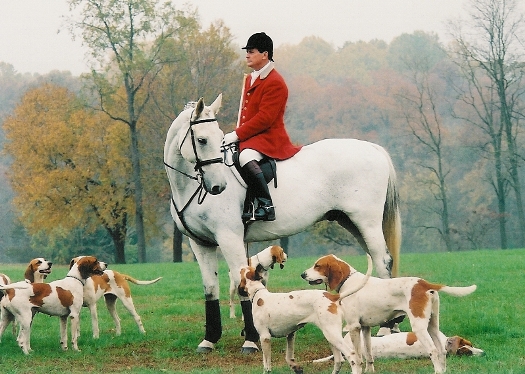
Robert Taylor, MFH and huntsman of the Goshen Hounds, had a memorable hunt with hounds on New Year’s Day.
Some days you simply wonder what the gods are thinking. Today, New Year’s Day, was a day that I simply could not hunt because of social obligations unrelated to the hunting world. No amount of explaining and squirming would have been adequate to allow me to meet with the Goshen Hounds (MD) today. Consequently, it was with some delight when I was finally able to quietly announce at about 2:00 pm that I thought I would “visit the kennels” for a short while.
When I arrived it was apparent the hounds were still in the field, so I drove to the usual draw down Middleton Lane and was greeted with the distant view of a whipper-in and the cheering of huntsman and Joint-Master Robert Taylor. I knew exactly where they were, but getting to them in my trusty Tahoe was a different matter. Undaunted, I proceeded on (in four wheel drive), but still could not quite make contact.
Several riders were coming in with tales of, “Wow! What a run! My horse is cooked!” In desperation, I gave up and headed to the kennels. Soon I was greeted with the sight of Robert and hounds coming in, and, oh, what tales they had to tell.
Boxing Day Meets Revive Conflict in UK
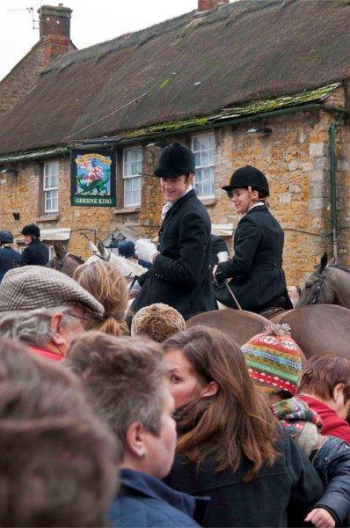
Two-hundred-fifty-thousand foxhunting supporters—both mounted and on foot—were expected to turn out on Thursday, the day after Christmas, for the annual Boxing Day meets across the UK. About 250 hunts participated in foxhunting’s biggest day of the year there.
“The incredible support for hunts has not wavered since the Hunting Act and shows the demand for repeal of this unfair and unworkable act, which was not born of concern for animal welfare, but rather prejudice against those people standing in fields across Yorkshire today,” wrote Ted Bonner, director of campaigns for the Countryside Alliance in The Information Daily.
Despite Chairman Lord Burns’s 2003 pronouncement at the conclusion of the government Inquiry into Hunting with Dogs—that the committee did not find hunting to be cruel—a prohibition on hunting was inevitable. The Hunting Act was passed and became effective in 2004.
Hark! Old Horse
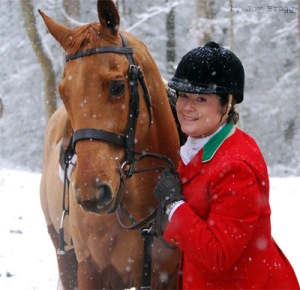
Carla Hawkinson, MFH with her soulmate, Forty-One, her inspiration for the poem / Joy Bragg photoThis wonderful poem recently appeared on This poem recently appeared on FaceBook under the credit line, Author Unknown. We must correct that! The author is Carla Hawkinson, MFH of the Tennessee Valley Hunt.
“Hark! Old Horse” was published in the Summer, 2008 issue of Covertside when I was editor of that magazine. It surely deserves to be re-published, and Foxhunting Life is proud to do it…with appropriate credit. -Ed.
Hark! Old horse.
Please meet me at the gate.
Hounds are leaving kennels soon,
And we will not be late.
Step up. Old horse.
Carry me to the meet.
Our years together count for much,
Though you’re no longer fleet.
Trot on. Old horse.
I know you hear the horn.
The hounds are in the valley now,
The fox is in the corn!
Hunt Reports: How Old Dominion’s Huntsman Hooks the Kids
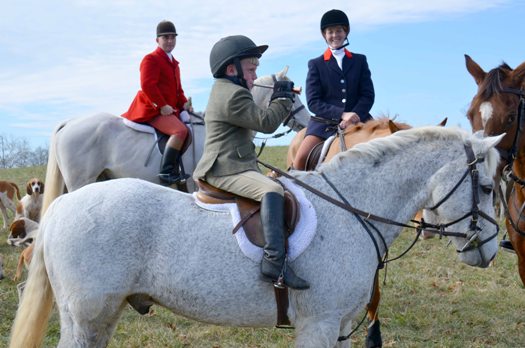
Colby Poe huffs and puffs on huntsman Ross Salter’s hunting horn. Honorary whipper-in Denya Dee Leake tells the story. / Michele Arnold photo
Ross Salter, first-season huntsman at Old Dominion Hounds (VA), and I came to the hunt three seasons ago. There were a few juniors in the field on a regular basis and always a good number on Junior Day. This year, however, the number of juniors on ordinary hunting days has increased dramatically, and Junior Day was a complete surprise to everyone.
We met at Copperfield Farm, between the village of Hume and the village of Orlean. The staff walked to the top of the hill with hounds and waited for the juniors to join us. They started coming up the hill, and they just kept coming and coming. We had juniors that were nearly adults, juniors that were just old enough to ride away from their parents, and some that were being led by their parents! In total we had fifty-two juniors surrounding the hounds.
Including the juniors we had a field of one hundred and nineteen riders. In all of Old Dominion’s history I do not believe that they have seen so many juniors in one place on perfectly behaved horses and ponies. The Masters, Gus Forbush, Dr. Scott Dove, and Douglas Wise-Stuart, each assigned certain kids to each staff member and to become Field Master. Each of us staff members had two kids with us at the beginning, and we slowly brought more kids up as the day went on.
So Why All the Juniors?
How Old Dominion’s Huntsman Hooks the Kids
Colby Poe huffs and puffs on huntsman Ross Salter’s hunting horn. Honorary whipper-in Denya Dee Leake tells the story. / Michele Arnold photo
Ross Salter, first-season huntsman at Old Dominion Hounds (VA), and I came to the hunt three seasons ago. There were a few juniors in the field on a regular basis and always a good number on Junior Day. This year, however, the number of juniors on ordinary hunting days has increased dramatically, and Junior Day was a complete surprise to everyone.
We met at Copperfield Farm, between the village of Hume and the village of Orlean. The staff walked to the top of the hill with hounds and waited for the juniors to join us. They started coming up the hill, and they just kept coming and coming. We had juniors that were nearly adults, juniors that were just old enough to ride away from their parents, and some that were being led by their parents! In total we had fifty-two juniors surrounding the hounds.
Including the juniors we had a field of one hundred and nineteen riders. In all of Old Dominion’s history I do not believe that they have seen so many juniors in one place on perfectly behaved horses and ponies. The Masters, Gus Forbush, Dr. Scott Dove, and Douglas Wise-Stuart, each assigned certain kids to each staff member and to become Field Master. Each of us staff members had two kids with us at the beginning, and we slowly brought more kids up as the day went on.
So Why All the Juniors?
How We Match the Foxhunter to the Hireling
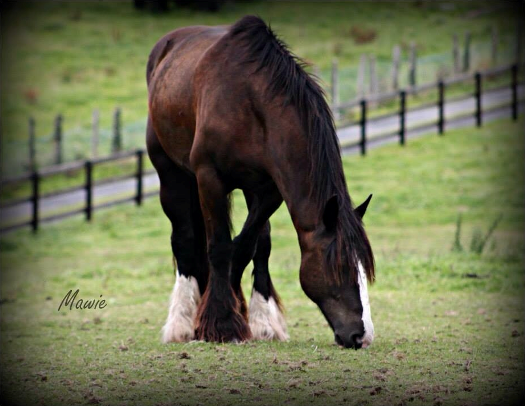
Midnight, a 16-hh black Irish cob at Coopers Hill is everyone’s favorite, young and old.
How do I match riders I have never met with horses that will take care of them out hunting? The answer to that question starts with how the animal was gentled into riding and jumping to begin with. That’s the key.
It takes a number of years to get a horse hunting right. Anyone who hunts knows that you can get pullers, stoppers, and downright cranky horses. And then there are the ones that kick, bite, and buck. An odd buck of joy is fine, but the buck that is directed toward the rider’s dismount is coming from a horse that wasn’t respected and won’t give respect.
Down through the years the locals have brought very difficult animals to our yard for breaking. But we like to turn that word—breaking—on its head. We prefer to say we gentle and respect the animal and allow them the time to come to the conclusion that it is okay to accept the bit, okay to be brushed, okay to have their feet lifted up, to be saddled and eventually mounted. Some animals accept sooner than others simply because some trust sooner than others. The manner in which this is done determines the product—the horse—you are going to mount for your day’s hunting.
Chip Anderson Was a Hunting Man
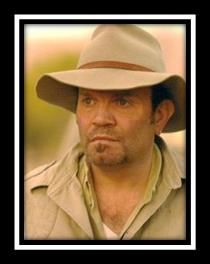
Huntsman Chip Anderson lay terminally ill on the morning of December 7, 2013 as the Santa Ynez Valley Hounds met for their Opening Meet at Master Steve Lyons’ KickOn Ranch in Santa Barbara, California. Before hounds moved off, word came quietly to the Masters that Chip had died. Lyons chose to withhold the sad news until after the meet, when, along with the announcement, he dedicated the day to Chip.
I got to know Chip when I was editor of Covertside magazine. He submitted a hunting story to me for publication, and I was riveted. I published a number of his hunting stories and loved every one; they were full of adventure, suspense, danger, and exotic locales.
Chip was mad-keen to hunt. Whatever the game; wherever the habitat; he devoured the experience. He hunted wild boar with foxhounds in California, with Ariegeois hounds in Italy, with the Aidi dogs of the Berber tribes in Morocco, and with the Dogo Argentino on the South American pampas—sometimes with guns, sometimes with short swords, and sometimes with daggers in close combat. He was, for a time, a professional guide for dove and pigeon shoots in South America, and he wrote a fingernail-biter about shooting a cattle-killing jaguar that he tracked with a pack of dogs, one of which was a foxhound from the Tryon Hunt in North Carolina that he had bred while huntsman there.